
Last updated: November 7, 2026 – By Diane Holcomb
November 2026 update: reconfirmed scratch, detailing, windshield, and repaint cost ranges.
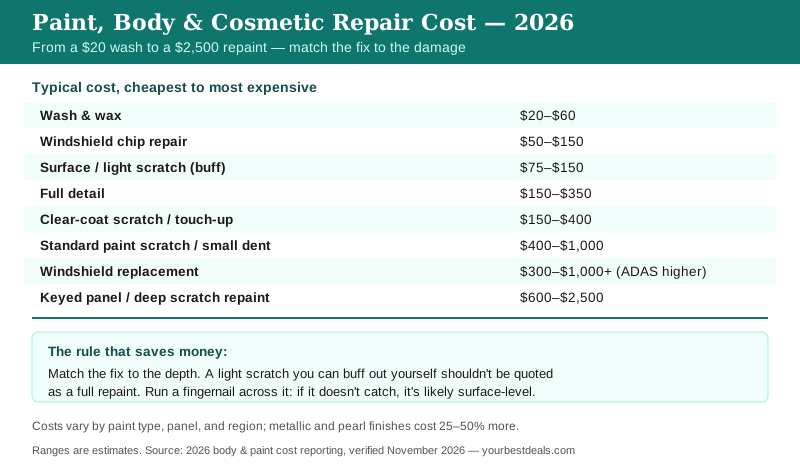
Cosmetic car repair spans a huge range – from a $20 wash to a $2,500 multi-panel repaint – and the money-saving key is matching the fix to the depth of the damage. A light scratch you can buff out at home for the cost of a $15 compound shouldn’t be quoted as a $1,000 repaint, and a deep scratch through to the metal really needs the bigger job. Common cosmetic work lands like this: a full detail $150 to $350, a surface scratch $75 to $150, a clear-coat scratch or touch-up $150 to $400, a standard paint scratch or small dent $400 to $1,000, a windshield chip repair $50 to $150, and a windshield replacement $300 to $1,000 or more. These are estimated ranges that vary by paint type, panel, and region.
Body and paint were where I saw customers most unsure what a fair price was, because cosmetic damage looks worse than it often is to fix – or gets quoted higher than it needs to be. The whole game here is knowing how deep the damage really goes, because that determines whether you’re looking at a $50 fix or a $1,500 one. Let me lay out the cost ladder, the fingernail test that tells you the depth, and where people overpay.
The cost ladder
Here’s the rough cost for common cosmetic and body work, cheapest first. Treat these as estimated ranges, since paint type and panel size swing them a lot.
| Job | Typical cost | Notes |
|---|---|---|
| Wash & wax | $20–$60 | Basic upkeep |
| Windshield chip repair | $50–$150 | Often covered by insurance |
| Surface / light scratch (buff) | $75–$150 | DIY-able for much less |
| Full detail | $150–$350 | Interior + exterior |
| Clear-coat scratch / touch-up | $150–$400 | Doesn’t reach paint |
| Standard paint scratch / small dent | $400–$1,000 | Reaches the paint layer |
| Windshield replacement | $300–$1,000+ | ADAS recalibration adds cost |
| Keyed panel / deep scratch repaint | $600–$2,500 | Sanding, primer, repaint |
Notice how much the depth matters: a surface scratch and a deep one look similar but differ by a factor of ten or more in cost. That’s why the single most useful skill here is judging how deep the damage goes before you get a quote. Metallic and pearl paints add 25% to 50% because they’re harder to match, and a scratch crossing two panels costs more because both must be blended. Our deep scratch guide and windshield chip guide go deeper on those two.
Straight From the Invoice: the fingernail test in action
I pulled these from actual situations I either handled or reviewed – a buff, a chip caught in time, and a repaint that couldn’t be avoided.
Invoice #1 – 2019 Honda CR-V, light scratch buffed, Charlotte NC
Cart scuff that looked bad but a fingernail didn’t catch; a $15 polishing compound and ten minutes made it vanish. A shop had quoted a panel repaint. Lesson: many “scratches” are surface scuffs in the clear coat that buff out for almost nothing – don’t pay repaint money for a polish job.
Invoice #2 – 2016 Toyota Camry, windshield chip repaired, Charlotte NC
Rock chip caught early and filled for around $100 – often free under full-coverage insurance – before it could spread into a crack requiring a full replacement. Lesson: a chip is a cheap fix and a crack is an expensive one, so repairing a chip promptly saves the replacement.
Invoice #3 – 2015 sedan, keyed door, Charlotte NC
A key scratch that caught a fingernail and reached the paint required sanding, primer, and repainting the panel – a real four-figure job, not a buff. Lesson: when the damage is deep enough to catch a fingernail and reach bare paint or metal, the bigger repair is legitimate and worth doing right to prevent rust.
The fingernail test: how deep is it?
Before you get a quote, run your fingernail gently across the scratch. If your nail glides over it without catching, the damage is likely in the clear coat only – a surface scratch that can often be buffed or polished out for very little, sometimes DIY. If your nail catches in the scratch, it has gone through the clear coat into the paint or down to the primer or metal, which needs filling, sanding, and repainting. That single test roughly sorts a cheap fix from an expensive one.
Depth also drives urgency for a different reason: rust. A scratch that reaches bare metal will start to rust if left exposed, so a deep scratch isn’t purely cosmetic – leaving it can turn a paint repair into a rust repair. Windshields follow a similar logic: a chip is cheap to fill, but if it spreads into a crack (which temperature swings and bumps encourage), you’re into a full replacement. So the theme across cosmetic work is that catching damage at the shallow stage keeps it cheap.
Shop Talk
Two insurance angles worth knowing. First, many full full-coverage-coverage policies cover windshield chip repair with no deductible, because insurers would rather pay $100 for a chip than $600 for the replacement it becomes – so check your policy before paying out of pocket, it may be free. Second, for cosmetic paint damage, get the repair quote before you file a claim: if the fix is close to or below your deductible, paying cash keeps a claim off your record and avoids a possible premium increase. And for light scratches, always try a polishing compound yourself first – a $15 bottle and a microfiber cloth erase a surprising number of “scratches” that are really just scuffs sitting in the clear coat.
Where Drivers Overpay
The biggest cosmetic overpay is paying for a repaint on damage that would buff out. Because a surface scuff and a deep scratch can look identical, people accept a body-shop repaint quote for something a $15 compound would have erased. The fingernail test is the defense: if it doesn’t catch, try polishing it first. Body shops aren’t necessarily gouging – they may quote the thorough fix by default – but you can often solve a clear-coat scratch yourself for almost nothing.
The second overpay is letting cheap damage become expensive by waiting: a fillable windshield chip that spreads into a replacement, or a deep scratch that rusts before you address it. Both convert a modest fix into a big one. And the third is filing insurance claims on cosmetic damage near your deductible, which can cost you more in premium than paying cash. So the money-smart pattern is: judge the depth, DIY the shallow stuff, fix chips and deep scratches promptly before they escalate, and compare cosmetic repair costs to your deductible before filing. Match the fix to the damage and the timing to the risk.
The Real Number
Cosmetic repair runs from a $20 wash to a $2,500 repaint, and the depth of the damage decides where you land – all estimated ranges by paint and panel. Use the fingernail test: if it doesn’t catch, it’s a clear-coat scuff you can often buff out for the price of a $15 compound; if it catches, it’s reached the paint and needs a real repair. Fix windshield chips ($50 to $150, often free under insurance) and deep scratches promptly, before a chip becomes a $600 replacement or a scratch rusts. And compare any cosmetic repair to your deductible before filing a claim.
Frequently Asked Questions
How much does it cost to fix a scratch on a car?
It depends entirely on depth. A light surface scratch in the clear coat can be buffed out for $75 to $150 at a shop, or far less as a DIY polish. A clear-coat scratch or touch-up runs $150 to $400, a standard paint scratch $400 to $1,000, and a deep scratch requiring sanding, primer, and repainting $1,500 to $2,500. A keyed panel typically runs $600 to $1,500 per panel. These are estimated ranges that vary by paint type and region, with metallic and pearl finishes costing 25% to 50% more. The fingernail test – whether your nail catches in the scratch – is the quickest way to gauge which category, and cost, you’re facing.
How do I know if a scratch is deep or just surface?
Run your fingernail gently across it. If your nail glides over without catching, the scratch is likely in the clear coat only – surface-level damage that can often be buffed or polished out cheaply, sometimes yourself. If your nail catches in the scratch, it has cut through the clear coat into the paint, primer, or metal, which needs filling and repainting and costs much more. This simple test roughly separates a sub-$150 fix from a four-figure one. It also matters for urgency: a scratch deep enough to reach bare metal will start to rust if left, so a deep scratch is worth addressing promptly rather than leaving exposed.
Should I fix a windshield chip or replace the whole windshield?
If it’s a chip rather than a spreading crack, repair it – a chip repair runs $50 to $150 (often free under full-coverage insurance) and prevents the chip from growing into a crack that requires a full replacement at $300 to $1,000 or more. Small chips away from the driver’s line of sight are usually repairable. Once a chip spreads into a long crack, reaches the edge of the glass, or sits directly in the driver’s view, replacement is typically needed. Temperature swings and bumps encourage chips to spread, so repairing promptly is the money-saver. On cars with ADAS cameras, replacement also requires recalibration, which adds to the cost.
Can I fix car scratches myself?
Light, surface-level scratches – the kind your fingernail glides over – are very DIY-friendly. A polishing or rubbing compound and a microfiber cloth (a $15-or-so investment) can erase many clear-coat scuffs, and touch-up paint pens handle small chips. This saves the shop cost entirely on shallow damage. Deeper scratches that catch your fingernail and reach the paint or metal are harder to DIY well, since they need proper filling, sanding, color-matched paint, and clear coat to look right and prevent rust – those are usually better left to a shop. Start by trying a compound on light scratches, and reserve the shop for the deep ones.
How much does car detailing cost?
A full professional detail – thorough interior and exterior cleaning – typically runs $150 to $350, while a basic wash and wax is $20 to $60. Premium services like paint correction, ceramic coating, or extensive interior restoration cost more, sometimes several hundred dollars and up. These are estimated ranges that vary by vehicle size, condition, and region. Detailing is partly cosmetic upkeep and partly value protection, since it helps maintain paint and interior condition for resale. For routine upkeep, a regular wash and occasional wax you do yourself costs little, with a full professional detail a few times a year or before selling.
Does a scratch or chip need to be fixed right away?
It depends on depth and type. A shallow clear-coat scratch is purely cosmetic and not urgent, though buffing it is easy. A deep scratch that reaches bare metal should be addressed reasonably promptly, because exposed metal will rust, which turns a paint repair into a more involved rust repair. A windshield chip is worth repairing quickly, since it can spread into a crack that forces a full replacement – a much bigger bill. So the urgency tracks the risk of escalation: surface damage can wait, but anything that can rust or spread is cheaper to fix sooner rather than later. Catching damage early at the shallow stage is the theme.
Should I use insurance for cosmetic damage?
Compare the repair cost to your deductible first. If the cosmetic repair is close to or below your deductible, paying out of pocket usually makes more sense, since filing a claim can raise your premium and stays on your record – potentially costing more over time than the repair itself. Windshield chip repair is a notable exception: many full-coverage policies cover it with no deductible, because insurers prefer paying for a cheap repair over a costly replacement, so that’s often worth a claim. For paint and body damage, get a repair quote, weigh it against your deductible and potential premium impact, and decide. Cash is frequently the smarter route for minor cosmetic work.
Sources
Paint, body, and windshield cost ranges verified against 2026 cost reporting on November 7, 2026. Figures are estimated ranges that vary widely by vehicle, paint type, and region; confirm with a shop.
- CarXplorer – car scratch repair cost guide, 2026
- Glass & Auto – windshield chip repair cost, 2026
- AAA – windshield repair or replacement cost
Related Guides
- How to fix deep scratches on a car
- What to do with a chipped or cracked windshield
- Car maintenance schedule and cost
- Service cost estimator

Diane Holcomb spent seven years at Charlotte dealership service desks, where cosmetic damage was the work customers were least sure how to price – and where a $15 polishing compound often replaced a repaint quote. She writes the cost guides on Your Best Deals and takes no referral fees. She drives a 2019 Honda CR-V and a 2007 Toyota Camry.