
Last updated: November 10, 2026 – By Diane Holcomb
November 2026 update: reconfirmed the by-layer repair steps, cost ranges, and the rust warning.
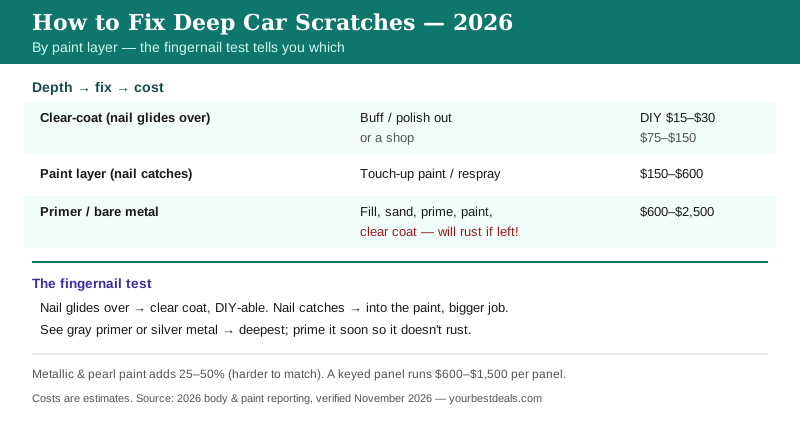
Fixing a deep car scratch starts with one question: how deep does it actually go? Your car’s paint has layers – clear coat on top, then color, then primer, then metal – and the layer the scratch reaches decides whether it’s a $20 DIY job or a $2,000 body-shop repaint. A scratch your fingernail glides over is in the clear coat and often buffs out yourself; one your nail catches has reached the paint and needs more; and one showing gray primer or silver metal is the deepest, needs full repair, and will rust if you leave it. Here’s how to identify the depth and fix each, along with what it costs.
At the service desk, “deep scratch” meant very different jobs to different people, and I’d always start by feeling the scratch myself. Half the time what someone called deep was a clear-coat scuff that polished right out. Let me walk you through the fingernail test, the fix for each depth, and when to do it yourself versus pay a shop.
First, find the depth: the fingernail test
Run your fingernail gently across the scratch, perpendicular to it. If your nail glides over without catching, the scratch is in the clear coat only – the top protective layer – and is the easiest and cheapest to fix, often DIY. If your nail catches in the groove, the scratch has cut through the clear coat into the color layer or deeper, which needs filling and paint. And if you can actually see a different color in the scratch – gray or white (primer) or bare silver (metal) – it’s through to the deepest layers and needs full repair plus rust prevention.
This test matters because the layers determine everything about the fix and cost. A clear-coat scratch is cosmetic and cheap; a bare-metal scratch is both more expensive and time-sensitive, because exposed metal rusts. So before you buy any product or accept any quote, feel the scratch and look at what color shows in it. That tells you which of the three repair paths below you’re on, and roughly what it should cost.
Fixing each depth
Clear-coat scratch (nail glides over). These often buff out. A polishing or rubbing compound with a microfiber cloth or a machine polisher removes the fine scratch by leveling the clear coat slightly – a $15-to-$30 DIY job, or $75 to $150 at a shop. Work the compound in, buff, and reapply if needed. Most light scuffs and swirl marks disappear this way, which is why so many “scratches” cost almost nothing to fix.
Paint-layer scratch (nail catches). Once the clear coat is breached into the color, buffing alone won’t fix it – you need to add paint back. Touch-up paint (a color-matched pen or bottle, applied carefully in thin layers, then clear coat over) can handle narrow scratches as a DIY job, while a shop respray of the area does it more cleanly for $150 to $600. Getting the color match right is the tricky part, especially on metallic finishes.
Primer or bare-metal scratch. The deepest scratches need the full process: cleaning, filling if there’s a gouge, sanding, priming, color-matched paint, and clear coat – $600 to $2,500 at a shop depending on size, panel, and paint type, and a keyed panel typically $600 to $1,500 per panel. This is really hard to DIY well. Just as important, bare metal must be primed promptly because it will rust, so even if you can’t do the full repair immediately, covering exposed metal is time-sensitive. See our paint and body cost guide for the full ladder.
Shop Talk
Before spending anything, wash the area and look again – a shocking number of “scratches” are actually transfer marks: paint or rubber from another car or a cart rubbed onto your clear coat, sitting on top rather than cut into it. Those wipe off with a little compound or even a clay bar, no repair needed. When you do buy touch-up paint for a real paint-layer scratch, get the exact color code from the sticker in your driver’s door jamb or under the hood – “close enough” looks worse than the scratch on many colors, especially metallics. And for a deep scratch you can’t fix right away, dab clear nail polish or touch-up over any bare metal as a temporary rust barrier until you get it repaired properly.
Where Drivers Overpay
The classic overpay is paying repaint prices for a clear-coat scuff. Because a surface scratch and a deep one look alike from a step back, people accept a several-hundred-dollar body-shop quote for damage a $15 compound would erase. The fingernail test is the whole defense: if it doesn’t catch, try polishing first, and you’ll often solve it for the price of a bottle of compound. Only when the nail catches or you see primer or metal does the bigger job become legitimate.
The second overpay is letting a deep scratch rust before you fix it, which converts a paint repair into a paint-plus-rust repair. Bare metal exposed to air and moisture starts corroding, and rust spreads under the surrounding paint, enlarging the job. So a bare-metal scratch is worth at least a temporary primer or touch-up promptly, even if the full repair waits. Match the repair to the depth, DIY the clear-coat stuff, get the exact color code for paint-layer touch-ups, and don’t let bare metal sit – that’s how you keep scratch repair from costing more than it should.
The Real Number
Fix a deep scratch by its depth: a clear-coat scratch (nail glides over) buffs out for $15 to $30 DIY or $75 to $150 at a shop; a paint-layer scratch (nail catches) needs touch-up paint or a respray at $150 to $600; and a primer or bare-metal scratch needs the full fill-sand-prime-paint-clear process at $600 to $2,500 – all estimated ranges, more for metallic paint. Use the fingernail test first and try a compound on anything that doesn’t catch before paying for a repaint. And prime any exposed bare metal promptly, because a deep scratch left open will rust and grow the repair.
Frequently Asked Questions
How much does it cost to fix a deep scratch on a car?
It depends on how deep. A clear-coat scratch buffs out for $15 to $30 as a DIY job or $75 to $150 at a shop. A paint-layer scratch needs touch-up paint or a respray at $150 to $600. A primer or bare-metal scratch needs the full process of filling, sanding, priming, painting, and clear coat, running $600 to $2,500 depending on size and panel, with a keyed panel typically $600 to $1,500 per panel. These are estimated ranges that vary by paint type and region, and metallic or pearl finishes add 25% to 50% because they’re harder to match. The fingernail test tells you which category, and cost, applies.
Can you fix a deep scratch that reaches the metal?
Yes, but it needs the full repair process and is hard to DIY well. A bare-metal scratch requires cleaning, filling any gouge, sanding, priming the metal, applying color-matched paint in layers, and finishing with clear coat – steps that a body shop does properly for $600 to $2,500. The critical point is timing: exposed metal rusts, and rust spreads under surrounding paint, so it should be addressed reasonably promptly. If you can’t get the full repair done right away, at least cover the bare metal with primer or touch-up as a temporary rust barrier. Leaving bare metal open turns a paint repair into a larger rust repair.
How do I know if a scratch is through the clear coat?
The fingernail test is the quickest way. Run your nail across the scratch: if it glides over smoothly, the scratch is in the clear coat and hasn’t reached the paint, so it can likely be buffed out. If your nail catches in the groove, it has cut through the clear coat into the color layer or deeper. You can also look at the scratch in good light – a clear-coat scratch appears as a faint line, while a deeper one may show a different color (the paint, gray primer, or silver metal) in the groove. Seeing primer or metal means it’s well past the clear coat and needs paint added back.
Do scratch repair kits and pens actually work?
They work within their limits. Polishing compounds work well on clear-coat scratches and scuffs, really erasing many light scratches. Touch-up paint pens work for small, narrow paint-layer scratches and chips if you match the color exactly and apply thin, patient layers – the result is functional and stops rust, though rarely invisible up close. Where kits fall short is on wide, long, or deep scratches, and on getting a flawless finish on metallic or pearl paint, which is hard to match. So they’re worth trying on minor damage to save shop cost, but set realistic expectations, and use a shop for large or highly visible deep scratches where appearance matters.
Will a deep scratch rust if I don’t fix it?
If the scratch reaches bare metal, yes – exposed steel begins to oxidize when it meets air and moisture, and once rust starts it spreads underneath the surrounding paint, enlarging the damage over time. That’s why a bare-metal scratch is time-sensitive in a way a clear-coat scratch isn’t. A scratch that only reaches the primer or paint is less urgent, since those layers still protect the metal somewhat, but any scratch showing silver metal should be covered promptly. Even a temporary dab of touch-up paint or primer over the bare metal buys you time and prevents rust until you can get the proper repair done.
Should I use touch-up paint or take it to a body shop?
It depends on the scratch and how invisible you need the result. For small, narrow paint-layer scratches and chips, touch-up paint with the exact color code is a reasonable DIY route that protects against rust and looks acceptable, saving the shop cost. For wide, long, or highly visible scratches, deep gouges, or damage on metallic and pearl paints where matching is difficult, a body shop’s respray gives a far better, more clean result – worth the $150-to-$2,500 depending on depth. A practical approach is DIY touch-up on minor, less-visible damage, and a shop for anything large, deep, or on a prominent panel where appearance matters most.
Why does metallic paint cost more to repair?
Metallic and pearl paints contain reflective flakes that catch light, and matching both the color and the way those flakes lie is much harder than matching a solid color. A shop has to blend carefully and often extend the repair into surrounding panels so the flake pattern and shade match under different lighting, which adds labor and materials – typically 25% to 50% more than a standard solid-color repair. DIY touch-up on metallics is also trickier for the same reason, with results more likely to look “off” up close. So if you have metallic or pearl paint, factor in the higher cost, and lean toward a professional for visible scratches where the match really shows.
Sources
Scratch repair costs and steps verified against 2026 body and paint cost reporting on November 10, 2026. Costs are estimated ranges that vary by depth, paint type, and region; confirm with a shop.
- CarXplorer – car scratch repair cost, minor to deep, 2026
- ClearPro – scratch repair cost, DIY vs pro, 2026
- CarXplorer – car paint repair cost guide, 2026
Related Guides
- Car paint, body, and cosmetic repair cost
- What to do with a chipped or cracked windshield
- Car maintenance schedule and cost
- Service cost estimator

Diane Holcomb spent seven years at Charlotte dealership service desks, where the first thing she did with a “deep scratch” was feel it herself – because half of them polished right out. She writes the cost guides on Your Best Deals and takes no referral fees. She drives a 2019 Honda CR-V and a 2007 Toyota Camry.