
Last updated: November 9, 2026 – By Diane Holcomb
November 2026 update: reconfirmed the repair-vs-replace criteria, cost ranges, and the insurance and ADAS notes.
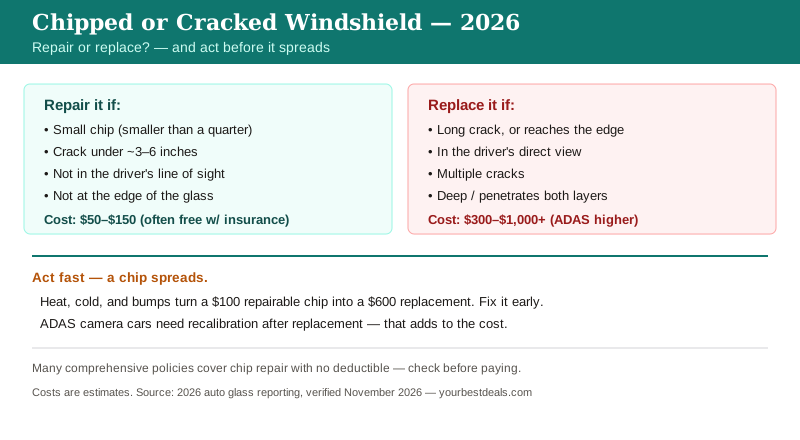
A chipped or cracked windshield comes down to one decision: repair or replace. Repair the damage if it’s a small chip (roughly smaller than a quarter) or a short crack, not in the driver’s direct line of sight, and not at the edge of the glass – that’s a $50-to-$150 fix, and often free under full-coverage insurance. Replace it if the crack is long, reaches the edge, sits in your view, or there are several cracks – a $300-to-$1,000-plus job, higher if your car has an ADAS camera that needs recalibrating. The most important thing to know: act fast, because a repairable chip spreads into a crack that forces the expensive replacement.
Windshield chips were the repair I most wished people would handle sooner, because the window to fix them cheaply is short. A rock chip caught this week is $100; the same chip after a cold snap spread it across the glass is a full replacement. Let me walk through exactly when to repair versus replace, what each costs, and why insurance often makes the chip repair free.
Repair or replace: the criteria
A few clear factors decide it. Repair is the answer when the damage is small and contained: a chip smaller than about a quarter, or a crack shorter than roughly 3 to 6 inches, that isn’t directly in the driver’s line of sight and isn’t at the edge of the glass. Modern repair resins fill these well, restoring strength and stopping the spread. Small bullseye and star chips from rocks are the classic repairable cases.
Replacement becomes necessary when the damage is beyond what repair can safely restore: a long crack, a crack that reaches the edge of the windshield (which compromises structural integrity), damage directly in the driver’s critical viewing area (where even a good repair can leave distortion), multiple cracks, or damage that penetrates both layers of the laminated glass. Edge cracks and driver’s-sightline damage are the two that most often push a chip into replacement territory. Our paint and body cost guide covers where windshield work fits in overall cosmetic costs.
What each costs
The gap between the two is why acting early matters. A windshield chip repair runs $50 to $150 – a quick job where resin is injected into the chip. A full windshield replacement runs $300 to $1,000 or more, depending on the vehicle and glass type. Luxury vehicles, heated or acoustic glass, and rain-sensor or camera-equipped windshields cost more.
The modern cost-driver to know about is ADAS: many newer cars have a forward-facing camera mounted at the windshield for lane-keeping, automatic emergency braking, and adaptive cruise. When the windshield is replaced, that camera must be recalibrated so those safety systems aim correctly – an added step that can push the total well up, sometimes several hundred dollars on top of the glass. This is a real reason to repair a chip before it becomes a replacement, since the recalibration only comes into play with a full replacement. Confirm whether your car needs it, because skipping recalibration can leave safety systems misaimed.
Shop Talk
Check your insurance before paying for a chip repair out of pocket – many full-coverage policies cover windshield chip repair with zero deductible, because the insurer would much rather pay $100 now than $600 for the replacement a spread chip becomes. Some states even mandate no-deductible glass repair. A quick call to your insurer often turns a chip repair free. Two more field tips: if you get a chip and can’t fix it immediately, put a piece of clear tape over it to keep dirt and moisture out (which helps the eventual repair bond), and avoid blasting the defroster or a car wash on a fresh chip, since sudden temperature changes are exactly what makes a chip spread into a crack.
Where Drivers Overpay
The biggest overpay is waiting: letting a repairable chip turn into a replaceable crack. A chip is $50 to $150 (often free with insurance); the replacement it becomes is $300 to $1,000-plus, and more with ADAS recalibration. Temperature swings, potholes, and even slamming a door can spread a chip, so the cheap window is short. Fixing a chip promptly is one of the clearest money-savers in car care – you’re spending a little now to avoid spending a lot soon.
The second overpay is paying out of pocket for a chip repair your insurance would have covered free, so always check the policy first. And on the replacement side, if you do need new glass, get a quote that includes the required ADAS recalibration rather than discovering it after – and make sure the recalibration is actually done, because a misaimed safety camera is a safety issue, not just a cost. So the pattern is: fix chips fast and check insurance, and if replacement is unavoidable, get a complete quote including recalibration. That’s how you keep windshield costs from ballooning.
The Real Number
Repair a windshield chip or short crack that’s small, out of the driver’s sightline, and away from the edge – it’s $50 to $150 and often free under full-coverage insurance. Replace it if the crack is long, reaches the edge, sits in your view, or there are multiple cracks, at $300 to $1,000-plus, higher with ADAS camera recalibration. The money-saver is speed: a repairable chip spreads into a replaceable crack with heat, cold, and bumps, so fix it fast. Check your insurance before paying, and if you do replace, get a quote that includes recalibration.
Frequently Asked Questions
Should I repair or replace a chipped windshield?
Repair if the damage is small and contained: a chip smaller than about a quarter or a crack under roughly 3 to 6 inches, not in the driver’s direct line of sight, and not at the edge of the glass. That’s a $50-to-$150 fix, often free with full-coverage insurance. Replace if the crack is long, reaches the edge of the windshield, sits directly in the driver’s view, there are multiple cracks, or the damage penetrates both glass layers – a $300-to-$1,000-plus job. Edge cracks and driver’s-sightline damage are the two factors that most often require replacement. When in doubt, an auto glass shop can tell you which applies.
How much does it cost to fix a windshield chip?
A windshield chip repair typically runs $50 to $150, with small chips near the lower end and larger or combination-type damage toward the top. The repair injects resin into the chip to restore strength and stop it spreading. Importantly, many full-coverage insurance policies cover chip repair with no deductible, so it’s often free – check your policy before paying out of pocket. This is a fraction of a full windshield replacement, which runs $300 to $1,000 or more, so repairing a chip promptly before it spreads is one of the clearest ways to save money on auto glass. These are estimated ranges that vary by location.
How much does windshield replacement cost?
A windshield replacement typically runs $300 to $1,000 or more, depending on the vehicle and glass type. Luxury vehicles, heated or acoustic glass, and windshields with rain sensors or cameras cost more. The big modern factor is ADAS: many newer cars have a forward camera at the windshield that must be recalibrated after replacement so lane-keeping and automatic braking aim correctly, which can add several hundred dollars. These are estimated ranges that vary by car and region. Because replacement is so much more than a chip repair, catching and repairing chips early is the key money-saver. If you do replace, get a quote that includes any required recalibration.
Does insurance cover windshield repair?
Often yes for chip repair. Many full-coverage auto insurance policies cover windshield chip repair with no deductible, because insurers would rather pay for a cheap repair than the costly replacement a spread chip becomes, and some states mandate no-deductible glass repair. So a chip repair is frequently free – check your policy or call your insurer before paying. Full windshield replacement is usually covered under full full-coverage-tier coverage too, but subject to your deductible, so if the replacement cost is near your deductible, weigh paying out of pocket. The economics strongly favor using the free chip-repair benefit promptly rather than letting damage grow into a deductible-triggering replacement.
Is it safe to drive with a cracked windshield?
It depends on the crack. A small chip or short crack outside the driver’s line of sight is generally safe to drive on briefly while you arrange a repair, though you should fix it promptly before it spreads. A large crack, one in the driver’s direct view, or one at the edge of the glass is more serious: it impairs visibility and weakens the windshield’s structural role, which matters in a collision or rollover since the windshield supports the roof and airbag deployment. Many areas also have laws against driving with cracks in the driver’s sightline. So minor damage is drivable short-term, but significant cracks should be addressed quickly for safety and legality.
Why does my car need recalibration after windshield replacement?
Many newer vehicles have advanced driver-assistance systems (ADAS) that rely on a camera mounted at the top of the windshield – powering lane-keeping assist, automatic emergency braking, and adaptive cruise control. When the windshield is replaced, that camera’s position shifts slightly, so it must be recalibrated to aim correctly, or those safety systems can misjudge distances and lane position. Recalibration is a real, necessary step on ADAS-equipped cars, done with specialized equipment, and it adds to the replacement cost. Skipping it can leave safety features misaimed, which is a safety risk, not just a technicality. If your car has these features, make sure any replacement quote includes the recalibration.
How fast does a windshield chip spread into a crack?
It’s unpredictable but often faster than people expect. A chip can stay stable for a while or spread within days, and the triggers are common: temperature swings (a hot day then a cold night, or blasting the defroster or AC), hitting a pothole or bump, slamming a door, or even the glass flexing on the highway. Once a chip starts spreading into a crack, it can move quickly and is no longer repairable, forcing a full replacement. That unpredictability is exactly why repairing a chip promptly is the smart move – you can’t count on it staying small. Covering a fresh chip with clear tape and avoiding sudden temperature changes helps until you get it repaired.
Sources
Windshield repair and replacement criteria and costs verified against 2026 auto glass cost reporting on November 9, 2026. Costs are estimated ranges that vary by vehicle and region; check your insurance for chip-repair coverage.
- Glass & Auto – windshield chip repair cost, when to replace, 2026
- AAA – windshield repair or replacement cost
- Windshield Repair Prices – chip and crack repair guide, 2026
Related Guides
- Car paint, body, and cosmetic repair cost
- How to fix deep scratches on a car
- Car maintenance schedule and cost
- What does a check engine light mean?

Diane Holcomb spent seven years at Charlotte dealership service desks, where windshield chips were the repair she most wished people handled sooner – a $100 fix this week, a full replacement after the next cold snap. She writes the cost guides on Your Best Deals and takes no referral fees. She drives a 2019 Honda CR-V and a 2007 Toyota Camry.