
Last updated: November 7, 2026 – By Eddie Brennan
November 2026 update: refreshed the common-cause cost table and reconfirmed the scan-first, steady-versus-flashing guidance.
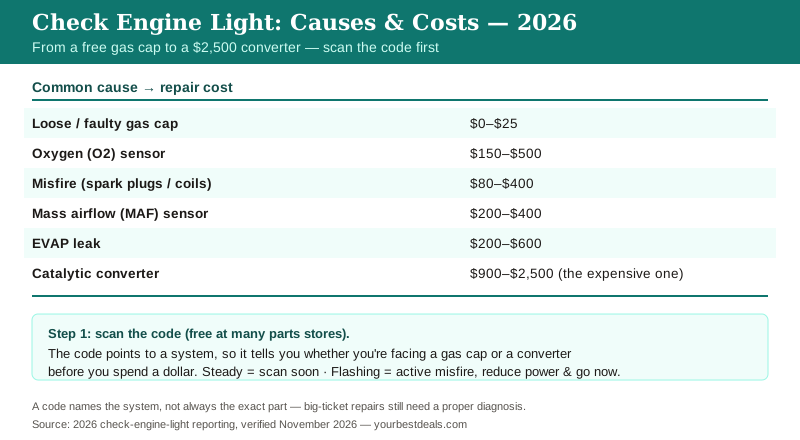
A check engine light means your car’s computer has detected a fault in the engine or emissions system and stored a trouble code. The catch is how much that covers – the same light can mean a loose gas cap that costs nothing to fix or a failing catalytic converter that costs $900 to $2,500. Because the range is so wide, the first and most important step is always the same: scan the code to find out which problem you actually have before you spend a dollar.
I read thousands of these codes over eleven years, and the light causes far more anxiety than it usually deserves. A lot of check engine lights are a cheap sensor or literally the gas cap, not the disaster people picture. This guide covers the common causes and what each costs, how to read the code (often free), and the one distinction that changes the urgency: steady versus flashing.
Common causes and what they cost
Here are the frequent causes of a check engine light, from cheapest to priciest.
| Cause | Repair cost | Notes |
|---|---|---|
| Loose / faulty gas cap | $0–$25 | Most common; often free |
| Oxygen (O2) sensor | $150–$500 | Affects economy if ignored |
| Misfire (spark plugs / coils) | $80–$400 | See spark plug cost guide |
| Mass airflow (MAF) sensor | $200–$400 | Rough running, poor economy |
| EVAP leak | $200–$600 | Emissions system leak |
| Catalytic converter | $900–$2,500 | The expensive one |
Notice how weighted this is toward the cheap end – a gas cap, a sensor, or a misfire covers a large share of check engine lights, and only the catalytic converter is truly expensive. And the converter is often the result of ignoring a cheaper problem, like a long-running misfire, so catching the small stuff early keeps you out of the big-ticket repair. For the misfire side, see our spark plug cost guide.
Scan the code first
Before you assume anything, get the code read. Your car stored a specific diagnostic trouble code when the light came on, and reading it tells you which system is at fault – many auto-parts stores will scan it for free with a handheld reader and give you the code plus a plain-English description. This turns an anxious mystery light into a named problem you can research or price, and it stops you from guessing or overpaying.
One important caveat: a code points to a system, not always the exact failed part. A code like “oxygen sensor slow response” or “cylinder 3 misfire” tells you where to look, but the actual cause could be the sensor, the wiring, or something upstream. So a free code read is the perfect first step for cheap problems like a gas cap, but a big-ticket repair like a catalytic converter or a persistent misfire still deserves a proper diagnosis before you buy the part. Read the code, then decide whether it’s a DIY fix or a shop visit.
Steady vs flashing: the urgency
Steady light
A steady check engine light means the computer logged a fault, but it’s usually not an emergency, and the car often runs fine. It needs scanning and attention soon, not a roadside stop. The common causes – a loose gas cap, an oxygen sensor, an EVAP leak – fall here. Drive to a shop or a parts store, get the code, and address it within a few days. A steady light left for months can hide a worsening problem, so don’t ignore it indefinitely, but you don’t need to panic.
Flashing light
A flashing check engine light is more serious: it signals an active engine misfire dumping raw fuel into the exhaust, which can quickly overheat and destroy the catalytic converter – turning a cheap misfire into a $900-to-$2,500 repair. When it flashes, reduce power, avoid hard acceleration, and get it seen the same day. Our flashing check engine light guide covers exactly what to do. The difference between steady and flashing is the difference between “soon” and “now.”
Straight From the Invoice: check engine codes
These are jobs I either did myself or watched come through the bay – a free fix, a sensor, and a converter caused by waiting.
Invoice #1 – 2017 Honda Civic, gas cap, independent, Ohio
Steady light, car fine. The scan showed an EVAP code; the gas cap hadn’t clicked tight. Tightened it, cleared the code, no charge. Lesson: scan before you worry – the single most common check engine cause is the cheapest, and sometimes it’s literally the gas cap.
Invoice #2 – 2015 Toyota Camry, oxygen sensor, Columbus
Steady light with slightly worse fuel economy. The code and a check pointed to a lazy oxygen sensor; replaced for about $280 and economy came back. Lesson: an O2 sensor is a common, mid-range fix, and ignoring it costs you at the pump, so it’s worth doing once confirmed.
Invoice #3 – 2013 sedan, converter from an ignored misfire, Texas
A misfire code the owner ignored for months eventually cooked the catalytic converter – a $1,800 repair instead of a $250 coil-and-plug fix months earlier. Lesson: the expensive converter is often the price of ignoring a cheap misfire; scan and fix the small code early.
Shop Talk
Two moves handle almost every check engine light. First, if it’s steady, before anything else make sure your gas cap is clicked tight and get the code read free at a parts store – that alone resolves or names a huge share of lights. Second, don’t let a cheap code sit for months. A misfire or a lean code that’s a $250 fix today can cook a $1,800 catalytic converter if you drive on it long enough. The light isn’t the enemy; ignoring the small code behind it is what turns a cheap repair into an expensive one.
What gets people in trouble
The costly mistake with a check engine light is ignoring it because the car “drives fine.” A steady light often does come with normal driving, which lulls people into leaving it for months – but the code behind it can be a misfire slowly damaging the catalytic converter, an oxygen sensor quietly costing fuel, or an emissions fault that fails an inspection. The car running fine doesn’t mean nothing’s wrong; it means the problem hasn’t grown yet. Scan it and know what you’re dealing with.
The opposite mistake is over-reacting to a steady light – panicking, or worse, letting a shop sell a big repair off the code alone without a proper diagnosis. A code names a system, not always the exact part, so a catalytic converter or a persistent misfire should be confirmed before you buy the expensive part. Scan first for cheap fixes, demand a real diagnosis for expensive ones, and you’ll neither ignore a real problem nor overpay for a guessed one.
The Real Number
A check engine light spans a free gas cap to a $2,500 catalytic converter, so the first step is always to scan the code – free at many parts stores. Common causes run cheap: a gas cap ($0–$25), an oxygen sensor ($150–$500), or a misfire ($80–$400), with the converter the pricey outlier that’s often caused by ignoring a cheaper problem. Steady means scan and fix soon; flashing means an active misfire, so reduce power and go the same day. Scan first, fix the small stuff early, and demand a real diagnosis before any big-ticket part.
Frequently Asked Questions
What does it mean when the check engine light comes on?
It means your car’s computer detected a fault in the engine or emissions system and stored a diagnostic trouble code. That covers a huge range – from a loose gas cap that costs nothing to a failing catalytic converter costing $900 to $2,500 – so the light itself doesn’t tell you the severity. The way to find out is to scan the code, which names the system at fault. Many causes are cheap sensors or a gas cap, so a check engine light is usually far less alarming than it feels once you read the code.
How much does it cost to fix a check engine light?
It depends entirely on the cause. A loose gas cap is $0 to $25, an oxygen sensor $150 to $500, a misfire from plugs or coils $80 to $400, a mass airflow sensor $200 to $400, and an EVAP leak $200 to $600. The expensive outlier is a catalytic converter at $900 to $2,500, often caused by ignoring a cheaper problem like a long-running misfire. Because the range is so wide, scanning the code first tells you which repair you’re facing before you spend anything. Most common causes land at the cheaper end.
Can I still drive with the check engine light on?
A steady check engine light with the car running normally usually means you can drive to a shop soon, since it’s often a minor issue like a gas cap or a sensor. A flashing light, though, means an active misfire that can damage the catalytic converter, so reduce power and get seen the same day. Also treat it as urgent if the car is running rough, losing power, overheating, or a red light is also on. When in doubt, get the code scanned to know whether it’s safe to keep driving.
Where can I get my check engine code read?
Many auto-parts stores read check engine codes for free with a handheld scanner and give you the code plus a plain-English description, which is the ideal first step. You can also buy an inexpensive code reader or an app-based Bluetooth adapter to read it yourself, or have a shop scan it as part of a diagnosis. Remember the code points to a system, not always the exact part, so it’s perfect for identifying cheap fixes like a gas cap, while a big-ticket repair still needs a proper diagnosis to confirm the actual failed component.
Why is my check engine light on but the car runs fine?
Because many check engine causes don’t affect how the car drives day to day – a loose gas cap, a minor EVAP leak, or an early oxygen-sensor fault can all trigger the light while the car feels completely normal. That’s reassuring but not a reason to ignore it, since the underlying problem can still worsen, cost you fuel economy, or fail an emissions test. Scan the code to learn what it is; often it’s a cheap fix. The car running fine simply means the problem hasn’t grown yet, not that there isn’t one.
Will the check engine light reset itself after I fix the problem?
Often, yes. After the underlying fault is fixed, the computer needs a few drive cycles to reconfirm the system is fine, and then many check engine lights turn off on their own – for example, a day or two after you tighten a loose gas cap. Some codes need to be cleared with a scanner. If the light stays on well after the repair, either the problem wasn’t fully fixed or the code needs clearing, so it’s worth rescanning to confirm the fault is actually resolved rather than assuming the repair didn’t work.
Is a check engine light always a serious problem?
No. Most check engine lights trace to relatively minor, affordable causes – a gas cap, an oxygen or mass airflow sensor, or a misfire – rather than a catastrophic failure. The catalytic converter is the one expensive common cause, and it’s frequently the result of ignoring a cheaper problem too long. So a check engine light is a prompt to scan and investigate, not automatic proof of a disaster. Read the code, address cheap fixes promptly so they don’t escalate, and get a real diagnosis before any expensive repair.
Sources
Check engine light causes and cost figures verified against 2026 reporting on November 7, 2026. Costs vary by vehicle and region; a code scan and proper diagnosis are the first steps.
- AutoNation Mobile Service – check engine light and gas cap
- Check engine light: 12 causes and fixes, 2026
- RepairPal – spark plug and misfire repair cost
Related Guides
- Dashboard warning lights guide
- Why is my check engine light flashing?
- Spark plug replacement cost
- Car repair cost estimator hub

Eddie Brennan is an ASE Master Certified technician (including A6, Electrical/Electronic Systems) who spent 11 years at an independent shop in Columbus, OH, reading trouble codes and talking drivers through what their check engine light actually meant. He writes the repair and diagnostic guides on Your Best Deals and takes no referral fees. He drives a 250,000-mile 2015 Subaru Outback and a 2020 Ford F-150.