
Last updated: November 7, 2026 – By Eddie Brennan
November 2026 update: refreshed the no-start diagnosis table and the battery, starter, and alternator cost ranges.
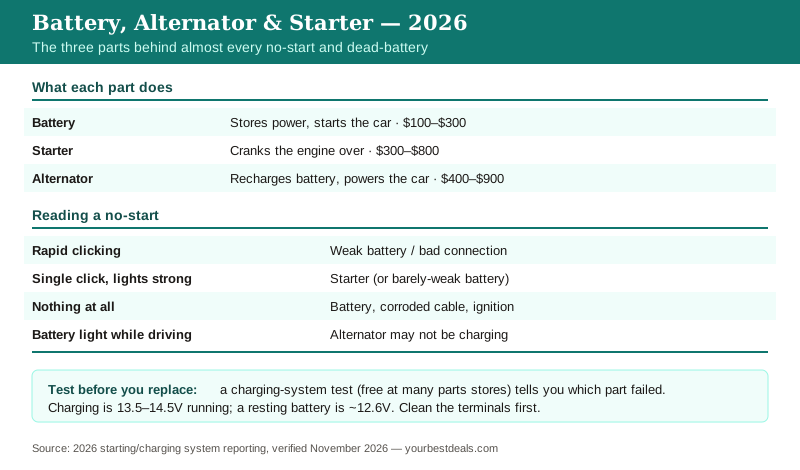
Almost every no-start and dead-battery problem comes down to three parts: the battery, which stores power and starts the car; the starter, which cranks the engine; and the alternator, which recharges the battery and runs the electrical system while you drive. They work as a team, and because a failure in any one can look like a failure in another, the single most valuable skill is reading the symptom correctly before you replace a part. This guide covers what each does, how to read a no-start, and what each fix costs.
Charging and starting is one of my ASE certs, A6, and it’s the area where I saw the most wasted money – people replacing a $500 alternator when a $150 battery had died, or a starter when a corroded cable was the whole problem. The parts are cheap to test and expensive to guess at. So let’s make the diagnosis simple, because the symptom usually tells you which of the three is at fault.
What each part does
The battery is a storage tank for electricity. It provides the big jolt of power that spins the starter and starts the car, and it steadies the electrical system. It doesn’t power the car while driving – that’s the alternator’s job. A typical battery lasts three to five years and costs $100 to $300 to replace. The starter is an electric motor that, when you turn the key, cranks the engine over fast enough to start; it runs $300 to $800 to replace. The alternator is driven by the engine and does double duty: it recharges the battery and powers everything electrical while the car runs, at $400 to $900 to replace.
Understanding the division of labor is what makes diagnosis click. If the car won’t crank, you’re looking at the battery, starter, or the connections between them. If the car starts fine but the battery keeps dying or a warning light comes on while driving, you’re looking at the alternator or a drain. Knowing which job failed points you to the right part. See our alternator cost guide and starter cost guide for the full breakdowns.
How to read a no-start
The sound your car makes when it won’t start narrows the cause quickly.
| What you hear/see | Most likely cause | Go deeper |
|---|---|---|
| Rapid clicking | Weak battery or bad connection | Battery won’t hold charge |
| Single click, lights strong | Starter (or barely-weak battery) | Bad starter signs |
| Nothing at all, no crank | Battery, corroded cable, ignition, safety switch | Starter cost |
| Battery light on while driving | Alternator may not be charging | Alternator cost |
| Starts, then dies / keeps dying | Alternator or parasitic drain | Battery won’t hold charge |
The single most useful rule: rapid clicking is a battery symptom, not a starter one. That chatter-chatter-chatter when you turn the key almost always means the battery is too weak to spin the starter, or a connection is bad – not that the starter is dead. A single loud click with the lights and dash staying strong is more likely the starter. Getting that distinction right saves people from replacing the wrong part constantly.
Test before you replace
The battery, alternator, and starter are all cheap to test and expensive to guess at, and a charging-system test settles which one failed in about five minutes – many parts stores do it free in the lot. The two key numbers: with the engine running, a healthy alternator puts out 13.5 to 14.5 volts; a battery at rest should read around 12.6 volts. If the alternator’s output is low, it’s the alternator; if output is fine but the battery won’t hold a charge, it’s the battery. And before condemning anything, clean and tighten the battery terminals, because a corroded connection mimics a dead battery, starter, or alternator.
This test-first habit is the whole game with electrical problems. A weak battery makes the starter and alternator both look bad; a corroded cable makes everything look bad. Confirm the actual fault with a meter or a free parts-store test, clean the connections, and only then replace a part. It’s the difference between fixing the problem once and replacing parts until you accidentally get the right one.
Straight From the Invoice: electrical calls
These are jobs I either did myself or watched come through the bay – a battery mistaken for an alternator, a corroded cable, and a real starter.
Invoice #1 – 2013 Toyota Camry, “bad alternator” that was a battery, Columbus
Came in sure the alternator was dead. The tester showed it charging at 14.1 volts; the five-year-old battery couldn’t hold a charge. A $160 battery, not a $500 alternator. Lesson: test before you replace – a dying battery is the most-misdiagnosed “alternator” there is.
Invoice #2 – 2012 Nissan Altima, corroded terminal, Ohio
Rapid clicking on a cold morning; the driver feared a starter. A green, crusty battery terminal was the whole problem – cleaned and tightened, it cranked right up. Lesson: rapid clicking plus a corroded terminal is a free fix; clean the connections before buying a starter.
Invoice #3 – 2014 Honda Civic, real starter, independent, Texas
Strong battery, single click, intermittent no-crank that got worse – a genuine dying starter. Reman unit, about $360. Confirmed by a good battery and clean connections. Lesson: a healthy battery with a single click and intermittent cranking is a real starter, and $300-$450 is fair on a compact.
Shop Talk
Before you or a shop replaces any electrical part, do two free things: clean and tighten the battery terminals, and get a charging-system test at a parts store. Those two steps catch the most common and cheapest problems – a corroded connection and a worn-out battery – that otherwise get misdiagnosed as a starter or alternator. And learn the one sound: rapid clicking is the battery, a single click with strong lights is the starter. Between the terminal check, the free test, and that one distinction, you’ll almost never buy the wrong electrical part.
What gets people in trouble
The number-one electrical overpay is replacing the wrong one of the three. A weak battery makes the alternator and starter both look bad, so people buy a $500 alternator or a $400 starter when a $150 battery had died – the single most common electrical misdiagnosis there is. The charging-system test prevents it entirely, and it’s free. Whenever an electrical part is proposed, ask whether the battery was load-tested and the alternator output measured first.
The second is ignoring the terminals. A corroded or loose battery connection resists current and mimics a dead battery, starter, or alternator, and cleaning it is free. Plenty of “no-start” tows would’ve been a two-minute terminal cleaning. And the third is treating a battery that keeps dying as just needing another battery, when the real issue is a parasitic drain or a failing alternator – replacing the battery without finding why it died just kills the new one too. Our battery guide covers that.
The Real Number
Battery, starter, and alternator are the three parts behind almost every no-start and dead-battery, at $100-$300, $300-$800, and $400-$900 respectively. Read the symptom: rapid clicking is the battery, a single click with strong lights is the starter, a battery light while driving is the alternator. Before replacing anything, clean the terminals and get a free charging-system test, because a weak battery or a corroded cable is the most-misdiagnosed problem there is. Test first, and you’ll fix it once instead of replacing parts until one works.
Frequently Asked Questions
Is it my battery, starter, or alternator?
Read the symptom. Rapid clicking when you turn the key almost always means a weak battery or a bad connection, not the starter. A single loud click with the lights staying strong points to the starter. Nothing at all can be the battery, a corroded cable, or the ignition. A battery warning light while driving, or a car that starts then dies, points to the alternator. Confirm with a free charging-system test at a parts store, which measures whether the alternator is charging and whether the battery holds a charge, before replacing any part.
Why does my car click rapidly when I try to start it?
Rapid clicking is a classic weak-battery or bad-connection symptom, not usually the starter. The clicking is the starter solenoid trying and failing to engage because there isn’t enough current to spin the motor – either the battery is too weak or a cable connection is corroded or loose. Before assuming the starter, load-test the battery and clean the terminals, since a green, crusty terminal is a common and free fix. Rapid clicking almost never means you need a starter; it means the battery or the connection to it can’t deliver enough power.
How much does it cost to fix a car that won’t start?
It depends on the cause. A battery is $100 to $300, and often it’s just a corroded terminal cleaning, which is essentially free. A starter runs $300 to $800, and an alternator $400 to $900. Because a weak battery mimics a starter or alternator problem, the cheapest fix is often the actual one, which is why a free charging-system test and a terminal cleaning come first. Replacing the correct part after testing costs far less over time than guessing and replacing the wrong one, then the right one.
Can a bad alternator drain the battery?
Yes, in a couple of ways. An alternator with failed diodes can allow current to flow backward when the engine is off, draining the battery overnight. And an alternator that undercharges leaves the battery chronically low, shortening its life and eventually leaving you stranded. That’s why, when a battery keeps dying, the alternator is a prime suspect alongside a parasitic drain and an old battery. A charging-system test checks the alternator’s output and can reveal a bad diode, so testing distinguishes an alternator problem from a simply worn-out battery.
How long does a car battery last?
Most car batteries last three to five years, though heat, frequent short trips that never fully recharge it, and deep discharges shorten that. A battery approaching or past five years old that’s struggling to start the car is often simply worn out, regardless of anything else. Since a dying battery mimics starter and alternator problems, the age of your battery is useful context – if it’s old and the car is slow to start or the battery keeps dying, replacing the battery is frequently the answer, confirmed by a quick load test.
Why does my car battery keep dying?
Three main reasons: the battery is simply old and can’t hold a charge, a parasitic drain is pulling power while the car is off (a stuck light, a faulty module, or an aftermarket accessory), or the alternator isn’t charging it properly. A healthy battery in a modern car can usually sit two to three weeks before the normal small draw drains it, so if yours dies in a couple of days, you likely have a parasitic drain or a charging problem, not just a bad battery. See our battery guide for how to find which.
Should I clean my battery terminals before replacing parts?
Absolutely, because it’s free and a corroded or loose terminal is one of the most common causes of no-start and charging complaints. A green or white crusty buildup on the terminals resists current flow and can perfectly mimic a dead battery, a bad starter, or a failing alternator. Cleaning and tightening the terminals takes a few minutes and regularly fixes a “no-start” that would otherwise get a part thrown at it. Always rule out the connections before spending on a battery, starter, or alternator, since the fix might be a wire brush and a wrench.
Sources
Starting and charging system diagnostics and cost figures verified against 2026 reporting on November 7, 2026. Costs vary by vehicle and region; test the battery and connections before replacing parts.
- AutoZone DIY – parasitic battery drain causes
- RepairPal – alternator replacement cost
- RepairPal – starter replacement cost
Related Guides
- 5 signs of a bad starter motor
- Why won’t my car battery hold a charge?
- Alternator replacement cost
- Starter replacement cost

Eddie Brennan is an ASE Master Certified technician (including A6, Electrical/Electronic Systems) who spent 11 years at an independent shop in Columbus, OH, testing charging systems and saving customers from replacing the wrong one of the battery-starter-alternator trio. He writes the repair and diagnostic guides on Your Best Deals and takes no referral fees. He drives a 250,000-mile 2015 Subaru Outback and a 2020 Ford F-150.