
Last updated: November 9, 2026 – By Diane Holcomb
November 2026 update: reconfirmed the drain causes, battery/diagnosis costs, and the age-vs-alternator tell.
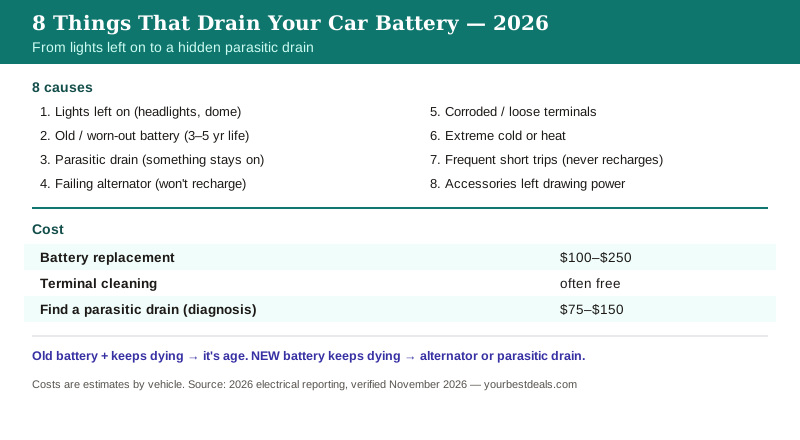
A car battery that keeps dying is one of the more frustrating problems, and the cause is usually one of eight things – from the obvious (lights left on) to the hidden (a parasitic drain that keeps drawing power while the car is off). The most useful shortcut for figuring out which: if your battery is 3 to 5 years old and keeps dying, it’s probably just worn out ($100 to $250 to replace); but if a new battery keeps dying, the culprit is usually the alternator not recharging it or a parasitic drain pulling it down. Finding a parasitic drain is a $75-to-$150 diagnostic job, and cleaning corroded terminals is often free. Here are the eight things that drain a battery and how to narrow down yours.
At the service desk, “my battery keeps dying” was a weekly conversation, and the first question was always how old the battery is. That one fact splits the diagnosis in half. Let me run through the eight common causes and the simple logic that tells you whether you’re looking at a $150 battery or a hunt for a hidden drain.
The eight things that drain a battery
Here are the common causes, from the simple to the sneaky.
1. Lights left on. The classic – headlights, a dome light, the trunk light, or a door left ajar keeping an interior light on overnight will flatten a battery. Easy to do, easy to fix.
2. An old, worn-out battery. Batteries last about 3 to 5 years. An aging battery loses its ability to hold a charge, so it dies more easily and recharges less. If yours is that old and struggling, age is the likely answer.
3. A parasitic drain. This is a component that stays powered when the car is off – a stuck relay, a faulty module, a glovebox or under-hood light that won’t turn off, or an aftermarket accessory wired in wrong. It slowly pulls the battery down overnight or over a few days.
4. A failing alternator. If the alternator isn’t recharging the battery while you drive, the battery keeps depleting. A new battery that dies again quickly points here.
5. Corroded or loose terminals. Corrosion or a loose connection interrupts charging and can leave the battery undercharged.
6. Extreme temperatures. Very cold weather reduces a battery’s cranking power, and extreme heat degrades it over time, both stressing the battery.
7. Frequent short trips. Very short drives don’t give the alternator enough time to fully recharge the battery after starting, so it slowly falls behind, especially in winter.
8. Accessories left drawing power. A phone charger, dash cam hardwired to stay on, the radio, or other accessories left running can drain the battery, particularly when the car sits.
The cost, and the diagnostic shortcut
The fixes range from free to a moderate diagnosis. Cleaning corroded terminals is often free or nearly so. Replacing a worn-out battery is $100 to $250. Finding a parasitic drain – where a technician measures the current draw with the car off and hunts down what’s pulling it – is a diagnostic job of roughly $75 to $150, plus whatever the offending part costs to fix. A failing alternator is $300 to $800. These are estimated ranges that vary by vehicle.
Here’s the shortcut that saves the most time and money: the age of the battery. If it’s 3 to 5 years old (or older) and keeps dying, age is the most likely cause, and a replacement usually solves it – no need to chase exotic problems first. But if the battery is new or recently replaced and still keeps dying, don’t buy another battery; the cause is almost certainly the alternator not charging or a parasitic drain, both of which a new battery won’t fix. That single distinction points you at the right, cost-effective diagnosis. Our electrical system guide and alternator symptoms guide cover those.
Shop Talk
Before spending on a parasitic-drain hunt, do the free checks: make sure no lights are staying on (open the hood and trunk and confirm those lights go off, check that all doors and the glovebox are fully closed), and have the battery load-tested and its age checked at a parts store – most do it free. A battery date code on the case tells you how old it is. If it’s over 3 to 5 years, just replace it and you’ve likely solved it. If the battery and alternator both test good but it still drains overnight, that’s when a parasitic-draw test is worth paying for. And a practical tip for a car that sits: a $20 battery tender (trickle charger) keeps a battery topped up during storage or long parking, preventing the slow drain that kills batteries on cars that aren’t driven regularly.
The Real Number
A car battery drains from eight common things: lights left on, an old battery, a parasitic drain, a failing alternator, corroded terminals, extreme temperatures, frequent short trips, and accessories left drawing power. The money-saving shortcut is the battery’s age: 3-to-5-years-old and dying usually means it’s just worn out ($100 to $250 to replace), while a new battery that keeps dying points at the alternator or a parasitic drain (a $75-to-$150 diagnosis) – so don’t buy another battery in that case. Do the free checks first: lights off, terminals clean, and a free parts-store battery test.
Frequently Asked Questions
What drains a car battery?
Common causes are lights left on (headlights, dome, trunk), an old worn-out battery, a parasitic drain from something staying powered when the car is off, a failing alternator that doesn’t recharge the battery, corroded or loose terminals, extreme cold or heat, frequent short trips that never fully recharge it, and accessories like a hardwired dash cam or charger left drawing power. The battery’s age is the key clue: if it’s 3 to 5 years old and dying, it’s probably worn out, while a new battery that keeps dying points at the alternator or a parasitic drain. Start with the free checks – lights off, terminals clean, and a battery test – before assuming a complex problem.
Why does my battery keep dying even though it’s new?
If a new or recently replaced battery keeps dying, the problem almost certainly isn’t the battery – it’s something draining or failing to charge it. The two main culprits are a failing alternator, which isn’t recharging the battery while you drive, and a parasitic drain, where a component stays powered when the car is off and slowly pulls the battery down. Corroded terminals or a bad ground can also prevent proper charging. So replacing the battery again won’t fix it; you need the charging system tested and, if that’s good, a parasitic-draw test to find what’s pulling power. A new battery that keeps dying is a clear signal to look beyond the battery.
What is a parasitic drain?
A parasitic drain is an electrical draw that continues after the car is turned off, slowly depleting the battery. Some small draw is normal (for the clock, memory, and security system), but an abnormal parasitic drain – from a stuck relay, a faulty module, a light that won’t turn off, or a poorly wired aftermarket accessory – pulls too much and flattens the battery over hours or days. Finding it involves a technician measuring the current draw with the car off and systematically pulling fuses to isolate the circuit, a diagnostic job of about $75 to $150 plus the repair. If your battery drains overnight or over a few days with no lights left on, a parasitic drain is a likely cause.
How long should a car battery last?
Most car batteries last about 3 to 5 years, though it varies with climate and use. Extreme heat shortens battery life significantly, so batteries in hot regions may last closer to 3 years, while those in mild climates can reach 5 or more. Frequent short trips and letting the battery repeatedly run down also shorten its life. Because 3 to 5 years is the norm, a battery that’s in that range and starting to struggle is likely just aging out, and replacing it is usually the fix. Checking the date code on the battery tells you its age. If yours is old and dying, don’t chase complex diagnoses first – it’s probably just worn out.
Do short trips drain your battery?
They can, over time. Starting the engine uses a lot of battery power, and the alternator then recharges it as you drive – but a very short trip may not give the alternator enough time to fully replace what starting used, so the battery slowly falls behind with each short trip. This is worse in cold weather, when starting takes more power and the battery is already weaker. Drivers who only make short hops, especially in winter, may find their battery chronically undercharged and prone to dying. Taking an occasional longer drive, or using a battery tender during periods of short-trip-only use, helps keep it charged. So short trips are a real, if gradual, contributor to a weak battery.
How do I stop my car battery from draining?
Start with the basics: make sure lights and accessories are off when you park, keep the terminals clean and tight, and replace the battery if it’s over 3 to 5 years old and struggling. If you make mostly short trips, take an occasional longer drive to let the alternator recharge it, or use an inexpensive battery tender when the car sits. If the battery and alternator test good but it still drains, have a parasitic-draw test done to find and fix whatever is pulling power when the car is off. And in extreme climates, parking in shade or a garage reduces heat stress. Matching the fix to the cause – age, charging, or a drain – is what actually stops the draining.
How much does it cost to fix a battery that keeps draining?
It depends on the cause. Cleaning corroded terminals is often free or a few dollars. Replacing a worn-out battery is $100 to $250. Diagnosing a parasitic drain is a $75-to-$150 job, plus the cost to fix whatever is causing it. A failing alternator is $300 to $800 installed. These are estimated ranges that vary by vehicle. Because the causes range so widely in cost, using the age shortcut and the free checks first – lights off, terminals clean, a free battery and charging test – narrows it down before you pay for a deeper diagnosis. That keeps you from replacing a battery when the alternator was the problem, or chasing a drain when the battery was simply old.
Sources
Battery-drain causes and cost ranges verified against 2026 electrical reporting on November 9, 2026. Costs are estimated ranges that vary by vehicle; a battery test and parasitic-draw test identify the cause.
- Interstate Batteries – what drains a car battery, 2026
- RepairPal – car battery replacement cost, 2026
- AAA – battery drain and dead-battery causes
Related Guides
- Battery, starter, and electrical system cost
- Why won’t my car battery hold a charge?
- 8 symptoms of a failing alternator
- Why won’t my car start?

Diane Holcomb spent seven years at Charlotte dealership service desks, where “my battery keeps dying” always started with one question – how old is the battery? – because that one fact split the diagnosis in half. She writes the cost guides on Your Best Deals and takes no referral fees. She drives a 2019 Honda CR-V and a 2007 Toyota Camry.