
Last updated: November 10, 2026 – By Diane Holcomb
November 2026 update: reconfirmed the driving and parked lifespan figures and the storage-care steps.
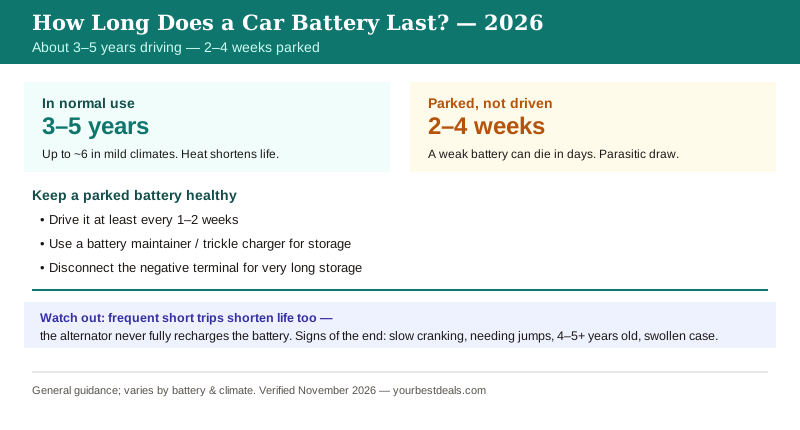
A car battery lasts about 3 to 5 years in normal use (up to 6 in mild climates), but if the car just sits, a healthy battery usually goes flat in about 2 to 4 weeks – and a weak one can die in days. The reason a parked car drains is that modern vehicles never fully “sleep”: the computers, clock, alarm, and keyless system pull a small parasitic current the whole time the car sits, and with no driving the alternator never recharges it. So if you’re leaving a car parked for more than a couple of weeks, plan to keep the battery up. The good news is it’s easy: drive it occasionally, put it on a maintainer, or disconnect the battery for long storage.
This came up constantly with customers who had a second car, a seasonal vehicle, or a college kid’s car sitting at home – “I didn’t drive it for three weeks and now it’s dead, is the battery bad?” Usually not. A battery that dies from sitting isn’t necessarily worn out; it just drained. Let me explain how long you really have, why sitting kills batteries, and how to keep a parked one alive.
How long it lasts: driving vs. parked
These are two different clocks. In regular use, a battery’s calendar life is about 3 to 5 years, sometimes up to 6 in mild climates – and, counterintuitively, hot climates shorten battery life more than cold ones, because heat accelerates the internal wear (cold just makes a weak battery’s shortcomings show up on a January morning). When a car is parked and not driven, the limiting factor isn’t age but the parasitic draw: a healthy battery in a modern car typically lasts about 2 to 4 weeks sitting before it’s too low to start the car. An older or already-weak battery can be dead in a matter of days.
Worth knowing: constant short trips are hard on batteries too. If every drive is five minutes to the store, the alternator never fully recharges what starting the car used, so the battery slowly runs down over weeks even though you’re “driving” it. Between long-sits and all-short-trips, a lot of “my battery keeps dying” complaints are really charging-pattern problems, not bad batteries. Our battery light guide covers charging-system warnings.
Shop Talk
If you’re storing a car – for the season, a deployment, a long trip – here’s the simple hierarchy of what to do, cheapest and easiest first. For a couple of weeks, nothing special is needed on a healthy battery. For a month or more, the best answer is a battery maintainer (a “trickle charger” or “battery tender”), a $25-to-$50 device you plug into the wall and clip to the battery; it keeps it topped up indefinitely and is the gold standard for storage. No outlet where it’s parked? Then either drive the car for a solid 20-plus minutes every week or two to recharge it, or, for very long storage, disconnect the negative battery terminal to stop the parasitic drain entirely (note this resets the clock and radio presets, and on some cars requires a relearn). One caution: don’t rely on “starting it and letting it idle for five minutes” – idling barely charges the battery and isn’t enough. If you’re going to run it, actually drive it. And if a battery dies repeatedly from sitting and is over about four years old, it may be near the end anyway – a free parts-store test settles it.
Where Drivers Overpay
The most common overpay here is replacing a perfectly good battery that just drained from sitting. A battery dead after three weeks parked isn’t automatically worn out – charge it back up (or jump-start and drive it a good while) and test it, and it’s often fine. Buying a new battery every time a stored car goes flat wastes money when a $30 maintainer would have prevented it. Test before you replace, especially if the battery is under a few years old.
The flip side is throwing money at repeated jump-starts and short-trip band-aids on a battery that really is at the end of its life. If your battery is 4 to 5 years old, cranks slowly, needs frequent jumps, or has a swollen case, it’s near done and worth replacing before it strands you – see our battery cost guide. The way to tell “just drained” from “worn out” is a battery test, free at most parts stores. Match the fix to the real cause: a maintainer for a stored car, a new battery for a really old one.
The Real Number
A car battery lasts 3 to 5 years in use but only about 2 to 4 weeks parked, because the car’s electronics keep drawing a small current with no driving to recharge it. For storage, a $25-to-$50 battery maintainer is the easy fix; otherwise drive it 20-plus minutes every week or two, or disconnect the battery for very long storage. Don’t replace a battery that simply drained from sitting – test it first – but do replace one that’s 4-to-5-plus years old and cranking slowly.
Frequently Asked Questions
How long does a car battery last without driving?
A healthy battery in a modern car typically lasts about 2 to 4 weeks parked before it’s too low to start the car, because the vehicle’s computers, clock, and alarm draw a small parasitic current the whole time it sits. An older or weak battery can be dead in just a few days. This is separate from the battery’s overall lifespan of 3 to 5 years in regular use. If you’re leaving a car parked longer than a couple of weeks, plan to keep the battery charged with a maintainer or by driving it periodically.
How many years does a car battery last?
About 3 to 5 years in normal use, sometimes up to 6 in mild climates. Interestingly, hot climates shorten battery life more than cold ones because heat accelerates the internal wear – cold weather mainly reveals an already-weak battery on a cold morning. Frequent short trips also shorten life, since the alternator never fully recharges the battery between starts. Once a battery passes about 4 to 5 years, it’s worth testing periodically so you can replace it on your terms rather than getting stranded.
Why does my car battery die when the car sits?
Because modern cars never fully power down – the computers, clock, keyless entry, alarm, and other modules draw a small “parasitic” current continuously, even with the car off. When you drive, the alternator replaces that drain and more, but a parked car just keeps drawing down with nothing to recharge it, so a healthy battery goes flat in about 2 to 4 weeks. It doesn’t mean the battery is bad; it drained. If it dies unusually fast (days), you may have a weak battery or an excessive parasitic draw worth checking.
How can I keep my car battery from dying while parked?
The easiest reliable method is a battery maintainer (trickle charger or battery tender), a $25-to-$50 device you plug into the wall and clip to the battery to keep it topped up indefinitely – ideal for storage. If you can’t plug one in, drive the car for a solid 20-plus minutes every week or two to recharge it. For very long storage, you can disconnect the negative battery terminal to stop the parasitic drain entirely (this resets the clock and radio and, on some cars, needs a relearn). Don’t rely on brief idling; it barely charges the battery.
Does starting my car and letting it idle charge the battery?
Barely, and not enough to count on. At idle the alternator produces relatively little charge, and starting the engine used a chunk of battery power in the first place, so a few minutes of idling doesn’t meaningfully recharge a battery – it can even net out negative. To actually recharge a battery you need to drive the car at higher RPM for a sustained period, generally 20-plus minutes. For a stored car, a maintainer is far more effective than periodic idling, and if you’re going to run the engine, drive it rather than letting it sit and idle.
Is my battery bad or did it just drain from sitting?
The way to tell is a battery test, free at most auto-parts stores, which checks voltage and cranking ability. A battery that drained from sitting will often recharge and test fine, meaning it just needs to be kept up during storage. A battery that fails the test, cranks slowly even when charged, is 4 to 5-plus years old, or has a swollen case is really worn out and should be replaced. So before buying a new battery for a car that died while parked, charge it and test it – it may be perfectly good.
Will disconnecting the battery keep it from dying in storage?
Yes. Disconnecting the negative battery terminal breaks the circuit so the car’s electronics can’t draw their parasitic current, which stops the slow drain during long storage – a good option when you can’t use a maintainer. The trade-offs are that it resets the clock, radio presets, and some settings, and on certain modern cars the computer may need to relearn things like idle or window auto-up afterward. For seasonal or very long storage with no power available, disconnecting is a simple, effective way to find the battery still charged when you return.
Sources
Lifespan and storage guidance reflect standard battery-care practice, reviewed November 2026. Figures are general estimates that vary by battery, climate, and vehicle.
- AAA – car battery basics and life
- Interstate Batteries – battery care and storage
- NAPA – battery maintenance resources
Related Guides
- Car Battery Replacement Cost
- How to Tell How Old a Car Battery Is
- What Does the Battery Light Mean?
- Signs of a Failing Alternator
- Electrical System Guide

Diane Holcomb spent seven years as a service advisor at multi-brand dealerships in Charlotte, NC, fielding “it sat for three weeks and now it’s dead” questions from customers with second cars and seasonal vehicles. She drives a 2019 Honda CR-V and a hand-me-down 2007 Toyota Camry, and takes no referral fees or advertising money from any shop or chain.