
Last updated: November 9, 2026 – By Diane Holcomb
November 2026 update: reconciled battery pricing by purchase channel (retailer vs. shop/dealer), and merged the standard-vs-AGM, retailer, registration, and core-charge detail into one guide.
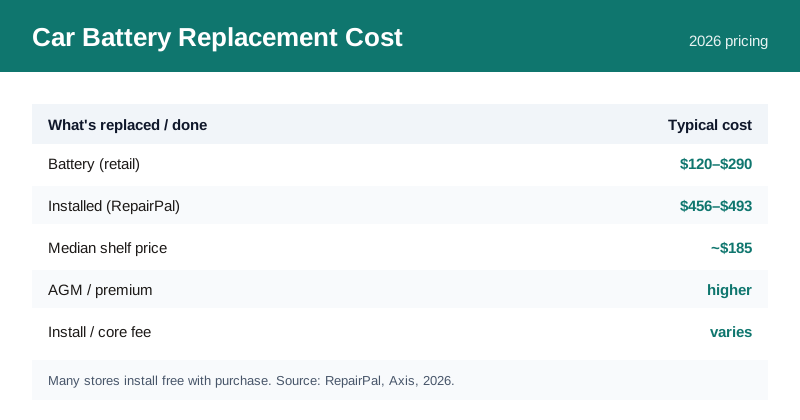
A standard 12-volt car battery costs about $100 to $200 for the part, or $200 to $400 for an AGM battery (required on many newer and stop-start vehicles). Here’s what most people miss: because many auto parts stores, Walmart, and tire chains install a battery free with purchase on accessible cars, a replacement at a retailer often comes to roughly $150 to $300 all-in – essentially just the price of the battery. A full-service shop or dealer charges more for the same job (RepairPal estimates about $456 to $493), and that premium is most likely on an AGM battery, a hard-to-reach battery, or a car that needs the new battery registered. The single biggest cost driver isn’t where you shop – it’s whether your car takes the cheaper standard battery or the pricier AGM, so check the required type first. Two line items catch people off guard: a refundable core charge added at purchase, and, on some modern cars, the need to register the new battery to the computer.
Batteries were one of the most common counter transactions I handled, and the questions were always the same: why is mine more than my neighbor’s, and where should I buy it? Both answers come down to battery type and free installation, not brand loyalty. Let me lay out the real numbers, what drives them, and how not to overpay.
What you’ll actually pay
Here’s the picture by type and purchase channel. These are estimates that vary by vehicle, region, and retailer.
| Option | Cost | Notes |
|---|---|---|
| Standard flooded battery (part) | $100–$200 | Older/simpler cars; median ~$160 |
| AGM battery (part) | $200–$400 | Newer & stop-start vehicles |
| Retailer install | often free | With purchase, accessible battery |
| Parts store / Walmart / tire chain, all-in | ~$150–$300 | Battery plus free install |
| Full-service shop or dealer | higher (~$450+) | RepairPal ~$456–$493; AGM, hard access, registration |
The type is the fork in the road. If your car came with an AGM battery – common on newer vehicles and almost anything with engine stop-start – you generally need to replace it with AGM, which roughly doubles the part cost versus a standard battery. Putting a cheaper standard battery in a car that requires AGM is a false economy that shortens its life or upsets the charging system. Retailers that sell and install (Walmart, parts stores, tire chains) often include free installation, so their all-in total usually beats a dealer. A dead car isn’t always the battery, though; our alternator guide and starter guide cover the other parts of the starting and charging system.
Shop Talk
This is one repair where where you buy matters as much as the battery itself. Most major auto parts chains will test your battery free, sell you one, and install it free in the parking lot on cars where the battery is easy to reach – so for a simple car you can pay just the battery price (around $100 to $200 standard, $200 to $400 AGM) instead of the $450-plus a full-service shop estimate might show. A few things to know going in. One, many newer cars, especially with stop-start, need an AGM battery; don’t put a cheaper standard battery in a car that calls for AGM, because it won’t last. Two, some modern cars (many European makes and stop-start vehicles especially) need the new battery electronically “registered” to the car’s computer so the charging system treats it as new; skip that and the car can undercharge the new battery and shorten its life. A parts store swapping a battery in the lot usually can’t register it – a shop with a scan tool can, sometimes for a small fee, so ask before you pick where to buy. Three, the core charge: you’ll pay a small refundable deposit (often $10 to $30) that comes back when you hand over the old battery – if they install it, the old core is taken on the spot and it washes out; if you buy it to install yourself, keep the receipt and bring the old one back. And the big one: before you buy a battery at all, get it tested free. A battery that’s just discharged (lights left on, short trips) may only need charging, and one that keeps dying may be a bad alternator or a parasitic drain – don’t keep buying batteries to cover for a charging problem.
Where Drivers Overpay
The simplest overpay is paying full shop-install pricing when a parts store or Walmart would sell and install the same battery free with purchase – often the difference between roughly $150 to $300 all-in and $450-plus on an easy-access car. For a simple battery that’s real money left on the table. The reverse mistake is going too cheap: putting a bargain standard battery in a car that requires AGM, which fails early or causes charging problems. Match the type first, then shop for price.
The deeper overpay is buying a battery you didn’t need at all: a discharged battery may just need charging, and a battery that keeps dying may be a bad alternator or a parasitic drain rather than a bad battery. The pattern: get a free test first, replace only if the battery is truly bad, buy the correct type, take the free install when it’s offered, and check the alternator if batteries keep failing. Before you buy, ask two questions – does my car need AGM, and does it need registration – because those answers, not the brand on the box, decide your real cost.
The Real Number
Budget $100 to $200 for a standard battery or $200 to $400 for AGM. Because retailers often install free with purchase, a parts-store or Walmart replacement is commonly about $150 to $300 all-in, while a full-service shop or dealer runs higher (RepairPal estimates $456 to $493). The type your car requires – not where you shop – is the biggest cost driver, so check it first and don’t put a standard battery in an AGM car. Get a free test before buying (a discharged battery may just need a charge, and one that keeps dying may be the alternator), remember the refundable core charge, and ask whether your car needs the new battery registered.
Frequently Asked Questions
How much does a car battery replacement cost?
The battery itself runs about $100 to $200 for a standard flooded type or $200 to $400 for an AGM battery used in newer and stop-start cars. Installation is frequently free when you buy the battery at a store that installs it – Walmart, a parts store, or a tire chain – so a retailer replacement on an accessible car often comes to roughly $150 to $300 all-in, essentially the price of the battery. A full-service shop or dealer charges more for the same job: RepairPal estimates about $456 to $493, with the premium most likely on an AGM battery, a hard-to-reach battery, or a car that needs electronic registration. The biggest variable is whether your car needs a standard or AGM battery. There may also be a refundable core fee and, on some cars, a registration step. These are estimates that vary by vehicle, region, and retailer, and getting the battery tested first makes sure you actually need a new one rather than just a charge.
How do I know if my car needs a standard or AGM battery?
Check your owner’s manual, the label on your current battery, or the vehicle’s specifications – the required type is listed. As a rule of thumb, newer vehicles and almost anything with engine stop-start (auto start-stop at red lights) uses AGM, while many older and simpler cars use standard flooded batteries. AGM (absorbent glass mat) batteries use a more advanced construction that handles the heavy electrical demands and frequent stop-start cycling of newer vehicles better, which is why they cost roughly $200 to $400 versus $100 to $200. The important point: if your car came with or specifies an AGM battery, replace it with AGM, not a cheaper standard battery – a standard battery in a stop-start car won’t handle the demands and will fail prematurely. Getting this right matters because the type is the single biggest cost factor and because the wrong type is a false economy that fails early or disturbs the charging system. When in doubt, a parts store can look up your vehicle and tell you the correct type.
Is installation included, and where is the cheapest place to buy a battery?
For all-in cost, retailers with free installation typically win. Walmart, parts stores, and tire chains such as Pep Boys or Firestone frequently include free installation when you buy the battery there, at least on cars with an accessible battery, and that free install is why buying from a retailer usually beats a dealer’s all-in price. Dealers and full-service shops generally charge more for the same battery and labor. That said, “cheapest” only counts if you buy the correct type – a standard battery in an AGM car costs you more in the long run. So shop the retailers with free install, but match your car’s required battery type first. The exceptions where a shop makes sense are cars where the battery is hard to reach (under a seat, in the trunk, or buried in the engine bay) or that need electronic registration, which a parking-lot install usually can’t handle. Ask about install when you buy, and check your owner’s manual or the old battery’s label for the type.
Does my new car battery need to be registered or programmed?
Many modern cars do, especially European makes and vehicles with engine stop-start. Battery registration tells the car’s computer that a new battery is installed so the charging system manages it correctly; skip it and the car may undercharge the new battery and shorten its life. A parts store swapping a battery in the parking lot usually can’t perform registration, but a shop with a scan tool can, sometimes for a small fee. This is one reason a newer car with stop-start can cost more to do properly than an older car – it’s not just the AGM battery, it’s the registration step. If your car is newer with stop-start, ask whether it needs registration before deciding where to buy the battery, because that answer may point you to a shop rather than a free parking-lot install.
What is a core charge on a battery?
A core charge (or core fee) is a small refundable deposit – often $10 to $30 – added when you buy a battery, there to encourage you to return the old one for recycling. Car batteries contain lead and acid, which are hazardous and recyclable, so retailers charge the fee and refund it when you hand over your old battery, either at purchase (if you bring the old one) or when you return it afterward. If you have the store install the new battery, they take the old core on the spot and the charge washes out automatically. If you buy a battery to install yourself, you pay the core charge upfront and get it back when you bring the old battery in – so keep your receipt and return the core. It’s not a real added cost as long as you return the old battery.
Do I need a new battery, or just a charge or a charging-system repair?
Testing tells you, and it’s usually free. If your battery is simply discharged – from leaving lights on, a door ajar, or lots of short trips that didn’t fully recharge it – it may just need charging and could be fine afterward. If it’s truly worn out (old, won’t hold a charge, or fails a load test), it needs replacing. Most auto parts stores and shops test a battery’s state of charge and health in a few minutes at no cost. But if a battery – especially a new or recently charged one – keeps going dead, the battery often isn’t the real problem: the two most common culprits are a failing alternator that isn’t recharging the battery while you drive, and a parasitic drain (something staying powered on when the car is off, like a stuck relay, a light, or a faulty module). So before buying a battery, have it tested, and if it keeps dying after charging or replacement, get a charging-system test and, if needed, a parasitic draw test rather than buying another battery – see our alternator guide. Diagnosing the real cause saves repeat purchases.
Can I replace a car battery myself?
For many cars, yes – it’s a common DIY: with the car off, disconnect the negative terminal first then the positive, remove the hold-down bracket, lift out the old battery (they’re heavy), set in the new one, reconnect positive first then negative, and secure it. The cautions: batteries are heavy and contain acid, so handle them carefully; clean any corrosion off the terminals; and connect in the right order to avoid sparks. Two modern wrinkles make some cars less DIY-friendly: a battery that’s hard to access (under a seat, in the trunk, or buried in the engine bay), and cars that require the new battery to be electronically registered to the charging system, which needs a scan tool. For an accessible battery on a car that doesn’t need registration, DIY is easy and saves the install – though since many retailers install free with purchase anyway, the savings over a free parts-store install is mostly convenience. For a buried battery or one needing registration, a parts store or shop is simplest.
Sources
Price ranges verified against 2026 car battery retail and installation pricing in November 2026. Dollar amounts are estimates that vary by vehicle, battery type, region, and retailer.
- Jerry – car battery replacement cost
- RepairPal – repair cost estimator
- ASE – National Institute for Automotive Service Excellence
Related Guides
- Alternator Replacement Cost
- Starter Motor Replacement Cost
- How to Tell How Old a Car Battery Is
- What Does the Battery Light Mean?
- Car Repair Cost Estimator

Diane Holcomb spent seven years as a service advisor at multi-brand dealerships in Charlotte, NC, where battery sales – and explaining core charges, AGM pricing, and free install – were a daily part of the counter. She’d tell customers with an easy-access battery to let a parts store install it free rather than pay shop labor, and to get it tested before buying at all. She drives a 2019 Honda CR-V and a hand-me-down 2007 Toyota Camry, and takes no referral fees or advertising money from any shop or chain.