
Last updated: November 8, 2026 – By Diane Holcomb
November 2026 update: reconfirmed starter pricing and the battery-vs-starter test.
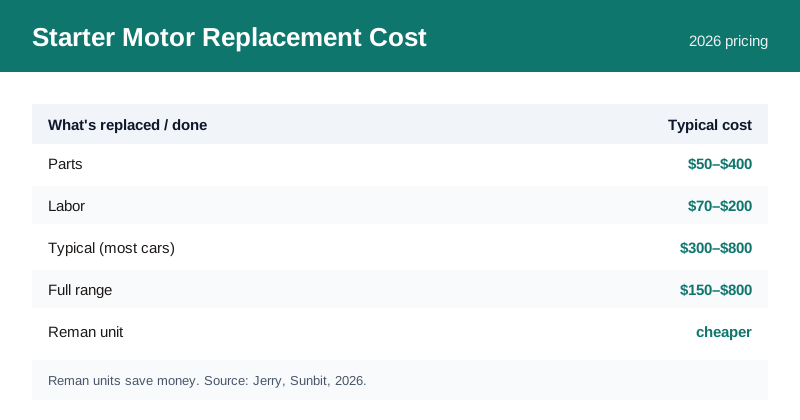
A starter motor replacement runs about $300 to $800 for most cars, with a full range of roughly $150 to $800. Parts are about $50 to $400 and labor $70 to $200 (typically 1 to 3 hours, depending on how buried the starter is). A remanufactured starter is cheaper than new, and luxury vehicles land at the high end. The starter is the electric motor that cranks the engine over so it can start – when you turn the key or press the button, the starter spins the engine until it fires. A failing starter causes a single loud click or rapid clicking, a grinding noise, intermittent no-starts (works sometimes, not others), or nothing at all when you try to start. Here’s the catch: a weak or dead battery causes very similar symptoms, so testing the battery first is what keeps you from replacing a perfectly good starter.
Battery or starter? That’s the question worth answering before you spend a dime. Let me cover the cost and how to tell them apart.
What you’ll actually pay
Here’s the picture. These are estimates that vary by vehicle and shop.
| Item | Cost | Notes |
|---|---|---|
| Parts | $50–$400 | Reman cheaper |
| Labor | $70–$200 | 1–3 hrs |
| Typical (most cars) | $300–$800 | Parts + labor |
| Luxury / hard access | high end | Buried starter |
Since a no-start is often the battery, our car battery guide and alternator guide cover the rest of the starting and charging system.
Shop Talk
Before you (or a shop) replace a starter, rule out the battery – it’s the cheapest, most common cause of the same symptoms, and testing it is free at most parts stores. Here’s a rough field guide. If turning the key gives you a single click and nothing cranks, it can be a dead starter solenoid or a weak battery/corroded connection – check the battery first. If you get rapid clicking (click-click-click), that’s classically a battery that’s too weak to engage the starter, not usually the starter itself. If the dash lights are strong and the engine cranks slowly or not at all with a clunk or grind, the starter is more likely. And if it starts fine sometimes and clicks dead other times (especially when hot), that intermittent behavior is a classic dying starter. The other cheap things to check: clean, tight battery terminals (corrosion causes no-starts that mimic a bad starter) and the battery’s actual charge and health. If the battery tests good, the connections are clean, and you’re still getting a no-crank or grind, then the starter is the suspect. One more: a grinding noise during starting can also mean a worn starter gear or a worn engine flywheel ring gear – worth having confirmed, because the flywheel is a much bigger job than the starter.
Where Drivers Overpay
The number-one overpay is replacing the starter when the battery or a corroded connection was the real problem. Both cause clicking and no-starts, and a battery test is free at most parts stores – so ruling out the battery and terminals first is the cheapest step and the biggest potential save.
The second is buying new when a quality remanufactured starter would do, since reman units are cheaper and common for this part. The pattern: test the battery and clean the terminals first, confirm the starter with the symptoms (slow crank or grind with a strong battery, or intermittent hot no-start), and consider a reman unit before paying for new.
The Real Number
A starter replacement is $300 to $800 for most cars (parts $50 to $400, labor $70 to $200), with a reman unit cheaper than new. But before you pay, rule out the battery – it’s free to test and causes the same clicking and no-starts. Rapid clicking usually means a weak battery; a slow crank or grind with a strong battery points to the starter; an intermittent hot no-start is a classic dying starter. Clean the terminals too.
Frequently Asked Questions
How much does it cost to replace a starter?
About $300 to $800 for most cars, with a full range of roughly $150 to $800. Parts run about $50 to $400 (a remanufactured starter is cheaper than new), and labor $70 to $200, typically 1 to 3 hours depending on how accessible the starter is – some are easy to reach, others are buried under the intake or behind the engine. Luxury vehicles and those with hard-to-reach starters land at the high end. These are estimates that vary by vehicle and shop. Before paying for a starter, it’s worth confirming the battery and connections aren’t the cause, since they produce similar no-start symptoms and are far cheaper to fix.
What does the starter do?
The starter is a powerful electric motor that cranks the engine to get it running. When you turn the key or push the start button, battery power energizes the starter’s solenoid, which engages a small gear (the pinion) with the engine’s flywheel ring gear and spins the engine fast enough for it to start. Once the engine fires and runs on its own, the starter disengages. It only operates for those few seconds of starting, but it draws a lot of current and does hard work each time. Because it depends on strong battery power and good connections to function, a weak battery or corroded cables can make a good starter seem bad – which is why starting problems need the whole starting circuit considered, not just the starter.
How do I know if it’s the starter or the battery?
Some clues help, though testing confirms it. Rapid clicking (click-click-click) when you try to start is classically a battery too weak to engage the starter, not the starter itself. A single click with no crank can be a bad starter solenoid or a weak battery/bad connection. If the dashboard lights and electronics are strong but the engine cranks slowly, grinds, or won’t crank, the starter is more likely. If the car starts fine sometimes and is dead other times – especially when the engine is hot – that intermittent pattern points to a dying starter. Dim lights and a no-crank point toward the battery. The reliable way to tell is to test the battery (free at most parts stores) and check the connections; if the battery’s good and clean, suspect the starter.
Can a bad battery or connection mimic a bad starter?
Absolutely – this is the most common reason people replace a starter that didn’t need replacing. A weak, discharged, or failing battery doesn’t have the power to spin the starter properly, causing clicking or a no-crank that feels exactly like a bad starter. Likewise, corroded, loose, or dirty battery terminals and cables create resistance that starves the starter of current, producing the same symptoms even with a good battery and good starter. That’s why checking the battery’s charge and health and cleaning/tightening the connections comes first. Many a “dead starter” has been fixed with a battery charge, a new battery, or a terminal cleaning. Only after the battery and connections check out should the starter itself be condemned. It’s a free or cheap check that can save the whole starter cost.
Can you drive with a failing starter?
You can keep driving the car once it’s running – the starter only works during starting, not while you drive – but the risk is getting stranded when it won’t start next time. A failing starter often gives warning: intermittent no-starts, clicking, or slow cranking that gets worse. Once it starts acting up, it can fail completely without much notice, potentially leaving you stuck somewhere inconvenient. So while a car with a flaky starter is technically drivable, it’s wise to replace the starter promptly once the symptoms appear, rather than gambling on where it’ll finally quit. If you’re getting intermittent starting, don’t shut the engine off somewhere you can’t get a tow or a jump. Plan the repair before it fully fails.
Should I buy a new or remanufactured starter?
A remanufactured starter is a very common and sensible choice for this part. Starters are routinely rebuilt – a reman unit is a used starter restored with new wear components – and a quality reman from a reputable supplier is cheaper than new and typically carries a warranty, which is why many shops use them. A new (or new OEM) starter costs more and may last longer, which can matter on a vehicle you’re keeping a long time or a model where reman quality varies. For most everyday cars, a good reman starter is a solid value. Ask your shop what they’d recommend for your vehicle and what warranty comes with it. Either way, buying from a reputable source matters more than new-versus-reman for reliability.
Why does a starter grind, and could it be the flywheel?
A grinding noise during starting usually means the starter’s gear isn’t meshing cleanly with the engine’s flywheel ring gear. This can come from a worn starter drive gear, a starter that’s not engaging/disengaging properly, or worn or damaged teeth on the flywheel ring gear itself. The distinction matters a lot for cost: replacing the starter is the moderate repair described here, but if the flywheel (flexplate) ring gear teeth are chewed up, replacing that is a much bigger, more expensive job because it’s between the engine and transmission. So a grinding starter should be diagnosed to see whether it’s the starter gear (replace the starter) or the flywheel (a larger repair). Don’t assume a grind is just the starter until the flywheel teeth are confirmed okay.
Sources
Price ranges verified against 2026 starter motor pricing in November 2026. Dollar amounts are estimates that vary by vehicle and shop.
- Jerry – starter replacement cost
- RepairPal – repair cost estimator
- ASE – National Institute for Automotive Service Excellence
Related Guides
- Car Battery Replacement Cost
- Alternator Replacement Cost
- Ignition Switch Replacement Cost
- Car Diagnostic Testing and Costs
- Car Repair Cost Estimator

Diane Holcomb spent seven years as a service advisor at multi-brand dealerships in Charlotte, NC, where “my starter’s bad” turned out to be a weak battery or corroded terminals often enough that she always had it tested first. She drives a 2019 Honda CR-V and a hand-me-down 2007 Toyota Camry, and takes no referral fees or advertising money from any shop or chain.