
Last updated: November 7, 2026 – By Eddie Brennan
November 2026 update: reconfirmed the reset methods, scanner costs, and the battery-disconnect emissions caution.
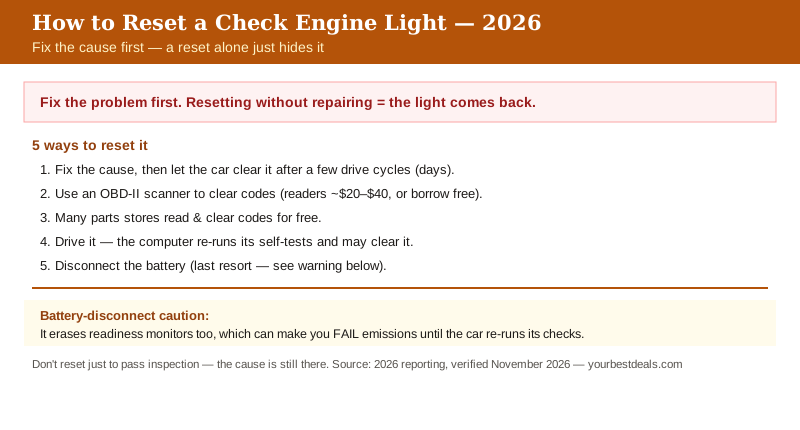
The most important thing about resetting a check engine light is this: fix the underlying problem first. Clearing the light without repairing the cause just turns it off temporarily – it will come back once the car re-detects the fault, and you’ll have accomplished nothing except hiding a warning. Once the actual issue is fixed, there are five ways to clear the light: let the car clear it itself after a few drive cycles, use an OBD-II scanner (readers cost $20 to $40 or borrow one free), have a parts store clear it free, simply drive it while the computer re-runs its checks, or – as a last resort – disconnect the battery. That last method has a real downside for emissions testing. Here are the five ways and when to use each.
People asked me how to “turn off” the light all the time, and my first answer was always the same: why is it on? Resetting a light on an unrepaired car is like unplugging a smoke detector that’s beeping – the problem’s still there. So with the fix-it-first rule firmly in mind, let me walk through the five reset methods.
Fix the cause first – always
This isn’t optional, it’s the whole point. The check engine light is on because the car detected a fault, and the light is just the messenger. If you clear it without fixing what triggered it, the car will run its self-diagnostics again over the next drive cycles and, finding the same problem, turn the light right back on. So the correct sequence is: read the code, diagnose and repair the cause, then clear the light (or let it clear itself). Our check engine light guide covers reading and interpreting codes.
The one exception where a reset alone makes sense is when you’ve already fixed the problem – for example, you tightened a loose gas cap or replaced a sensor – and just want to clear the leftover code so the light goes off promptly rather than waiting for the car to do it. In that case, resetting is fine because the underlying issue is really resolved. But resetting to “make the light go away” on an unrepaired car is pointless and, for an emissions test, counterproductive. With that settled, here are the methods.
The five ways to reset it
1. Fix it and let the car clear the light itself. Once the problem is repaired, most cars turn the light off on their own after several drive cycles – typically a few days of normal driving – as the system re-runs its checks and confirms the fault is gone. This is the hands-off method: fix it, drive it, and the light clears when the car is satisfied.
2. Use an OBD-II scanner or code reader. This is the reliable, deliberate method. Plug a scanner into the OBD-II port (under the dash on the driver’s side), read the codes, and use the “clear codes” function. Basic readers cost $20 to $40, and many parts stores lend them free. This clears the codes and the light immediately after your repair.
3. Have a parts store clear it free. Many auto-parts stores will read and clear codes at no charge as a service, using their scanner. Convenient if you don’t own a reader.
4. Just drive it. Overlaps with #1 – after a genuine fix (or a self-resolving issue like a re-tightened gas cap), normal driving lets the computer re-run its monitors and clear the light on its own.
5. Disconnect the battery (last resort). Disconnecting the negative battery terminal for a short time can clear the codes and light, but it’s the crude method with a catch, covered next.
Shop Talk
Think twice before disconnecting the battery to clear a light, especially if you have an emissions test coming up. Yes, it turns the light off, but it also erases the “readiness monitors” – the self-tests the car has to complete to prove its emissions systems are working. Those reset to “not ready,” and until the car re-runs them all (which can take days of specific driving), an emissions station will fail you for incomplete monitors even with no light on. So you can end up worse off than before. A scanner’s “clear codes” is cleaner because it clears the codes but the monitors re-run normally. And the real point: never reset a light just to sneak through inspection – the underlying problem is still there, the car will detect it again, and you’ve only delayed dealing with it. Fix the cause, then clear.
What Gets Misdiagnosed
The core mistake here isn’t a misdiagnosis so much as a misunderstanding: treating “reset the light” as the fix. Clearing the light does nothing to the underlying problem, so a car reset without repair will simply relight, often within a few drives. People sometimes cycle through resets thinking they’re solving something, when they’re just repeatedly hiding the same fault. The light is a symptom; the code points at the cause; the repair fixes it. Reset only after the repair.
The second is the battery-disconnect trap for inspections. Someone with a check engine light before an emissions test disconnects the battery to clear it, shows up with no light – and fails anyway because the readiness monitors are incomplete, which stations check for exactly this reason. So the shortcut backfires. The right path before an emissions test is to fix the actual fault, clear the code with a scanner, then drive enough to complete the monitors before testing. Understanding that a reset isn’t a repair, and that battery-disconnect erases monitors, keeps you from wasting effort or failing inspection.
The Real Number
Fix the cause before resetting a check engine light – a reset without repair just hides the fault and the light returns. Once repaired, clear it by letting the car do it over a few drive cycles, using an OBD-II scanner ($20 to $40 or borrow free), or having a parts store clear it free. Avoid the battery-disconnect method if you have an emissions test coming up, because it erases the readiness monitors and can make you fail for incomplete monitors even with no light showing. And never reset a light just to pass inspection – the problem is still there and the car will find it again.
Frequently Asked Questions
How do I reset a check engine light?
First fix the underlying problem, then clear the light one of a few ways. The reliable method is an OBD-II scanner: plug it into the port under the dash, read the codes, and use “clear codes” – basic readers cost $20 to $40, or borrow one free at a parts store, which will often also clear it for you at no charge. Alternatively, after a genuine repair, just drive the car and it will usually turn the light off itself over several drive cycles. Disconnecting the battery also works but has downsides for emissions testing. The key is to reset only after fixing the cause, since clearing it on an unrepaired car just makes the light come back.
Will the check engine light come back after I reset it?
If you cleared it without fixing the underlying problem, yes – the car re-runs its diagnostics over the next drive cycles, detects the same fault, and turns the light back on, often within a few days. If you repaired the actual cause before clearing it, then no, it should stay off. So whether the light returns is the test of whether you fixed the real issue. A light that keeps coming back after resets is telling you the problem is still present and needs proper diagnosis and repair, not another reset. Read the code to see what fault is recurring rather than repeatedly clearing the light.
Does disconnecting the battery reset the check engine light?
Yes, disconnecting the negative battery terminal for a short period can clear the stored codes and turn off the check engine light. However, it’s a crude method with a significant downside: it also erases the readiness monitors, the self-tests that prove your emissions systems are functioning. Those reset to “not ready,” and until the car re-runs all of them (which can take days of driving), an emissions station will fail you for incomplete monitors – even with no light on. It can also reset radio presets and other settings. So while it works to clear the light, a scanner is a cleaner choice, and battery disconnect is a poor idea before an emissions test.
How long does it take for the light to reset itself?
After you’ve fixed the underlying problem, most cars will turn the light off on their own after several drive cycles – commonly a few days of normal driving – as the system re-runs its monitors and confirms the fault is gone. A drive cycle involves a mix of driving conditions the car needs to complete its self-checks. So there’s no need to manually clear the light after a repair if you’re willing to wait; it clears itself once satisfied. If you want it off sooner, an OBD-II scanner clears it immediately. If the light hasn’t cleared after a week or so of normal driving following a repair, it’s worth reading the codes to confirm the fault is actually resolved.
Can I reset the check engine light to pass an emissions test?
You shouldn’t, and it usually backfires. If you clear the light without fixing the problem, the car will re-detect the fault and relight – possibly before or during testing. And if you clear it by disconnecting the battery, the readiness monitors reset to “not ready,” and emissions stations fail vehicles with incomplete monitors precisely to catch this trick, so you’ll fail even with no light showing. The only way to really pass is to fix the actual fault, clear the code, and drive enough to complete the monitors before testing. Resetting to sneak through inspection wastes your time and doesn’t address the emissions problem the test exists to catch.
Do I need a special tool to reset the light?
Not necessarily. You can let the car clear the light itself by driving after a repair, or have a parts store clear it free with their scanner. If you want to do it yourself, an inexpensive OBD-II code reader ($20 to $40) plugs into the port under the dash and clears codes with a button, and it also lets you read what the code was – useful for diagnosis. Many parts stores lend readers free too. So while a scanner is the handiest tool, you don’t have to own one. What you should not rely on is the battery-disconnect method, since it erases emissions monitors. For most people, a cheap reader or a free parts-store scan is all they need.
Where is the OBD-II port to plug in a scanner?
On virtually all cars built since 1996, the OBD-II port is a standardized trapezoidal 16-pin connector located under the dashboard on the driver’s side, usually within reach below the steering column – sometimes behind a small cover or panel. You plug the scanner or code reader straight into it with the key in the on position (engine off or running, depending on what the tool needs). Because the port and connector are standardized across makes, one inexpensive reader works on essentially any modern car. If you can’t find it, your owner’s manual shows the exact location, and a quick search of your specific model will pinpoint it. It’s the same port a shop or parts store uses to read your codes.
Sources
Check-engine reset methods and emissions-monitor behavior verified against 2026 diagnostic reporting on November 7, 2026. Procedures vary by vehicle; always fix the underlying cause before clearing the light.
- Telle Tire – OBD-II scanning and check engine light, 2026
- Airtasker – car diagnostic and code-reading, 2026
- The Pricer – car diagnostic test and code reset, 2026
Related Guides
- What does a check engine light mean?
- Check engine light on but car runs fine?
- What is a car diagnostic test?
- Why is my check engine light flashing?

Eddie Brennan spent 11 years as an ASE Master Certified technician at an independent shop in Columbus, OH, where his answer to “how do I turn off the light?” was always “why is it on?” – and where he watched battery-disconnect resets fail emissions tests. His A6 electrical certification covers this directly. He takes no referral fees and drives a 250,000-mile 2015 Subaru Outback and a 2020 Ford F-150.