
Last updated: November 5, 2026 – By Diane Holcomb
November 2026 update: reconfirmed glass pricing, the ADAS calibration add-on, chip-repair cost, and insurance notes.
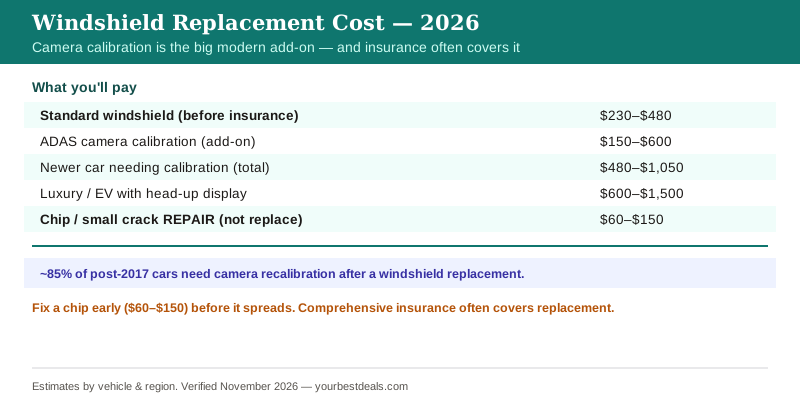
A standard car windshield replacement costs about $230 to $480 before insurance (averaging around $450, ranging $250 to $800). But on modern cars the big add-on is ADAS calibration – recalibrating the forward driver-assist camera mounted at the windshield – which about 85% of vehicles built after 2017 require and which adds $150 to $600. So a newer car that needs calibration totals roughly $480 to $1,050, and luxury or EV glass with a heads-up display can run $600 to $1,500. Two money points worth knowing: a chip or small crack can often be repaired for $60 to $150 instead of replacing the whole windshield, and comp insurance frequently covers replacement (sometimes with no deductible, depending on your state and policy).
Windshields used to be simple glass; now they’re part of your car’s safety-camera system, which is why the cost jumped and calibration matters. Let me cover the price, the calibration factor, when a chip repair beats replacement, and the insurance angle.
What you’ll actually pay
Here’s the price picture. These are estimated ranges that vary by vehicle and region.
| Situation | Cost | Notes |
|---|---|---|
| Standard windshield (before insurance) | $230–$480 | Average around $450 |
| ADAS camera calibration (add-on) | $150–$600 | ~85% of post-2017 cars |
| Newer car needing calibration (total) | $480–$1,050 | Glass + calibration |
| Luxury / EV with head-up display | $600–$1,500 | Specialty glass |
| Chip / small crack repair | $60–$150 | Instead of replacing |
The calibration is the modern cost driver: if your car has lane-keep assist, automatic emergency braking, or adaptive cruise, there’s a camera (and sometimes sensors) at the windshield that must be recalibrated after the glass is replaced so those safety systems aim correctly. Skipping it can leave driver-assist features miscalibrated, which is a safety issue. Our chipped windshield guide covers the repair-versus-replace decision.
Shop Talk
Two things save real money on windshields. First, fix a chip before it becomes a crack. A small chip or crack (generally smaller than a few inches and not in the driver’s direct line of sight) can usually be repaired with resin for $60 to $150 – or often free through insurance – instead of replacing the whole windshield for several hundred to over a thousand dollars. But chips spread, especially with temperature swings and bumps, so the window to repair is short; once it runs into a long crack, you’re into replacement. So handle a chip right away. Second, understand ADAS calibration and don’t let a shop skip it on a car that needs it. If your car has lane-keep, automatic emergency braking, or adaptive cruise, the camera at the windshield must be recalibrated after new glass, or those safety systems can aim wrong – a genuine safety problem, and sometimes a dashboard warning. A cheap quote that leaves out calibration isn’t really cheaper if your car needs it. On the insurance side: windshield damage is typically a comp claim, and some states (like Florida, Kentucky, South Carolina) require insurers to waive the deductible for windshield replacement, so check whether yours is covered before paying out of pocket. And use a reputable installer – a poorly installed windshield can leak or, in a crash, compromise the airbag and roof support it’s bonded to help with.
Where Drivers Overpay
The clearest overpay is replacing a windshield when a chip could have been repaired – a $60-to-$150 resin repair (often free through insurance) versus a several-hundred-dollar-plus replacement. Catch chips early before they spread. The second is paying out of pocket when comp insurance would have covered it, sometimes with the deductible waived in certain states – check your policy before assuming you owe the full amount.
The flip side is a too-cheap quote that omits required calibration. If your car has driver-assist features, the camera recalibration ($150 to $600) is a necessary part of the job, and a quote that skips it isn’t truly cheaper – it leaves safety systems potentially mis-aimed. Also, going with a bargain installer who does sloppy work risks leaks or compromised crash safety, since the windshield is bonded in to support the airbag and roof. The pattern: repair chips early, use insurance when it applies, include required calibration, and pick a reputable installer rather than the rock-bottom price.
The Real Number
A standard windshield is $230 to $480, but with ADAS camera calibration (needed on ~85% of post-2017 cars) the total runs $480 to $1,050, and luxury/EV glass up to $1,500. Repair a chip early for $60 to $150 instead of replacing. Check comp insurance – it often covers replacement, sometimes with no deductible. Don’t accept a quote that skips required calibration, and use a reputable installer, since the windshield supports crash safety.
Frequently Asked Questions
How much does it cost to replace a windshield?
A standard windshield runs about $230 to $480 before insurance (averaging around $450, up to $800). On modern cars, ADAS camera calibration adds $150 to $600, bringing a newer car that needs it to roughly $480 to $1,050. Luxury or EV glass with a heads-up display can run $600 to $1,500. A chip or small crack can often be repaired for $60 to $150 instead of a full replacement. These are estimates that vary by vehicle. The biggest modern cost driver is whether your car’s forward camera needs recalibration after the glass is replaced.
What is ADAS calibration and why does it add so much?
ADAS (advanced driver-assistance systems) calibration recalibrates the forward-facing camera (and sometimes sensors) mounted at the windshield that run features like lane-keep assist, automatic emergency braking, and adaptive cruise control. When the windshield is replaced, that camera’s position shifts slightly, so it must be recalibrated to aim correctly – otherwise those safety systems can misjudge distances and lane position. About 85% of vehicles built after 2017 require it, and it adds $150 to $600. It’s not an upsell; skipping it on a car that needs it leaves safety features potentially mis-aimed, which is a genuine hazard.
Should I repair or replace a chipped windshield?
Repair if you can – a small chip or crack (generally under a few inches and not in the driver’s direct sightline) can usually be filled with resin for $60 to $150, often free through insurance, versus replacing the whole windshield for far more. The catch is timing: chips spread with temperature changes and road bumps, so the window to repair is short, and once a chip runs into a long crack, you’re into replacement. So handle a chip immediately. Replacement is needed for large cracks, damage in the driver’s line of sight, or multiple chips. Our chipped windshield guide covers the decision.
Does insurance cover windshield replacement?
Often, yes, under comp coverage – the non-collision part of your auto policy (often labeled \”comp\”), not liability. Windshield damage is typically a comp claim, and some states – such as Florida, Kentucky, and South Carolina – require insurers to waive the deductible for windshield replacement, meaning no out-of-pocket cost. Elsewhere, you’d pay up to your comp deductible. Many insurers also cover chip repairs free because it’s cheaper than a later replacement. So before paying out of pocket, check your comp coverage and deductible, and whether your state waives it for glass. A glass shop can often bill your insurer directly.
Why is a windshield important for safety beyond visibility?
Because it’s a structural safety component, not just glass. The windshield is bonded into the body and helps support the roof in a rollover and provides a backstop for the passenger airbag to deploy against. That’s why proper installation matters – a poorly bonded or cheaply installed windshield can leak, come loose, or fail to do its crash-safety job. It’s also why the driver-assist camera mounted to it must be recalibrated after replacement. So don’t treat windshield work as trivial glass replacement; use a reputable installer and include required calibration for the safety systems to work correctly.
Can I drive with a cracked windshield?
It depends on the crack. A small chip or short crack outside the driver’s direct line of sight is usually drivable short-term, but you should repair it quickly before it spreads. A large crack, one in the driver’s sightline, or one that’s spreading is a safety and often a legal issue – it impairs visibility and weakens the glass, and many states can ticket you for it. A crack across the camera’s view can also disrupt driver-assist systems. So a minor chip is okay to drive on briefly while you arrange a repair, but a big or spreading crack should be addressed promptly.
Is aftermarket windshield glass as good as OEM?
Quality aftermarket glass is often fine and cheaper than OEM (dealer) glass, and many reputable installers use it successfully. The things that matter most are that the glass meets safety standards, fits properly, correctly accommodates any camera or sensor bracket, and is installed well so it bonds and seals correctly. For cars with a windshield camera or heads-up display, make sure the glass is the correct type for those features. So aftermarket can be a good value, but prioritize a reputable installer and the correct glass for your car’s features over simply the lowest price.
Sources
Price ranges verified against 2026 auto-glass pricing in November 2026. Dollar amounts are estimates that vary by vehicle, features, and region.
- Glass & Auto – windshield replacement cost
- Safelite – auto glass and calibration
- IIHS – advanced driver assistance systems
Related Guides
- What to Do With a Chipped Windshield
- Side Mirror Replacement Cost
- Car Insurance & Finance Guide
- Body & Paint Guide
- Car Repair Cost Estimator

Diane Holcomb spent seven years as a service advisor at multi-brand dealerships in Charlotte, NC, where she learned to send customers to fix a chip (often free through insurance) before it became a windshield. She drives a 2019 Honda CR-V and a hand-me-down 2007 Toyota Camry, and takes no referral fees or advertising money from any shop or chain.