
Last updated: November 7, 2026 – By Diane Holcomb
November 2026 update: refreshed the panel, economy, standard, and showroom ranges against current US reporting.
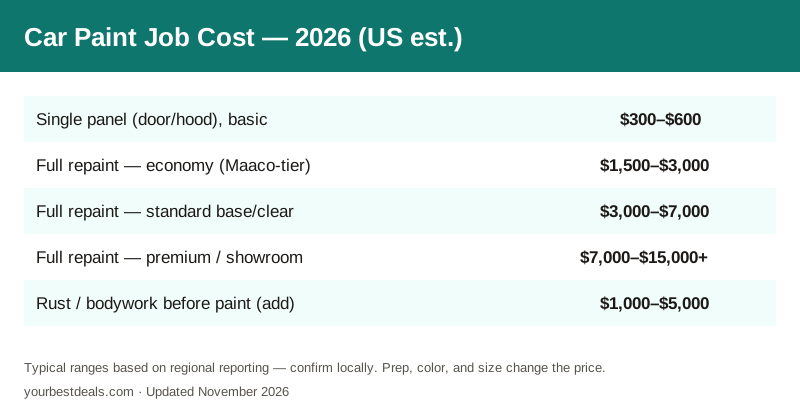
A car paint job can cost anywhere from a few hundred dollars for a single panel to well over ten thousand for a showroom-quality full repaint, because “paint job” covers a huge range of scope and quality. As broad US ranges: a single panel (a door or hood) runs about $300–$600 at the basic end; a full economy repaint (the Maaco-tier, single-stage, minimal prep) about $1,500–$3,000; a standard basecoat/clearcoat full repaint about $3,000–$7,000; and a premium or showroom job (extensive prep, disassembly, multiple coats) $7,000–$15,000+. Rust or bodywork before paint adds roughly $1,000–$5,000. These are typical ranges based on regional reporting – confirm locally, because prep quality and color drive the real number.
Paint was the service where the quote and the customer’s expectation were furthest apart. Someone would ask why one shop said $1,800 and another said $6,000 for “the same car,” and the honest answer was that they weren’t quoting the same job at all – the prep, the number of coats, and whether they pulled trim and masked properly were completely different.
Straight From the Invoice: What Paint Jobs Actually Cost
I pulled these from repair orders and body-shop estimates I either wrote up or reviewed over the years.
Invoice #1 – 2016 Honda Accord, single door respray, independent body shop, NC
Owner expected “a couple hundred.” Final: $520 for a single door panel, color-matched and blended into the adjacent fender so it didn’t look like a patch. The blending into the next panel is what made it look right – and what added to the price over a flat single-panel spray.
Invoice #2 – 2009 Toyota Camry, economy full repaint, chain paint shop, NC
Quoted $1,900, landed at $2,350 after they found the original quote assumed no prep and the car needed sanding and two small rust spots addressed. Still an economy single-stage job – fine for an older daily driver, not a show finish. The lesson: the cheap quote usually assumes the least prep.
Invoice #3 – 2018 Ford Mustang, quality base/clear full repaint, specialist shop, NC
Estimate held almost exactly: $6,200 against a $6,000 quote. They pulled trim and some glass, blocked and primed, and shot proper basecoat/clearcoat. This is where the money goes on a quality job – the prep and disassembly, not the paint itself. A matched expectation and a matched bill.
Car Paint Job Cost by Scope (2026, US estimates)
| Scope / quality | Typical range |
|---|---|
| Single panel (door/hood), basic | $300–$600 |
| Single panel, mid-range blended | $500–$1,000 |
| Full repaint – economy (single-stage) | $1,500–$3,000 |
| Full repaint – standard base/clear | $3,000–$7,000 |
| Full repaint – premium / showroom | $7,000–$15,000+ |
| Rust / bodywork before paint (add) | $1,000–$5,000 |
Typical ranges based on regional reporting – confirm locally. Metallic, pearl, and custom colors add cost.
Why Your Quote Looks Different
Paint quotes vary more than almost any other service, and it’s rarely about the paint. The biggest driver is prep and disassembly: a cheap quote often means spraying over the existing finish with minimal sanding and masking (taping around trim rather than removing it), while a quality job means sanding, priming, pulling trim and some glass, and multiple coats – far more labor. Color and paint type matter (metallic, pearl, and three-stage colors cost more and are harder to match). Body condition is huge – rust, dents, and bad prior repairs must be fixed first, and that’s bodywork, not paint. Vehicle size (a truck or SUV uses more material than a compact), and shop tier (a production chain vs a specialist) round it out. Two “full repaint” quotes can describe completely different jobs.
Shop Talk
When you compare paint quotes, don’t compare the price – compare the prep, because that’s where the difference lives. Ask each shop three things: Are you removing the trim and badges or masking around them? How much sanding and priming is included? And how many coats of color and clear? A $1,800 quote that masks around everything and sprays one stage over light sanding is a legitimate economy job, but it is not the same product as a $6,000 quote that pulls trim, blocks the body, and shoots proper base and clear – so putting them side by side as if they’re interchangeable is how people feel “ripped off” by the higher one when it’s actually the more honest quote. Also watch for the low quote that balloons: if a shop quotes cheap without seeing rust or prior damage, the number climbs once the car’s apart. For an older daily driver you just want to look decent, the economy tier is perfectly reasonable – don’t overpay for showroom prep on a car that doesn’t need it. For a newer or nicer car, or one you’ll keep and care about, the prep-heavy quality job is worth it and holds up far longer. Match the tier to the car and your goal, and judge quotes on scope, not just the bottom line.
Where Drivers Overpay
The overpay on paint goes both directions. Some people pay showroom-tier money for a car that only needed an economy respray to look presentable – a 12-year-old commuter doesn’t need a $7,000 blocked-and-cleared finish. Others “save” by taking the cheapest quote on a car they care about, get a thin single-stage job with poor prep, and watch it fade, peel, or show every flaw within a couple of years – then pay again to redo it.
The other trap is treating a single-panel repair as a whole-car problem (or vice versa). A scratch or one damaged panel is often a few hundred dollars blended in; you don’t need to repaint the car. Conversely, spot-painting a car that really needs a full respray leaves mismatched panels. Match the scope to the actual need, and judge quotes on prep, not price.
The Real Number
Budget about $300–$600 for a basic single panel, $1,500–$3,000 for an economy full repaint, $3,000–$7,000 for a quality base/clear job, and $7,000–$15,000+ for showroom work – with rust/bodywork adding $1,000–$5,000. The number is driven by prep and disassembly, not the paint, so compare quotes on scope (trim removal, sanding, coats), not the bottom line. Match the tier to the car: economy for an older daily driver, quality prep for one you’ll keep. Ranges are regional estimates – confirm locally.
Frequently Asked Questions
How much does it cost to paint a whole car?
Painting a whole car typically costs anywhere from about $1,500 for an economy, single-stage repaint to $7,000 or more for a quality basecoat/clearcoat job, and $7,000–$15,000+ for premium or showroom work, because the price depends almost entirely on the prep and quality tier rather than the paint itself. At the economy end (think production paint chains), roughly $1,500–$3,000 gets you a full repaint with minimal disassembly and prep, often a single-stage paint – perfectly reasonable for an older daily driver you just want to look decent, but not a show finish and not as durable. The standard tier, around $3,000–$7,000, includes more thorough prep, trim removal, and proper basecoat/clearcoat that looks good and lasts. Premium and showroom jobs, $7,000–$15,000+, involve extensive prep, significant disassembly, multiple coats, and meticulous finishing. On top of the tier, your car’s size (trucks and SUVs cost more), its body condition (rust and dents add bodywork cost before paint), and your color choice (metallic, pearl, custom) all move the number. Because the ranges are so wide and depend on what you actually want and need, the practical step is to get itemized quotes that specify the prep and coats, and match the tier to your car and goal. For related body work, see our scratch repair guide. Confirm pricing locally, as it varies by region and shop.
Why are car paint quotes so different from shop to shop?
Car paint quotes vary dramatically between shops because “a paint job” can mean wildly different amounts of prep, disassembly, paint quality, and finishing – so two shops quoting the same car may be describing completely different jobs, which is the single most important thing to understand before comparing prices. A low quote often assumes spraying over the existing finish with light sanding and masking around the trim and badges (taping rather than removing them), a single stage of paint, and minimal bodywork. A high quote typically includes sanding the car down, priming, removing trim and sometimes glass so paint doesn’t bridge onto them, applying proper basecoat and clearcoat in multiple coats, and careful finishing – far more labor and materials. On top of that, shops differ in tier (a high-volume production chain versus a specialist body shop), in the paint products they use (economy versus premium, and simple colors versus metallics or pearls that cost more and are harder to match), and in how they handle rust and prior damage. So when one shop says $1,800 and another says $6,000, they’re usually not quoting the same product. The right way to compare is to ask each shop specifically what prep, disassembly, and how many coats are included, then judge the quotes on scope rather than the bottom-line number. A cheap quote isn’t necessarily a rip-off, and an expensive one isn’t necessarily padding – they’re often just different jobs. For paint repair context, see our scratch repair guide.
How much does it cost to paint just one panel?
Painting a single panel – one door, a fender, or a hood – typically costs about $300–$600 at the basic end and $500–$1,000 for a mid-range job that blends the paint into the adjacent panels for a seamless match, making it a far cheaper fix than repainting the whole car when only one area is damaged. The basic single-panel price covers preparing and spraying that one panel in your car’s color. The higher, blended price accounts for the extra skill and material needed to feather the new paint into the neighboring panels so there’s no visible line where the repair ends – important because modern paints (especially metallics and pearls) are hard to match exactly, and a flat single-panel spray can leave a subtle mismatch that blending avoids. Which you need depends on the panel, the color, and how visible a slight mismatch would be; a solid color on a less conspicuous panel may be fine with a straight respray, while a metallic on a door right next to the fender usually benefits from blending. The key point is that for a scratch, a dent repair, or damage confined to one panel, you don’t need to repaint the car – single-panel work is the appropriate, economical scope. Trying to spot-fix a car that really needs a full respray, on the other hand, leaves mismatched panels. So match the scope to the damage. For scratch-specific pricing, see our scratch repair guide. Confirm locally, as color and panel vary the price.
Is a cheap Maaco-style paint job worth it?
An economy, production-shop paint job (the Maaco-style tier, roughly $1,500–$3,000 for a full car) can absolutely be worth it for the right situation – namely an older daily driver you simply want to look presentable again – but it’s not the right choice for a car you want to look showroom-quality or keep looking good for many years, because the lower price reflects less prep, often single-stage paint, and minimal disassembly. The value proposition of an economy repaint is honest: for a reasonable price, a faded or patchy older car gets a uniform, decent-looking finish that’s fine from a normal viewing distance, which is exactly what many people want for a commuter or a car they won’t keep forever. The trade-offs are also real: because these jobs typically mask around trim rather than removing it (so you may see paint edges or overspray near moldings), use fewer coats, and do less surface prep, the finish won’t be as flawless up close and won’t last as long as a quality basecoat/clearcoat job, and it may show flaws the prep didn’t address. So the answer depends on your goal and the car. If you’re refreshing a tired older vehicle on a budget and want it to look good enough, an economy job is a sensible, cost-effective choice and not a “rip-off.” If you have a newer or nicer car, or you want a durable, close-up-perfect finish, paying for the quality tier’s prep and paint is the better money. Match the tier to the car. For body work context, see our scratch repair guide.
Does rust or bodywork increase the paint cost?
Yes – rust, dents, and prior damage significantly increase the total cost of a paint job, because they must be repaired before painting, and that bodywork is separate (and often more expensive) than the paint itself, potentially adding roughly $1,000–$5,000 depending on severity. Paint only looks as good as what’s underneath it, so a reputable shop won’t simply spray over rust or dents – doing so would let the rust continue to spread under the new paint and leave dents visible. Surface rust may just need sanding and treating, which is relatively minor, but structural rust where metal has corroded through requires cutting out the bad metal and welding in new, which is labor-intensive and costly. Dents need to be pulled or filled and smoothed, and poor prior repairs may need to be redone. This is a major reason cheap quotes balloon: a shop that quotes a low price without inspecting for rust and damage will revise the number upward once the car is being prepped and the problems surface. It’s also why a car with significant rust or body damage can cost far more to paint properly than a clean car of the same size – you’re paying for the body repair plus the paint. If you’re getting quotes, have the shop inspect for rust and damage up front so the estimate reflects the real scope, and understand that addressing rust properly, while it adds cost, is what makes the paint job last rather than bubble and fail within a year or two. For related repair, see our scratch repair guide.
How long does a car paint job take?
A car paint job typically takes anywhere from a day or two for a single-panel repair or an economy full repaint up to one or two weeks (or more) for a quality or showroom job, because the time, like the cost, is driven mainly by the prep, disassembly, and number of coats rather than the spraying itself. A single panel can often be done in a day or two, since it’s a limited area. An economy full repaint at a production shop may be completed in a few days because the prep and disassembly are minimal. A quality basecoat/clearcoat repaint takes considerably longer – several days to a couple of weeks – because the car must be sanded, primed, trim and sometimes glass removed, multiple coats applied with proper drying/curing time between them, and then reassembled and finished. Showroom-level work can take longer still if there’s extensive bodywork, custom color, or meticulous finishing involved. Bodywork for rust or dents adds time on top of the painting itself. The spraying is actually a small fraction of the timeline; most of the duration is prep, cure time, and reassembly. So when a shop quotes a timeframe, a longer estimate often reflects a more thorough job rather than a slower shop. If you need the car back quickly, ask the shop realistically how long the tier of work you’re choosing will take, and don’t be surprised that a quality job keeps the car for a week or more – rushing paint and cure time tends to compromise the result. Plan for alternate transportation accordingly. For scope context, see the ranges above.
Can I just touch up or wrap my car instead of painting?
Yes – depending on your goal, touch-up paint or a vinyl wrap can be alternatives to a full paint job, each suited to different situations: touch-up is for small chips and scratches, while a wrap is a way to change the car’s color or protect the paint without repainting, though neither is a true substitute for a repaint when the existing paint is failing. Touch-up paint (a small bottle or pen matched to your color code) is for minor chips and scratches and is an inexpensive DIY fix that keeps small damage from rusting and looks acceptable at a distance, but it won’t match perfectly up close and isn’t meant for large areas – it’s maintenance, not a paint job. A vinyl wrap is a large adhesive film applied over the existing paint; it can change the car’s color or finish (matte, gloss, custom), is removable, and protects the underlying paint, and its cost is often comparable to a mid-range paint job. A wrap requires the existing paint to be in decent condition (it adheres to and shows the surface underneath, and won’t fix peeling or rust), so it’s a color-change or protection choice, not a repair for failing paint. So if you have minor chips, touch-up paint is the cheap, sensible route; if you want a different color or to protect good paint, a wrap is worth considering; but if your paint is faded, peeling, oxidized, or the body has been repaired, a proper repaint is what actually addresses that. Match the solution to the problem. For small damage, see our scratch repair guide.
Sources
Paint-job cost ranges reflect US regional reporting reviewed in November 2026. Figures are estimates; get itemized local quotes that specify prep and coats.
- J.D. Power – car ownership and repair guides
- Kelley Blue Book – car advice and ownership costs
- Cars.com – maintenance and repair resources
Related Guides
- Car Scratch Repair Cost
- Car Window Replacement Cost
- Quarter Panel Replacement Cost
- Car Headliner Repair Cost
- Service Cost Estimator

Diane Holcomb spent seven years as a service advisor at multi-brand dealerships in Charlotte, NC, writing up estimates and translating them for customers, before moving into writing about real-world service costs in 2023. Paint was the service where the quote and the customer’s expectation were furthest apart, which taught her to explain scope, not just price. She drives a 2019 Honda CR-V EX-L and a 2007 Toyota Camry, and takes no referral fees or advertising money from any shop or chain.