
Last updated: November 10, 2026 – By Eddie Brennan
November 2026 update: reconfirmed the noise-to-cause matches and the cost ranges for each.
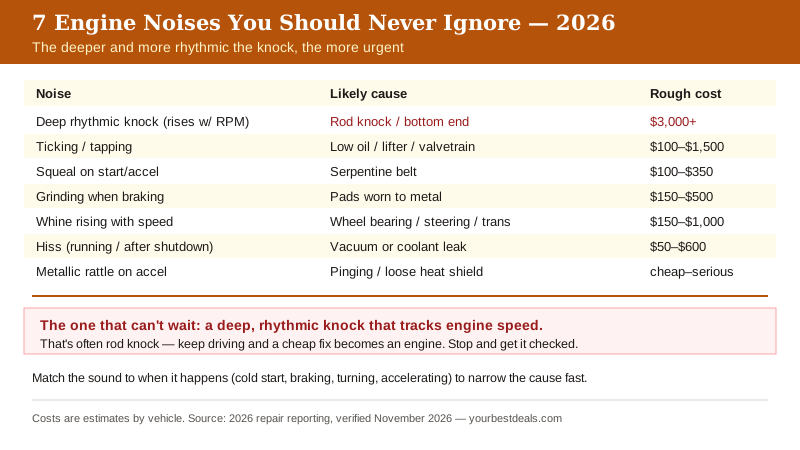
Not every engine noise is an emergency, but a few are, and the trick is knowing which is which. The single most important one: a deep, rhythmic knock that speeds up with the engine – that’s often rod knock (bottom-end bearing wear), one of the few noises where continuing to drive can turn a repair into a full engine replacement ($3,000 or more). The rest sort out by character: a ticking or tapping points at oil or the valvetrain ($100 to $1,500), a squeal is usually the serpentine belt ($100 to $350), a grind when braking is pads worn to metal ($150 to $500), a whine that rises with speed is a bearing or the drivetrain ($150 to $1,000), a hiss is a vacuum or coolant leak ($50 to $600), and a metallic rattle on acceleration is pinging or a loose heat shield. The pattern to remember is simple: the deeper and more rhythmic the knock, the more urgent it is.
I spent eleven years listening to engines, and the useful skill wasn’t naming the exact part from the driveway – it was knowing which sounds meant “finish your errand and book a visit” versus “shut it off now.” Let me walk through the seven, roughly in order of how loud the alarm bell should be, so you can place your noise and know how fast to move.
1. Deep rhythmic knock – stop driving
This is the one you never ignore. A deep, heavy knock – often described as a hammer tapping from low in the engine – that keeps time with engine speed and gets faster as you rev is the classic sign of rod knock or worn main/rod bearings. It usually means the bottom end of the engine is failing, and every mile you drive risks the rod letting go and destroying the block. This is a “pull over, shut it off, and have it towed” noise, not a “drive it to the shop” one. The repair is a major engine job or replacement, commonly $3,000 and up, which is exactly why catching it early (before the knock, when oil pressure or a lighter tick first shows up) matters so much.
2. Ticking or tapping – check oil first
A lighter ticking or tapping that changes with RPM is most often a valvetrain or lifter noise, and the very first thing to check is your oil. Low oil is a common, cheap cause – a hydraulic lifter starved of oil ticks until the level is corrected, and topping up or an oil change ($40 to $150) can silence it. If the oil is full and it still ticks, it can be a worn lifter, a lash issue, or valvetrain wear ($300 to $1,500). A tick isn’t as instantly dire as a bottom-end knock, but don’t sit on it – low oil left long enough leads to the serious knock in #1. Check the dipstick, and see our low oil pressure guide if the light is on too.
3. Squeal on startup or acceleration – the belt
A high squeal or chirp on cold startup or when you accelerate is almost always the serpentine (drive) belt slipping, or a pulley/tensioner. A glazed, worn, or loose belt slips on the pulleys and squeals, and replacing it runs about $100 to $350. It’s not an engine-destroyer, but a belt that snaps takes out your charging, power steering, and often cooling all at once, so a squealing belt is a soon-not-someday fix. Our serpentine belt cost guide has the details.
4. Grinding when braking – pads to metal
A harsh metallic grind when you press the brake means the pads are worn past their material and metal is on metal – the backing plate grinding the rotor. That’s both a safety issue and a rising cost: caught at a squeal it’s a pad job, but once it grinds you’re often into rotors too ($150 to $500 per axle, more if calipers are damaged). Don’t drive on grinding brakes. See our brakes guide for what worn brakes cost by stage.
5. Whine that rises with speed – bearing or drivetrain
A whine or hum that gets louder with vehicle speed (not engine RPM) commonly points at a failing wheel bearing – often changing pitch as you turn left vs. right. A whine that tracks engine RPM instead can be the power-steering pump or, on some cars, the transmission. Costs range widely, roughly $150 to $1,000 depending on which it is. A wheel bearing that’s caught early is a contained repair; ignored, it can seize. Match the whine to speed vs. RPM and to turning to narrow it down.
6. Hiss while running or after shutdown – a leak
A hiss suggests something is escaping under pressure: a vacuum leak (rough idle alongside the hiss) or a coolant leak (sweet smell, hiss after shutdown as the system’s still pressurized). Vacuum leaks run about $50 to $600 to trace and fix; a coolant leak’s cost depends on the source. Neither is usually a stop-now noise, but a coolant hiss that’s letting the engine run hot is – watch your temperature gauge. Our coolant guide covers overheating.
7. Metallic rattle on acceleration – ping or heat shield
A metallic rattle or “marbles in a can” under acceleration is often either pinging/knocking from the combustion side (wrong octane, carbon, or timing) or, very commonly and much cheaper, a loose exhaust heat shield vibrating. The heat-shield rattle is annoying but harmless and cheap to clamp; true pinging under load shouldn’t be ignored because sustained detonation damages pistons. If it rattles only on hard acceleration and you’ve been running low-octane fuel, try the correct octane first.
Shop Talk
The most useful thing you can do before any shop visit is note exactly when the noise happens, because that narrows the cause faster than any guess about the part. Cold start only? Belt or lifter. Only when braking? Brakes. Only when turning? Wheel bearing or a CV joint. Rises with vehicle speed vs. engine RPM? That one distinction separates a wheel bearing from a belt or pump. Worse under acceleration/load? Think pinging or a mount. And the safety filter on top of all of it: a deep, rhythmic knock that tracks engine speed is the one you stop for – everything else you can usually drive gently to a shop. A ten-second voice memo of the noise on your phone, plus “it does this when I do that,” saves you a diagnostic hour and keeps a shop from fishing.
What Gets Misdiagnosed
The costliest miss is treating a bottom-end knock like a minor tick and driving on it. Because a fresh rod knock can start relatively quiet, people assume it’s a lifter and keep going – until the rod fails and a $2,000 repair becomes a $5,000 engine. The rule that protects you: if a knock is deep, rhythmic, and speeds up with RPM, treat it as bottom-end and stop, even if it seems livable. Better to tow a car that turned out to have a cheap tick than to grenade an engine that was truly knocking.
The opposite miss is panic-spending on a harmless rattle. A loose heat shield sounds alarming – a tinny rattle at certain RPM – and people brace for a big engine bill when a shop can often clamp or replace the shield cheaply. Same with a belt squeal that gets misread as an internal engine noise. The fix for both directions is the same: match the sound to when it happens and to speed-vs-RPM before assuming the worst or the best. Get it listened to; a tech can usually place these in a few minutes.
The Real Number
Of the seven, one is a stop-now emergency: a deep, rhythmic knock that rises with RPM (rod knock, $3,000-plus or a replacement). The rest – tick ($100 to $1,500), squeal ($100 to $350), brake grind ($150 to $500), whine ($150 to $1,000), hiss ($50 to $600), and rattle (cheap to serious) – you can usually drive gently to a shop, soon. Note when the noise happens and whether it tracks speed or RPM, and don’t ever ride out a deep steady knock hoping it’s “just a lifter.”
Frequently Asked Questions
What engine noise means I should stop driving immediately?
A deep, rhythmic knocking that keeps time with engine speed and gets faster as you rev. That’s the signature of rod knock or worn bottom-end bearings, and driving on it risks a rod failure that destroys the engine – turning a repair into a replacement of $3,000 or more. If you hear a heavy, steady knock from low in the engine, pull over, shut it off, and have it towed rather than driving to the shop. Most other noises let you drive gently to get it checked, but not this one.
Why is my engine ticking?
The most common cause is oil-related – low oil or overdue oil starves the hydraulic lifters and they tick until the level is corrected, so check your dipstick first; an oil change runs about $40 to $150. If the oil is full and it still ticks, it can be a worn lifter or valvetrain wear ($300 to $1,500). A tick isn’t as urgent as a deep knock, but don’t ignore it, since low oil left too long leads to the serious bottom-end knock. See our low oil pressure guide.
What is a squealing noise when I start the car?
A squeal or chirp on startup or acceleration is almost always the serpentine belt slipping, or its tensioner/pulley. A worn, glazed, or loose belt slips on the pulleys and squeals, especially when cold or under load, and replacing it costs about $100 to $350. It’s not an engine-destroyer by itself, but a belt that snaps kills your charging, power steering, and often cooling at once, so treat a squeal as a soon fix. Our serpentine belt guide has costs.
Why does my car whine when I accelerate or drive faster?
A whine that rises with vehicle speed is often a failing wheel bearing – it may change pitch as you steer left versus right. A whine that tracks engine RPM instead can be the power-steering pump or, on some cars, the transmission. Costs run roughly $150 to $1,000 depending on which. The key clue is whether it follows speed or RPM, and whether turning changes it, which separates a wheel bearing from a pump or belt. A caught-early bearing is a contained repair; ignored, it can seize.
Is a rattling noise from my engine serious?
It depends on the source. A very common and cheap cause is a loose exhaust heat shield vibrating – a tinny rattle at certain RPM that’s harmless and inexpensive to clamp. But a metallic rattle under hard acceleration can be pinging/detonation from wrong-octane fuel, carbon, or timing, and sustained detonation damages pistons. If it rattles only on acceleration and you’ve run low-octane gas, try the correct octane first; if it persists or sounds deep, get it checked. Match when it happens before assuming.
What does a hissing noise under the hood mean?
A hiss usually means something escaping under pressure. With a rough idle, it’s often a vacuum leak (about $50 to $600 to trace and fix). With a sweet smell or a hiss after you shut the engine off, it’s likely a coolant leak in a still-pressurized system. Neither is automatically stop-now, but a coolant leak that lets the engine overheat is – watch the temperature gauge and don’t keep driving a hot engine. Our coolant guide covers overheating.
Can I diagnose an engine noise myself?
You can narrow it down a lot, and that saves diagnostic time. Note exactly when the noise happens: cold start (belt/lifter), braking (brakes), turning (wheel bearing/CV joint), or acceleration (mount/pinging). Note whether it rises with vehicle speed or with engine RPM. Record a short phone clip. That information plus a tech’s ear usually places the noise in minutes. The one thing not to DIY is deciding a deep, rhythmic knock is “probably fine” – that specific sound is the one to stop for and have checked.
Sources
Noise-to-cause matches reflect standard diagnostic practice; cost ranges verified against 2026 repair pricing in November 2026. Dollar amounts are estimates that vary by vehicle and region.
- ASE – National Institute for Automotive Service Excellence
- AAA – auto repair resources
- NHTSA – vehicle safety
Related Guides
- 6 Reasons Your Engine Is Knocking
- Why Your Car Vibrates at Idle
- What Does the Low Oil Pressure Light Mean?
- Brakes Guide
- Serpentine Belt Replacement Cost

Eddie Brennan is an ASE Master Certified technician (A1 Engine Repair, A4, A5, A6) who spent 11 years diagnosing engine, brake, and driveline noises at an independent shop in Columbus, OH before a back injury moved him into writing full-time. He drives a 2015 Subaru Outback with over 250,000 miles and a 2020 Ford F-150, and takes no referral fees or advertising money from any shop or chain.