
Last updated: November 10, 2026 – By Eddie Brennan
November 2026 update: reconfirmed the symptom list, the low cost, and the engine-vs-cabin filter distinction.
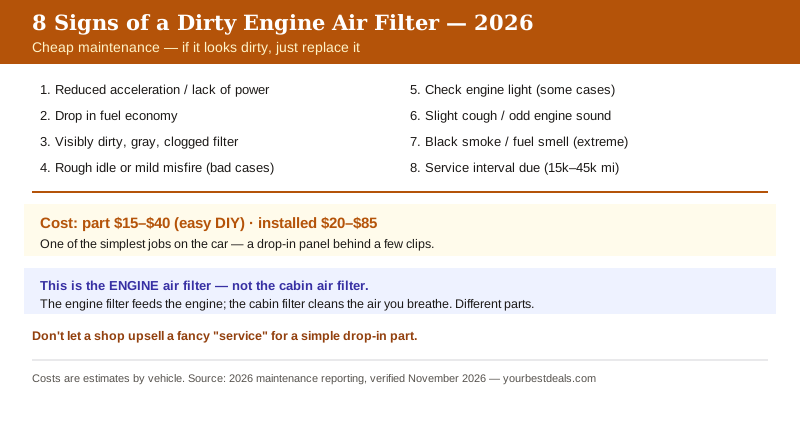
A dirty or clogged engine air filter chokes the airflow your engine needs, and the result is a mild but real drop in performance: reduced acceleration, worse fuel economy, and in bad cases a rough idle. The eight signs to watch are reduced power, a drop in fuel economy, a visibly dirty filter when you look at it, a rough idle or mild misfire, a check engine light in some cases, a slight cough or odd engine sound, black smoke or a fuel smell in extreme cases, and simply being due at the 15,000-to-45,000-mile service interval. The best news about this one: it’s the cheapest fix on the car. The filter part is $15 to $40 and it’s an easy do-it-yourself swap, or $20 to $85 installed at a shop. If it looks dirty, just replace it.
This is the repair I’d almost feel bad charging for, because it’s a drop-in panel behind a few clips. The thing worth your attention isn’t the diagnosis – a dirty filter is obvious when you pull it – it’s not overpaying for it. So let me cover the eight signs, clear up the engine-vs-cabin filter confusion, and flag the upsell to refuse.
The 8 signs
Most of these come from the engine getting less air than it wants, which throws off the air-fuel balance and costs you a bit of power and efficiency.
1. Reduced acceleration or lack of power – the engine can’t breathe freely, so it feels sluggish. 2. A drop in fuel economy as the mixture runs less efficiently. 3. A visibly dirty, gray, or clogged filter when you pull it out and hold it up – the simplest check of all. 4. A rough idle or mild misfire in bad cases, from the disrupted airflow. 5. A check engine light in some cases, if the airflow imbalance sets a code. 6. A slight cough or unusual engine sound. 7. Black smoke or a fuel smell in extreme cases, as the engine runs rich. 8. Being due or overdue – most makers suggest every 15,000 to 45,000 miles, sooner in dusty conditions. Our maintenance guide has interval details.
What it costs – and the cabin-filter mix-up
This is cheap. Here’s the price picture; these are estimated ranges that vary by vehicle.
| Option | Cost | Notes |
|---|---|---|
| Filter part (DIY) | $15–$40 | Drop-in panel, easy swap |
| Installed at a shop | $20–$85 | Filter + a few minutes labor |
| Dealer / bundled service | often more | Same part, premium price |
Worth clearing up because it confuses people and shops sometimes blur it: the engine air filter (which this page is about) feeds clean air to the engine, while the cabin air filter cleans the air coming through your vents for you to breathe. They’re two different parts in two different places, and both are cheap. If a shop quotes an “air filter service,” ask which one – and know that neither should cost much. Replacing the engine air filter is usually a matter of unclipping the airbox lid and dropping in the new panel.
Shop Talk
This is the classic quick-lube upsell, so know how to handle it. At an oil change, they’ll often bring your dirty air filter to the counter and quote you $30 to $60 to swap it. The part costs $15 to $40 at any parts store, and the job is unclipping the airbox and dropping in a new panel – five minutes, no tools on most cars. So you can almost always buy the filter yourself and change it in the parking lot for less than half their price. That said, the visual check they’re doing is legitimate – a truly dirty filter should be replaced – so don’t refuse the replacement, just refuse the markup. One more thing: don’t over-replace. If they show you a filter that’s only lightly dusty and you’re nowhere near your interval, it’s fine to say “not today.” And skip the pricey “high-flow” performance filters for a normal daily driver; a standard OEM-style filter is all your engine needs.
What Gets Misdiagnosed
The air filter itself is rarely misdiagnosed – you can see it’s dirty – but it gets blamed for problems it doesn’t cause, and it gets overcharged. Drivers sometimes replace a clean-enough filter hoping to fix a real power loss or a check engine light that’s actually a MAF sensor, a clogged fuel filter, or an ignition issue. A dirty engine air filter causes a mild, gradual drop in power and economy, not a dramatic failure, so if your car suddenly lost significant power or is throwing misfire codes, look past the air filter to those other causes.
The other miss is confusing the engine and cabin filters, or paying shop markup for a two-minute job. If your heater or AC airflow is weak or smells musty, that’s the cabin filter, not the engine filter – different part, different fix. And on cost: because the job is so simple, paying a big “service” fee for it is pure markup. Match the symptom to the right filter, confirm the engine filter is actually dirty by looking at it, and either swap it yourself or pay only a fair few dollars over the part price.
The Real Number
A dirty engine air filter causes a mild drop in power and fuel economy, and the fix is the cheapest on the car: a $15-to-$40 part you can drop in yourself, or $20 to $85 installed. If it looks dirty, replace it. Don’t confuse it with the cabin air filter (that’s the one for the air you breathe), don’t pay quick-lube markup for a five-minute job, and don’t blame the air filter for a big power loss or misfire codes – that’s usually a MAF sensor, fuel filter, or ignition issue.
Frequently Asked Questions
What are the symptoms of a dirty engine air filter?
The main signs are reduced acceleration or lack of power, a drop in fuel economy, a visibly dirty or gray filter, a rough idle or mild misfire in bad cases, a possible check engine light, a slight cough or odd engine sound, black smoke or a fuel smell in extreme cases, and simply being due at the 15,000-to-45,000-mile interval. The effect is usually mild and gradual rather than a dramatic failure. The easiest confirmation is to pull the filter and look at it – a clogged, dirty panel is obvious and should be replaced.
How much does an engine air filter cost to replace?
Very little. The filter part is about $15 to $40, and it’s an easy do-it-yourself swap on most cars – unclip the airbox and drop in the new panel. Installed at a shop it runs about $20 to $85, mostly the part plus a few minutes of labor. Dealers and bundled services often charge more for the same part. Because the job is so simple, this is one repair where buying the filter and doing it yourself saves a real chunk relative to shop markup. These are estimates that vary by vehicle.
Is the engine air filter the same as the cabin air filter?
No, they’re two different parts. The engine air filter feeds clean air to the engine for combustion, while the cabin air filter cleans the air that comes through your vents for you to breathe. They sit in different locations and do different jobs, though both are cheap and easy to replace. If your heater or AC airflow is weak or smells musty, that’s the cabin filter; if you have a mild power or economy drop, that’s the engine filter. When a shop quotes an “air filter,” ask which one they mean.
Can a dirty air filter cause a check engine light?
In some cases, yes. A badly clogged filter can disrupt the air-fuel balance enough to set a code and trigger the check engine light, though it’s not the most common cause. More often a dirty filter just causes mild power and economy loss without a light. If you have a check engine light, get the codes read rather than assuming the air filter – a light more often points to a MAF sensor, misfire, or emissions issue. Replace a dirty filter regardless, but don’t expect it to clear an unrelated code.
How often should I change my engine air filter?
Most manufacturers suggest every 15,000 to 45,000 miles, but it depends heavily on driving conditions – dusty, rural, or dirt-road driving clogs a filter much faster than clean highway miles. The best practice is to check it visually at oil changes and replace it when it looks dirty rather than strictly by mileage. Holding it up to light is a good test: if light barely passes through, it’s time. Check your owner’s manual for your vehicle’s recommended interval as a baseline.
Does a dirty air filter really affect fuel economy?
On modern fuel-injected engines the effect is real but modest – a clogged filter disrupts the air-fuel mixture and can cost you a bit of efficiency and power. It’s not the dramatic economy killer it was on older carbureted engines, so don’t expect a huge MPG jump from a new filter on a modern car. Still, a really clogged filter is worth replacing for the small economy and power gains plus smoother running, especially since it’s so cheap. Just don’t oversell yourself on the savings.
Can I clean and reuse my engine air filter instead of replacing it?
For standard paper/pleated filters, replacement is the right call – they’re cheap ($15 to $40) and not designed to be washed, and tapping out loose dust only helps a little. Some vehicles use reusable oiled cotton filters (like performance brands) that are designed to be cleaned and re-oiled with a specific kit, but those are the exception. For the common paper filter, don’t bother cleaning it; just drop in a new one. Trying to clean a paper filter often isn’t worth it for the few dollars a new one costs.
Sources
Symptom list and intervals reflect standard maintenance guidance; cost ranges verified against 2026 pricing in November 2026. Dollar amounts are estimates that vary by vehicle.
- FuelEconomy.gov – maintenance and air filter guidance
- AAA – auto repair resources
- ASE – National Institute for Automotive Service Excellence
Related Guides
- 8 Signs of a Bad MAF Sensor
- 6 Signs of a Clogged Fuel Filter
- Car Maintenance Guide
- What Is a Car Diagnostic Test?
- Fuel System Cleaning Cost

Eddie Brennan is an ASE Master Certified technician (A1, A4, A5, A6) who spent 11 years at an independent shop in Columbus, OH, where he watched the air-filter upsell get run on customers daily, before a back injury moved him into writing full-time. He drives a 2015 Subaru Outback with over 250,000 miles and a 2020 Ford F-150, and takes no referral fees or advertising money from any shop or chain.