
Last updated: November 2, 2026 – By Eddie Brennan
November 2026 update: reconfirmed the five causes, cost ranges, and the fuel-spark-timing framework.
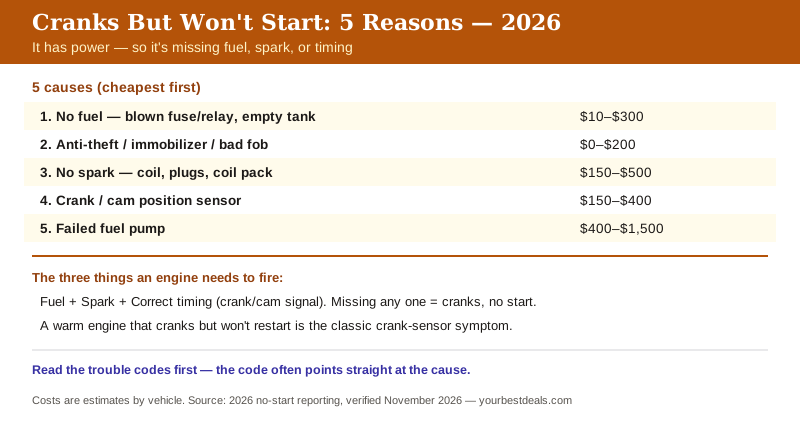
When your engine cranks – turns over normally – but never fires up, you’ve actually gotten good news: the battery and starter are working. The problem is that the engine isn’t getting one of the three things it needs to run: fuel, spark, or the correct timing signal from the crankshaft or camshaft sensor. Missing any one of those causes a crank-but-no-start. The five common causes range from a $10 fuse to a $1,500 fuel pump, and the single best first step is reading the trouble codes, because the code often points straight at which of the three is missing. Here are the five reasons, cheapest first, and how to tell them apart.
This is a diagnosis I actually enjoyed, because it’s logical: the engine needs fuel, spark, and timing, so you just figure out which one is absent. The mistake is guessing at parts instead of narrowing it down. Let me give you the five causes in order of likelihood-and-cost, and the clues that point to each.
The framework: fuel, spark, timing
Every gasoline engine needs three things to fire: fuel (delivered and sprayed into the cylinders), spark (to ignite it, at the right moment), and correct timing (the crankshaft and camshaft position sensors tell the computer when to fire). If the engine cranks but won’t start, exactly one of those is usually missing – the starter is clearly fine since it’s cranking. So the whole diagnosis is figuring out which of the three is absent, and the trouble codes plus a few checks get you there.
That’s why reading the codes first matters so much. A crank or cam sensor code points at timing; a misfire or coil code points at spark; a fuel-pressure or pump code points at fuel. The code narrows a broad “won’t start” down to one branch, saving you from throwing parts at it. This is a different problem from a car that won’t crank at all, which is a battery or starter issue – see our why-won’t-my-car-start guide for that branch. Here we’re strictly on the cranks-but-won’t-fire path.
The five causes
1. No fuel – blown fuel-pump fuse or relay, or empty/wrong-reading tank ($10 to $300). The cheapest cause. A blown fuel-pump fuse or a failed relay cuts fuel delivery, and the fix is a few dollars. Also check the obvious: is the tank actually empty, or is the fuel gauge reading wrong? People get stranded on “empty” tanks more than they admit.
2. Anti-theft / immobilizer or a bad key fob ($0 to $200). Modern cars have immobilizers that block starting if they don’t recognize the key. A dead key-fob battery, a security-system glitch, or a chip-key fault can cause a crank-no-start. Often a fob battery or a reset fixes it – cheap, and easy to overlook.
3. No spark – ignition coil, fouled spark plugs, or coil pack ($150 to $500). If fuel is reaching the engine but there’s no spark to ignite it, a failed ignition coil, worn or fouled spark plugs, or a bad coil pack is the likely cause. Flooding the engine with too much fuel (excess cranking) can also foul the plugs.
4. Crankshaft or camshaft position sensor ($150 to $400). These sensors tell the computer engine position and timing; if one fails, the computer doesn’t know when to fire and the engine cranks without starting. A classic clue: the car starts fine cold but refuses to restart once warm, since heat can make a marginal crank sensor drop out.
5. Failed fuel pump ($400 to $1,500). The priciest common cause. If the pump isn’t delivering fuel, the engine cranks but starves. Confirm with a fuel-pressure test before replacing, since a cheap filter or relay can mimic it – see our fuel pump symptoms guide.
Shop Talk
Two quick tells before you spend anything. First, the warm/cold clue: if your car starts fine when cold but cranks and won’t restart after it’s warmed up (like after a quick stop at the store), suspect the crankshaft position sensor – that heat-sensitive dropout is its signature, and it fools a lot of people into chasing fuel problems. Second, for the fuel side, turn the key to “on” (not start) and listen for a two-second hum from the rear of the car – that’s the fuel pump priming. No hum could mean a dead pump, a blown fuel-pump fuse, or a bad relay. And swapping a suspected relay with an identical one elsewhere in the fuse box is a free test. These narrow it down before you buy a single part.
What Gets Misdiagnosed
The most expensive misdiagnosis here is jumping to a fuel pump. Because “no fuel” is a common cause, people (and some shops) replace the $400-to-$1,500 pump when a $10 fuse, a failed relay, or a bad crank sensor was the real problem. A fuel-pressure test and reading the codes separate a really dead pump from the cheaper causes that mimic it. Never authorize a fuel pump on a crank-no-start without confirming the pump actually isn’t delivering pressure – the cheaper suspects should be ruled out first.
The second is missing the crank sensor on a warm no-start. When a car starts cold but won’t restart warm, people often chase fuel or battery problems and overlook the crankshaft position sensor, whose heat-sensitive failure produces exactly that pattern. Reading codes usually flags it. The broader lesson is the framework: with a cranks-but-won’t-fire car, identify whether fuel, spark, or timing is missing using the codes and a couple of checks, rather than guessing at the priciest part. That logical approach keeps a $150 sensor or a $10 fuse from being treated as a fuel pump.
The Real Number
A car that cranks but won’t start has power and a working starter, so it’s missing fuel, spark, or timing. Cheapest first: a blown fuel fuse/relay or empty tank ($10 to $300), an anti-theft/fob issue ($0 to $200), no spark from coils or plugs ($150 to $500), a crank/cam sensor ($150 to $400), or a failed fuel pump ($400 to $1,500) – all estimated ranges. Read the trouble codes first, since they point straight at the missing element. And don’t authorize a fuel pump without a pressure test; a cheap fuse, relay, or crank sensor mimics it. A warm-only no-start is the classic crank-sensor tell.
Frequently Asked Questions
What does it mean when a car cranks but won’t start?
It means the starter is turning the engine over normally, so the battery and starter are fine, but the engine isn’t getting one of the three things it needs to fire: fuel, spark, or the correct timing signal from the crankshaft or camshaft sensor. Missing any one causes a crank-but-no-start. Common causes include a blown fuel-pump fuse or relay, a failed fuel pump, a bad ignition coil or fouled spark plugs, a failing crank position sensor, or an anti-theft/immobilizer issue. Reading the trouble codes is the best first step, because the code usually points at which of fuel, spark, or timing is missing, narrowing the diagnosis quickly.
How do I know if it’s fuel or spark?
Reading the codes is the reliable way, but a couple of checks help. For fuel: turn the key to “on” without starting and listen for a two-second hum from the rear – that’s the fuel pump priming. No hum suggests a fuel-delivery problem (pump, fuse, or relay). For spark: a technician can check whether the plugs are firing, and misfire or coil codes point at spark. If the engine cranks, has a strong fuel-pump prime, and still won’t fire, spark or timing is more likely; if there’s no fuel prime, the fuel side is suspect. Codes plus these checks separate the two, so you’re not guessing between a coil and a pump.
Can a bad crankshaft sensor cause a no-start?
Yes, and it’s a classic cause. The crankshaft position sensor tells the computer the engine’s position and speed so it knows when to fire the spark and injectors. If it fails, the computer loses that timing reference and the engine cranks but won’t start. A hallmark symptom is a car that starts fine when cold but cranks and refuses to restart once warm, because heat can make a marginal sensor drop out. It often sets a specific trouble code, so a scan usually flags it. Replacement runs about $150 to $400. If you have a warm-only no-start, the crank sensor should be near the top of the suspect list rather than chasing fuel problems.
Why does my car crank but not start after getting gas?
A crank-no-start right after filling up can point at the evaporative emissions (EVAP) system, specifically the purge valve or a related component that can stick and affect starting, or simply an issue coincidentally noticed at the pump. Overfilling the tank past the first click can sometimes let fuel or vapor reach the EVAP charcoal canister and cause a hard start. In many cases it’s unrelated to the gas itself and is one of the standard crank-no-start causes. Reading the codes will point you at the cause, whether it’s an EVAP purge issue, a fuel-delivery problem, or something else. Avoid topping off past the automatic shutoff to reduce EVAP-related starting issues.
How much does it cost to fix a car that cranks but won’t start?
It depends entirely on which of fuel, spark, or timing is missing. The cheapest fixes are a blown fuel-pump fuse or relay ($10 to $300) or an anti-theft/key-fob issue ($0 to $200). Mid-range is a spark problem – ignition coil or plugs ($150 to $500) – or a crankshaft/camshaft position sensor ($150 to $400). The priciest common cause is a failed fuel pump ($400 to $1,500). These are estimated ranges that vary by vehicle. Because the spread is so wide, reading the trouble codes and doing a fuel-pressure test before replacing parts is what keeps you from paying fuel-pump money for what was a cheap fuse or sensor.
Is it safe to keep cranking the engine to try to start it?
Cranking repeatedly in long bursts isn’t a good idea. It drains the battery quickly, can overheat the starter, and – if the engine has fuel but no spark – can flood the cylinders with unburned fuel, fouling the spark plugs and washing oil off the cylinder walls, which makes starting even harder and can cause wear. If the car doesn’t start after a few short attempts, stop and diagnose rather than grinding away. Crank in short bursts of a few seconds with pauses, and if it won’t catch, read the codes or have it checked. Continuous cranking rarely forces a start and often makes the underlying problem worse.
Could it be the immobilizer or key fob?
Yes, and it’s an easy one to overlook. Modern cars have an immobilizer that prevents the engine from starting unless it recognizes the key, so a dead key-fob battery, a chip-key fault, or a security-system glitch can cause the engine to crank but not start. Often a security or key light on the dash hints at it. Fixes are frequently cheap – replacing the fob battery, using a backup key, or a system reset. On push-button-start cars especially, a weak fob battery is a common culprit. So before assuming an expensive fuel or ignition problem, check whether it’s a fob or immobilizer issue, since that can be a no-cost or low-cost fix.
Sources
Crank-no-start causes and cost ranges verified against 2026 reporting on November 2, 2026. Costs are estimated ranges that vary by vehicle; reading trouble codes and a fuel-pressure test are the key diagnostic steps.
- Samarins – 10 reasons the engine cranks but won’t start, 2026
- Car Treatments – engine cranks but won’t start causes, 2026
- AAA – reasons why your car won’t start
Related Guides
- Why won’t my car start? (diagnose by sound)
- Fuel pump symptoms
- Spark plug replacement cost
- What does a check engine light mean?

Eddie Brennan spent 11 years as an ASE Master Certified technician at an independent shop in Columbus, OH, where a cranks-but-won’t-start was a logic puzzle – fuel, spark, or timing – that his A1 Engine Repair and A6 electrical certifications were built to solve. He takes no referral fees and drives a 250,000-mile 2015 Subaru Outback and a 2020 Ford F-150.