
Last updated: November 7, 2026 – By Eddie Brennan
November 2026 update: refreshed belt-only and belt-plus-tensioner ranges against 2026 reporting and reconfirmed independent-versus-dealer pricing.
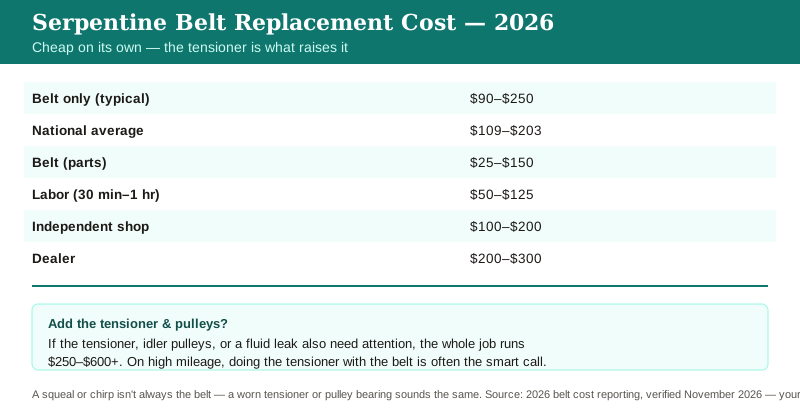
Serpentine belt replacement in 2026 runs $90 to $250 for the belt alone, with a national average of $109 to $203. It’s a cheap, quick job on most cars – the belt is $25 to $150 and it’s usually thirty minutes to an hour of labor. The number that climbs is when the tensioner and idler pulleys go with it, which pushes the whole job to $250 to $600 or more. Whether that’s a smart bundle or an unnecessary upsell depends on your mileage and what’s actually worn.
The serpentine belt is the single rubber belt that drives your alternator, power steering, water pump, and A/C compressor off the crankshaft, so when it fails, a lot stops working at once. In the bay I replaced these constantly, and the honest quote hinges on one thing: is it just the belt, or is the tensioner that keeps it tight also worn? This guide sorts out when the tensioner belongs in the job and when a squeal isn’t even the belt.
Serpentine belt cost breakdown
These are the ranges for the belt-only job and the fuller job when related parts are worn.
| Job | Typical cost | Notes |
|---|---|---|
| Belt only, independent | $100–$200 | The common, cheap job |
| Belt only, dealer | $200–$300 | Higher labor and OEM part |
| Belt + tensioner + pulleys | $250–$600+ | When those are worn too |
| Belt (parts only) | $25–$150 | Cheap; labor is the rest |
Labor is $50 to $125 for a thirty-minute-to-one-hour job on most cars, which is why the belt-only replacement is one of the more affordable repairs out there. A reputable independent runs $100 to $200 all-in; a dealer runs $200 to $300 for the same work. The jump to $250-plus only happens when the tensioner, idler pulleys, or a fluid leak really need attention alongside the belt.
What gets misdiagnosed
The classic belt symptom is a squeal or chirp from the front of the engine, often loudest on a cold start or when you crank the wheel or turn on the A/C. But here’s the catch: that exact same squeal can come from a worn tensioner or a dying idler-pulley bearing, not the belt itself. Replace the belt alone when the tensioner is the real problem, and the noise comes right back on a brand-new belt. The tensioner is a spring-loaded arm that keeps the belt tight, and when its spring weakens or its bearing wears, the belt slips and squeals no matter how new it is.
A decent tech checks the tensioner’s movement and listens to the pulleys with the belt off before blaming the belt. If the belt is cracked, glazed, or shredding, it’s the belt. If the belt looks fine but the tensioner is weak or a pulley bearing is rough, that’s your noise. This is why a shop that quotes a tensioner along with the belt on a high-mileage car often isn’t upselling – the parts wear together, and doing them separately means paying the labor twice.
Straight From the Invoice: belt jobs
These are jobs I either did myself or watched come through the bay – a simple belt, a squeal that was the tensioner, and a smart bundle.
Invoice #1 – 2016 Honda Accord, belt only, independent, Ohio
Cracked, glazed belt at 90,000 miles, tensioner still firm. Just the belt, about forty minutes, $140. Lesson: a worn belt with a good tensioner is a cheap, quick job – if that’s your situation, $100 to $200 at an independent is the fair number.
Invoice #2 – 2013 Toyota Camry, squeal that was the tensioner, Columbus
Owner had already replaced the belt elsewhere and the squeal came back in a week. The tensioner spring was weak and letting the new belt slip. A $70 tensioner fixed what a new belt couldn’t. Lesson: a squeal on a fresh belt is the tensioner or a pulley, not the belt – chasing it with another belt just wastes money.
Invoice #3 – 2015 Ford Escape, belt + tensioner + idler, independent, Texas
At 130,000 miles the belt was due and the tensioner and an idler pulley were both worn. Doing all three together came to $340 – more than a belt alone, but the labor overlapped, so it beat three separate visits. Lesson: on high mileage, bundling the tensioner and pulleys with the belt is often the smart call, not an upsell.
When to do the tensioner with the belt
The case for bundling
The tensioner and idler pulleys live right there with the belt and wear on a similar timeline, so on a high-mileage car – say over 100,000 miles – replacing them along with the belt is often truly smart. The labor to access them overlaps almost entirely with the belt job, so bundling avoids paying that labor twice when the tensioner fails six months later. If the tensioner is visibly weak or a pulley bearing is rough, doing them together is the efficient move, not an upsell.
The case for belt only
If the belt is worn but the tensioner is still firm and the pulleys spin smooth and quiet, there’s no reason to replace parts that are fine. A shop that automatically bundles a tensioner and pulleys onto every belt job regardless of their condition is padding the bill. The test is simple: the tensioner should hold firm tension and the pulleys should spin without noise or wobble. Ask the shop to check them, and do only what’s actually worn.
Shop Talk
If your belt squeals right after it was replaced, stop buying belts – the problem is the tensioner or a pulley bearing, and another new belt will squeal too. Have the shop check the tensioner’s spring tension and spin each pulley by hand with the belt off; a weak tensioner or a rough, noisy pulley is your culprit. On the flip side, if you’re doing a belt on a car past 100,000 miles, ask whether the tensioner and pulleys are worn, because doing them together while everything’s apart saves you the labor of a second visit when they fail later.
What actually drives the price
For the belt alone, very little drives the price – it’s a cheap part and a quick job, so $100 to $200 at an independent is about as predictable as car repairs get. The dealer premium of $200 to $300 for the same work is the main avoidable cost on a belt-only job, since a reputable independent does it for meaningfully less. What moves the number up legitimately is the tensioner and pulleys, and whether they’re real worn.
The avoidable cost runs both directions here. Paying for a tensioner and pulleys that are still good is an upsell; skipping them when they’re worn means paying the labor twice when they fail. And chasing a squeal with repeated new belts, when the tensioner is the real cause, is money burned on the wrong part. Diagnose the noise, check the tensioner’s condition, and bundle only what’s actually worn.
The Real Number
Budget $90 to $250 for the belt alone – $100 to $200 at an independent, more at a dealer – and $250 to $600 if the tensioner and pulleys really need to go with it. Use an independent over a dealer for this simple job. On a car past 100,000 miles, ask whether the tensioner and pulleys are worn and bundle them if they are, since the labor overlaps. And if a fresh belt squeals, don’t buy another one – it’s the tensioner or a pulley bearing, and that’s the part to replace.
Frequently Asked Questions
How much does serpentine belt replacement cost in 2026?
The belt alone runs $90 to $250, with a national average of $109 to $203. A reputable independent charges $100 to $200 and a dealer $200 to $300 for the same work. The belt itself is $25 to $150 and labor is $50 to $125 for a thirty-minute-to-one-hour job. If the tensioner, idler pulleys, or a fluid leak also need attention, the total commonly lands at $250 to $600 or more. Belt-only is one of the more affordable repairs; the tensioner is what raises the price.
Do I need to replace the tensioner with the serpentine belt?
Only if the tensioner is actually worn, which is more likely on a high-mileage car. The tensioner is a spring-loaded arm that keeps the belt tight, and it wears on a similar timeline to the belt, so past about 100,000 miles it’s often worth doing together since the labor overlaps. But if the tensioner still holds firm tension and the pulleys spin smooth and quiet, there’s no reason to replace them. Ask the shop to check the tensioner’s condition, and bundle it only if it’s truly weak.
Why does my new serpentine belt still squeal?
Because the belt probably wasn’t the problem – a squeal on a fresh belt almost always means a worn tensioner or a dying idler-pulley bearing. The tensioner keeps the belt tight, and if its spring is weak, even a brand-new belt slips and squeals. Replacing the belt again won’t fix it. Have the shop check the tensioner’s spring tension and spin each pulley by hand with the belt off; a weak tensioner or a rough, noisy pulley is the real cause, and replacing that part is what stops the noise.
What are the symptoms of a bad serpentine belt?
A squealing or chirping noise from the front of the engine, often on a cold start or when you turn the wheel or switch on the A/C, is the classic sign, along with visible cracking, glazing, or fraying on the belt. Because the belt drives the alternator, power steering, water pump, and A/C, a failing or broken belt can cause a dead battery, loss of power steering, or overheating. Just remember the squeal can also come from the tensioner or a pulley, so get it checked rather than assuming it’s the belt.
How long does a serpentine belt last?
Most modern serpentine belts last 60,000 to 100,000 miles, and many are made of durable EPDM rubber that doesn’t crack as visibly as older belts, so age and mileage matter as much as appearance. Check your owner’s manual for the recommended interval, and have the belt inspected at oil changes for cracking, glazing, or fraying. Because a broken belt can strand you and cause overheating, replacing it near the end of its interval rather than waiting for failure is the smart, cheap insurance on an inexpensive part.
Can I drive with a squealing serpentine belt?
Briefly, but don’t ignore it. A squeal means the belt is slipping or a tensioner or pulley is failing, and if the belt breaks, you lose the alternator, power steering, and water pump at once – a dead battery, hard steering, and an overheating engine, often all at highway speed. Get a squealing belt or tensioner looked at soon rather than waiting for the belt to snap. It’s a cheap repair to do on your schedule and an expensive, dangerous problem to have on the side of the road.
Is a serpentine belt job cheaper at an independent shop?
Yes. A reputable independent charges $100 to $200 for a belt replacement versus $200 to $300 at a dealer for identical work, since the dealer’s higher labor rate and OEM part add cost without adding quality on such a simple job. Unless you’re under warranty, the independent is the clear value for a belt. The same applies if you’re bundling the tensioner and pulleys – the independent’s lower labor rate makes the fuller job cheaper too, which matters more as the parts add up.
Sources
Serpentine belt cost ranges verified against 2026 parts-and-labor reporting on November 7, 2026. Ranges vary by vehicle, whether related parts are replaced, and region; confirm your exact price locally.
- RepairPal – serpentine belt replacement cost estimate
- Empire Auto Protect – serpentine belt replacement cost, 2026
- The Cost Guys – serpentine belt replacement, 2026
Related Guides
- Spark plug replacement cost
- Car repair cost estimator hub
- Alternator replacement cost
- About Eddie Brennan – ASE Master technician

Eddie Brennan is an ASE Master Certified technician who spent 11 years at an independent shop in Columbus, OH, where “my new belt still squeals” was a weekly conversation – and usually a tensioner. He writes the repair and diagnostic guides on Your Best Deals and takes no referral fees. He drives a 250,000-mile 2015 Subaru Outback and a 2020 Ford F-150.