
Last updated: November 9, 2026 – By Diane Holcomb
November 2026 update: reconfirmed pulley pricing and the do-it-with-the-belt point.
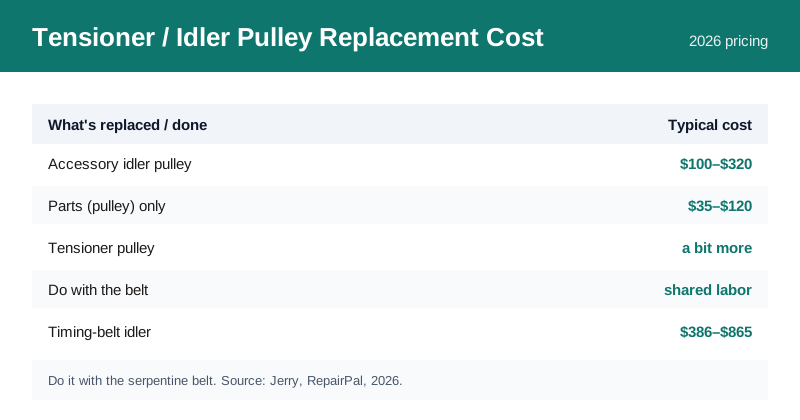
An accessory-belt idler or tensioner pulley runs about $100 to $320 installed, with the pulley part itself only $35 to $120. A tensioner pulley (spring-loaded, keeps belt tension) costs a bit more than a plain idler pulley (just guides the belt). Because the serpentine (drive) belt and its pulleys wear together, doing the pulley with the belt shares the labor and is common practice. Note: a timing-belt idler pulley is a completely different, much bigger job ($386 to $865) because the timing components must be removed. The serpentine belt winds around the engine’s accessories (alternator, power steering, water pump, AC), and the idler and tensioner pulleys guide and tension it. When a pulley’s bearing wears, you get a chirp, squeal, rattle, or grinding noise, and a failing tensioner can let the belt slip or even throw it off – stranding you.
A chirp or rattle from the front of the engine is often a pulley bearing, and it’s cheap to do with the belt. Let me break it down.
What you’ll actually pay
Here’s the picture. These are estimates that vary by vehicle and shop.
| Item | Cost | Notes |
|---|---|---|
| Accessory idler pulley | $100–$320 | Installed |
| Pulley (part) only | $35–$120 | Cheap part |
| Tensioner pulley | a bit more | Spring-loaded |
| Timing-belt idler | $386–$865 | Different, bigger job |
Pulleys work with the belt; our serpentine belt guide, belt tensioner guide, and timing belt guide cover the related parts.
Shop Talk
First, clear up which pulley. On the front of the engine, the serpentine (accessory) belt runs over idler pulleys (smooth wheels that just route the belt) and a tensioner (a spring-loaded arm with a pulley that keeps the belt tight). Those are cheap and accessible – $100 to $320 installed. A timing-belt idler/tensioner pulley is a totally different animal: it’s inside the timing cover, so reaching it means the big timing-belt teardown ($386 to $865), and it’s done as part of a timing-belt job, not on its own. Make sure you (and the shop) know which one you’re pricing. The classic symptom of a bad accessory pulley is a noise from the front of the engine – a chirp or squeal (often worst on cold start), a rattle, or a bearing growl/grinding that changes with engine speed. A quick check with the engine off and belt removed: spin each pulley by hand; a good one spins smooth and quiet, a bad one is rough, notchy, noisy, or wobbly. The smart-money move: the belt and the pulleys (idler + tensioner) wear together and share the same labor, so if the belt’s old or you’re replacing one worn pulley, do the belt and both pulleys as a set – a kit is cheap and you avoid paying the labor again soon. And don’t ignore a chirping tensioner: if the tensioner fails or the belt throws, you lose charging, power steering, and the water pump at once and can be stranded.
Where Drivers Overpay
The first clarification saves confusion and money: an accessory-belt idler/tensioner pulley is cheap ($100–$320), while a timing-belt pulley is a far bigger job – so make sure the quote matches which one you actually need.
The value move is treating the belt and pulleys as a set: they wear together and share the labor, so doing the belt plus the idler and tensioner at once (a cheap kit) avoids paying that labor twice. The pattern: confirm accessory vs timing pulley, spin-check the pulleys, and bundle the belt and both pulleys when one is worn or the belt’s aged.
The Real Number
An accessory-belt idler or tensioner pulley is $100 to $320 installed (the pulley is only $35 to $120) – a timing-belt pulley is a different, $386 to $865 job, so confirm which. A chirp, squeal, rattle, or bearing growl from the front of the engine is the sign. Because the belt and pulleys wear together and share the labor, do the belt and both pulleys as a set, and don’t ignore a chirping tensioner that could throw the belt.
Frequently Asked Questions
How much does it cost to replace a tensioner or idler pulley?
An accessory-belt (serpentine) idler or tensioner pulley runs about $100 to $320 installed, with the pulley part itself only $35 to $120 – the rest is labor, which is modest because the pulleys are accessible at the front of the engine. A tensioner pulley costs a bit more than a plain idler. These are estimates that vary by vehicle and shop. Importantly, a timing-belt idler or tensioner pulley is a completely different, much bigger job ($386 to $865) because it’s inside the timing cover and requires the timing-belt teardown. So confirm which pulley you mean. Because the serpentine belt and its pulleys wear together and share the labor, it’s cost-effective to replace the belt and both pulleys as a set (a kit) rather than one part at a time – ask whether that applies to your situation for the best value.
What do the idler and tensioner pulleys do?
They guide and tension the serpentine (drive) belt, which winds around the front of the engine driving the accessories – the alternator, power steering pump, water pump on many engines, and AC compressor. The idler pulley(s) are smooth wheels that route the belt around its path (keeping it on track and maintaining wrap around the accessories). The tensioner is a spring-loaded arm with a pulley that automatically keeps the correct tension on the belt, taking up slack as the belt stretches so it doesn’t slip. Both ride on bearings and spin constantly whenever the engine runs. Over time those bearings wear, and the tensioner’s spring can weaken. When a pulley bearing wears, it makes noise; when the tensioner weakens or a pulley seizes, the belt can slip, squeal, or be thrown off. So these pulleys are essential to keeping the belt – and therefore charging, steering assist, and cooling – working properly. They’re wear items that fail with age and miles.
What are the symptoms of a bad pulley?
The most common symptom is noise from the front of the engine: a chirp or squeal (often worst on a cold start or when accessories load up), a rattle, or a bearing growl/grinding that rises and falls with engine speed. A failing tensioner can also cause belt slip (squealing, especially when you turn the wheel or the AC kicks on) or visible belt flutter. In a worn pulley, you might feel roughness or play if you spin it by hand with the engine off and belt removed – a good pulley spins smooth and quiet, a bad one is rough, notchy, noisy, or wobbly. Because belt-area noises can come from the belt itself, a pulley, or the tensioner, a shop (or a careful DIY spin-check) pinpoints which. Don’t ignore these noises: a seized pulley or failed tensioner can throw the belt, which instantly kills charging, power steering, and the water pump, potentially stranding you and risking overheating. Catch a chirp or growl early.
Is this the same as a timing-belt pulley?
No – and confusing them leads to a very different cost, so it’s worth being clear. The idler and tensioner pulleys covered here are on the serpentine (accessory) belt, on the outside front of the engine, and are cheap and easy to reach ($100 to $320 installed). A timing belt also has its own idler and tensioner pulleys, but those are inside the timing cover, driving the engine’s internal timing – and reaching them requires the full timing-belt teardown, making a timing-belt pulley job much more involved and expensive ($386 to $865, and usually done as part of a complete timing-belt service). So “tensioner pulley” could mean either, and the price gap is large. If your noise is an external belt chirp/growl, it’s an accessory pulley (cheap). If you’re having timing-belt service, the timing pulleys are replaced as part of that kit. Make sure you and the shop are talking about the same pulley before comparing quotes – see our timing belt guide for that side.
Should I replace the belt and pulleys together?
Usually, yes – it’s the cost-effective approach because they wear together and share the labor. The serpentine belt, idler pulley(s), and tensioner are all driven by the engine and age at a similar rate, and the labor to access and remove the belt is the same whether you replace one part or all of them. So if your belt is old and you’re replacing a worn pulley (or vice versa), doing the belt and both pulleys as a set – often sold as a kit – avoids paying that labor again soon when the next part fails. On the other hand, if the belt is relatively new and only one pulley is noisy, you can replace just that pulley. But on a higher-mileage engine where everything’s aged, the kit approach is smart value. A good shop will tell you the condition of the belt, idler, and tensioner and recommend accordingly. Bundling the belt and pulleys when they’re all due is the same shared-labor logic that saves money on many jobs.
Can I replace a pulley myself?
For an accessory-belt idler or tensioner pulley, often yes – it’s one of the more DIY-friendly jobs if you’re comfortable under the hood. The basic process: relieve the belt tension with a wrench or breaker bar on the tensioner, slip the belt off, unbolt the old pulley, bolt on the new one, and route the belt back correctly (following the belt diagram, usually on a label under the hood). It’s a natural time to inspect and spin-check the other pulleys and the belt. The job takes anywhere from about 20 minutes to an hour with basic tools. The cautions are relieving the spring-loaded tensioner safely and getting the belt routing exactly right. A timing-belt pulley, by contrast, is not a casual DIY – it’s part of the involved timing-belt job. So for the accessory-belt pulleys, a handy owner can do it and save the (already modest) labor; if you’re not comfortable with the tensioner and belt routing, it’s inexpensive enough to have a shop do. Either way, consider doing the belt and both pulleys together.
What happens if a pulley or tensioner fails completely?
It can leave you stranded and cause secondary problems, which is why a noisy pulley or weak tensioner shouldn’t be ignored. If an accessory-belt pulley bearing seizes or a tensioner fails, the serpentine belt can slip badly or be thrown off the engine entirely. Since that one belt drives the alternator, power steering pump, water pump (on many engines), and AC, losing it means several systems quit at once: the battery stops charging (the car dies within minutes), the steering goes heavy, and – critically – if the belt drives the water pump, the engine can overheat. So a thrown belt from a failed pulley turns a cheap preventive repair into a roadside breakdown and possibly an overheating repair. That’s the whole argument for replacing a chirping, growling, or rough pulley (and a weak tensioner) proactively rather than waiting. The parts are inexpensive and the job is modest; a belt failure on the highway is neither. If you hear a worsening bearing growl or chirp up front, get it checked before it strands you.
Sources
Price ranges verified against 2026 pulley pricing in November 2026. Dollar amounts are estimates that vary by vehicle and shop.
- Jerry – idler pulley replacement cost
- thePricer – idler pulley replacement cost
- ASE – National Institute for Automotive Service Excellence
Related Guides
- Serpentine Belt Replacement Cost
- Belt Tensioner Replacement Cost
- Timing Belt Replacement Cost
- Water Pump Replacement Cost
- Car Repair Cost Estimator

Diane Holcomb spent seven years as a service advisor at multi-brand dealerships in Charlotte, NC, where a chirp up front usually meant a cheap accessory pulley – done with the belt as a kit – not the pricey timing-belt pulley customers sometimes feared. She drives a 2019 Honda CR-V and a hand-me-down 2007 Toyota Camry, and takes no referral fees or advertising money from any shop or chain.