
Last updated: November 9, 2026 – By Diane Holcomb
November 2026 update: reconfirmed belt and belt-plus-water-pump pricing and the interference-engine point.
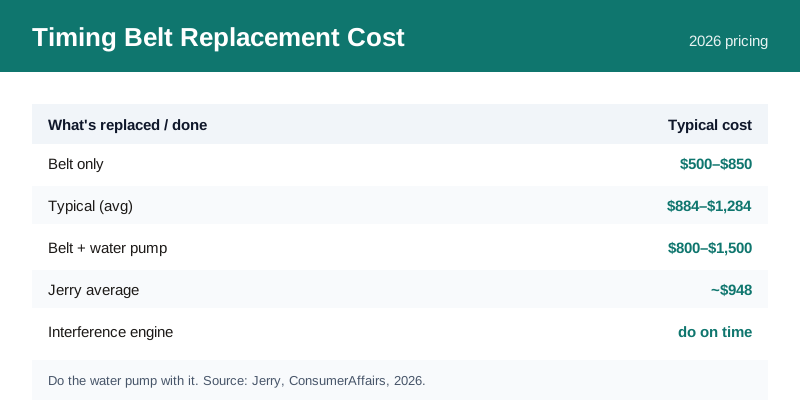
A timing belt replacement averages about $884 to $1,284 (Jerry puts it near $948). The belt job alone is roughly $500 to $850, but doing the water pump at the same time – usually recommended – brings it to about $800 to $1,500. The timing belt synchronizes the crankshaft and camshaft(s) so the engine’s valves and pistons move in perfect time with each other. It’s a toothed rubber belt, and unlike a timing chain (which usually lasts the life of the engine), a belt is a scheduled maintenance item – typically replaced around 60,000 to 105,000 miles, per your owner’s manual. The critical point: on an “interference” engine, if the timing belt snaps, the pistons and valves collide, causing major, expensive internal damage. That’s why this is a replace-on-schedule item, not a wait-until-it-breaks one.
This is the rare big repair you do before anything’s wrong, and there’s a very good reason. Let me explain the cost and the interference-engine stakes.
What you’ll actually pay
Here’s the picture. These are estimates that vary by vehicle and shop.
| Item | Cost | Notes |
|---|---|---|
| Belt only | $500–$850 | Belt + labor |
| Average (all-in) | $884–$1,284 | Jerry ~$948 |
| Belt + water pump | $800–$1,500 | Recommended |
| If belt snaps (interference) | $2,000+ damage | Avoidable |
Not every engine has a belt – many use a chain; our timing chain guide covers that, and the water pump guide covers the part you bundle with the belt.
Shop Talk
Two things make this repair worth understanding. First: does your engine even have a timing belt? Many modern engines use a timing chain instead, which isn’t a scheduled-replacement item. If yours has a belt, your owner’s manual lists the replacement interval (commonly 60,000 to 105,000 miles) – and that interval exists for a reason. On an interference engine (where the valves and pistons share the same space at different times), a snapped belt lets them hit each other, bending valves and sometimes worse, which is a repair bill several times the cost of the belt. So on an interference engine, the timing belt interval isn’t a suggestion; replacing it on time is cheap insurance against a catastrophic failure. Second: do the water pump (and the belt tensioner and idler pulleys) at the same time. On most engines the water pump is driven by or sits right behind the timing belt, so the labor to reach it is already done when the belt’s off. Replacing a $50 water pump later – after it fails and requires redoing the whole timing belt job – is how people pay the big labor twice. A proper timing belt service is really a kit: belt, tensioner, pulleys, water pump, and seals. It costs a bit more upfront but it’s the right way, and it resets the clock on the whole front of the engine.
Where Drivers Overpay
The worst overpay isn’t on the belt – it’s skipping it past the interval on an interference engine and having it snap, which turns a ~$1,000 service into a multi-thousand-dollar engine repair. Replacing it on schedule is the cheap insurance that avoids the catastrophic bill.
The second is doing the belt alone and leaving the water pump, tensioner, and pulleys – then paying the same big labor again when one fails soon after. The pattern: check whether your engine has a belt (not a chain), replace it on the manual’s interval, and do it as a full kit (belt, water pump, tensioner, pulleys, seals) so the shared labor is spent once.
The Real Number
A timing belt averages $884 to $1,284 (belt alone $500 to $850; with the water pump $800 to $1,500). On an interference engine, a snapped belt causes thousands in engine damage, so replacing it on the manual’s interval (often 60,000 to 105,000 miles) is non-negotiable insurance. Do it as a full kit – belt, water pump, tensioner, pulleys – so you pay the shared labor once. And check first whether your engine even has a belt or a chain.
Frequently Asked Questions
How much does it cost to replace a timing belt?
The average is about $884 to $1,284, with Jerry putting it near $948. The belt job alone runs roughly $500 to $850, and about $800 to $1,500 when the water pump is replaced at the same time, which is usually recommended. These are estimates that vary by vehicle and shop. Most of the cost is labor, because reaching the timing belt means removing accessory belts, covers, and sometimes engine mounts. That’s also why bundling the water pump, tensioner, and pulleys into the job is good value – the labor to access them is already being spent. The alternative, letting the belt fail on an interference engine, costs far more in engine damage, so this is a maintenance item worth doing on schedule.
What does the timing belt do?
The timing belt synchronizes the rotation of the crankshaft and the camshaft(s) so the engine’s valves open and close in precise time with the pistons moving up and down. It’s a toothed rubber belt that keeps everything in mechanical harmony – if that timing is lost, the engine can’t run properly, and on many engines the valves and pistons can collide. The belt also often drives the water pump. Unlike a timing chain, which is metal and usually lasts the engine’s life, a rubber timing belt wears and must be replaced on a schedule. So the timing belt is critical to the engine’s basic operation, and because it’s a wear item with serious consequences if it fails, manufacturers specify a replacement interval.
How often should a timing belt be replaced?
It depends on the vehicle, but timing belts are commonly replaced somewhere around 60,000 to 105,000 miles – your owner’s manual gives the exact interval for your car, sometimes also a time limit (for example, every so many years regardless of mileage, since rubber ages). It’s important to follow that interval because the belt wears and ages whether or not the car is driven much. Some intervals also depend on severe-use conditions. Because the consequences of a failure on an interference engine are severe, this is one maintenance item not to stretch past its interval. If you’ve bought a used car and don’t have records showing the belt was done, it’s worth replacing it or finding out when it was last changed. The manual is the authority.
What happens if a timing belt breaks?
It depends on whether your engine is an “interference” or “non-interference” design. On an interference engine (common today), the valves and pistons occupy the same space at different moments, kept apart by correct timing – so if the belt breaks, timing is lost and the pistons slam into open valves, bending valves and sometimes damaging pistons or the cylinder head. That’s a major, expensive repair, often several thousand dollars. On a non-interference engine, a broken belt simply stalls the engine without that collision, so you’re stranded but the engine usually isn’t damaged. Either way the car stops running. Because many engines are interference designs and the damage is so costly, replacing the belt before it breaks is strongly advised. If you don’t know which type you have, assume the stakes are high and stay on schedule.
Why should I replace the water pump with the timing belt?
Because on most engines the water pump is driven by or located right behind the timing belt, so the labor to reach it is already being done during the belt job. The water pump is a relatively cheap part, but replacing it on its own later requires largely redoing the timing belt job – paying that big labor charge a second time. Since a water pump is a wear item that often fails in a similar mileage range to the belt, replacing it preventively while everything’s apart is smart, cost-effective timing. The same logic applies to the belt tensioner and idler pulleys, which also wear and are accessible then. That’s why a proper timing belt service is done as a kit – belt, water pump, tensioner, pulleys, and seals – rather than just the belt alone.
Does my car have a timing belt or a timing chain?
It depends on the engine, and it’s the first thing to find out, because it changes everything. Many engines use a timing chain, which is metal, runs in oil, and is generally designed to last the life of the engine without scheduled replacement. Other engines use a rubber timing belt, which is a scheduled-replacement maintenance item as described here. Your owner’s manual will tell you, or you can look up your specific year, make, model, and engine. This matters because if you have a chain, there’s no timing belt interval to worry about (though chains can eventually stretch or fail – see our timing chain guide); if you have a belt, staying on the replacement interval is important. Don’t assume – confirm which one your engine uses.
Can I drive longer before replacing the timing belt to save money?
It’s a risky way to save, especially on an interference engine. The replacement interval exists because the belt wears and ages, and the longer you go past it, the higher the chance it snaps – and on an interference engine, that failure causes major engine damage costing several times the belt service. So stretching the interval gambles a possible multi-thousand-dollar repair to delay a planned one. On a non-interference engine the downside is being stranded rather than engine damage, which is less catastrophic but still a breakdown. The belt also gives little warning before it fails. So while it’s tempting to put off a four-figure maintenance item, the math strongly favors doing it on schedule. If money’s tight, it’s worth prioritizing this over less critical maintenance.
Sources
Price ranges verified against 2026 timing belt pricing in November 2026. Dollar amounts are estimates that vary by vehicle and shop.
- Jerry – timing belt replacement cost
- ConsumerAffairs – timing belt replacement cost
- ASE – National Institute for Automotive Service Excellence
Related Guides
- Timing Chain Replacement Cost
- Water Pump Replacement Cost
- Serpentine Belt Replacement Cost
- Crankshaft Replacement Cost
- Car Repair Cost Estimator

Diane Holcomb spent seven years as a service advisor at multi-brand dealerships in Charlotte, NC, where explaining why a healthy-running car needed a $1,000 belt – and why doing the water pump with it mattered – was a regular, worthwhile conversation. She drives a 2019 Honda CR-V and a hand-me-down 2007 Toyota Camry, and takes no referral fees or advertising money from any shop or chain.