
Last updated: November 7, 2026 – By Diane Holcomb
November 2026 update: reconfirmed tensioner pricing and the do-the-belt-at-the-same-time point.
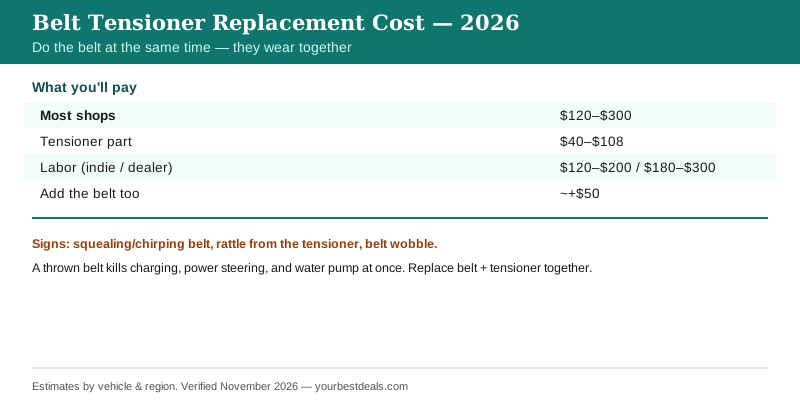
A serpentine belt tensioner replacement runs about $120 to $300 at most shops. The tensioner part is roughly $40 to $108, and labor runs about $120 to $200 at an independent shop or $180 to $300 at a dealer. Here’s the money tip: replacing the serpentine belt at the same time usually adds only about $50, and it’s the smart move because the belt and tensioner wear together and most of the labor overlaps. Signs of a failing tensioner include a squealing or chirping belt, a rattling or knocking noise from the tensioner, visible belt wobble, and in bad cases a thrown belt – which instantly kills your charging, power steering, and water pump all at once, often leaving you stranded. Replacing an aging tensioner and belt together is cheap insurance against a roadside breakdown.
The tensioner keeps the serpentine belt tight, and when it weakens, everything the belt drives is at risk. Let me cover the cost, why the belt should go with it, and what a thrown belt really costs you.
What you’ll actually pay
Here’s the price picture. These are estimated ranges that vary by vehicle and shop.
| Item | Cost | Notes |
|---|---|---|
| Tensioner (most shops) | $120–$300 | Parts + labor |
| Tensioner part | $40–$108 | Inexpensive |
| Labor (indie / dealer) | $120–$200 / $180–$300 | Access-dependent |
| Add the belt | ~+$50 | Smart to bundle |
Some engines also have idler pulleys that wear alongside the tensioner; doing worn ones together while the belt’s off saves labor. Our serpentine belt cost guide covers the belt itself.
Shop Talk
The serpentine belt and its tensioner are a team, and the smart money replaces them together. The tensioner is a spring-loaded arm with a pulley that keeps constant tension on the belt; as its spring weakens or its pulley bearing wears, you get belt squeal or chirp, a rattle or knock from the tensioner, and belt wobble you can sometimes see with the engine running. Because the belt has to come off to replace the tensioner anyway, adding a new belt is usually only about $50 more in parts – and since a belt and tensioner of the same age tend to fail around the same time, doing both now means you’re not paying the labor twice in six months. The same goes for any worn idler pulleys on that belt path. Why it matters so much: the serpentine belt drives your alternator, power steering pump, water pump (on many engines), and AC. If the tensioner lets go or the belt is thrown, all of those quit at once – you lose charging and power steering, the engine can overheat from a dead water pump, and you’re stranded. So a chirp or rattle from the belt area isn’t cosmetic; it’s an early warning to replace the tensioner and belt before they strand you.
Where Drivers Overpay
The subtle overpay is replacing the tensioner alone, leaving the same-age belt (and any worn idler pulleys) in place, only to pay the overlapping labor again when the belt fails soon after. Since the belt is off anyway, bundling it for about $50 more is the efficient move.
The bigger cost is ignoring the early warning. A squeal, chirp, or rattle from the belt area is the tensioner telling you it’s wearing out; wait until the belt is thrown and you lose charging, power steering, and the water pump at once – a breakdown, a tow, and possible overheating damage. The pattern: act on the noise early, replace the belt and any worn pulleys with the tensioner, and don’t let a cheap part strand you.
The Real Number
A belt tensioner is $120 to $300, and adding the serpentine belt is usually only about $50 more – bundle them, because they wear together and the labor overlaps. A squeal, chirp, or rattle from the belt area is the early warning. Don’t wait for a thrown belt: it kills charging, power steering, and the water pump at once, stranding you and risking overheating. Do any worn idler pulleys at the same time.
Frequently Asked Questions
How much does it cost to replace a belt tensioner?
About $120 to $300 at most shops. The tensioner part is inexpensive at roughly $40 to $108, and labor runs about $120 to $200 at an independent shop or $180 to $300 at a dealer, depending on engine access. These are estimates that vary by vehicle and shop. Because the belt must come off to replace the tensioner, adding a new serpentine belt at the same time usually costs only about $50 more and is worth doing. If the engine also has idler pulleys on that belt path and they’re worn, replacing them together saves paying the overlapping labor again later.
Should I replace the serpentine belt with the tensioner?
Usually yes. The belt has to be removed to replace the tensioner, so the extra labor to install a new belt is already covered – adding the belt is typically only about $50 more in parts. And since the belt and tensioner are the same age and tend to wear and fail around the same time, replacing both now avoids paying the overlapping labor again when the belt goes a short while later. The same logic applies to any worn idler pulleys on the belt path. So unless your belt is nearly new, doing the belt (and worn pulleys) along with the tensioner is the efficient, money-saving choice.
What are the signs of a bad belt tensioner?
Listen and look. A failing tensioner often causes belt noise – a squeal or chirp (especially at startup or when accessories load up) – and a rattling, knocking, or grinding sound from the tensioner itself as its spring weakens or its pulley bearing wears. You may see the belt wobbling or fluttering with the engine running, or notice the tensioner arm bouncing. In advanced cases the belt can slip, glaze, or eventually be thrown off. Any of these is a reason to have the tensioner and belt inspected promptly, because the failure mode – a thrown belt – leaves you without charging, power steering, and water-pump circulation all at once.
What happens if a belt tensioner fails completely?
It can throw or shred the serpentine belt, and that’s a serious problem because that one belt drives multiple critical systems. When the belt goes, you typically lose the alternator (so the battery stops charging and the car will soon die), the power steering pump (steering becomes very heavy), and on many engines the water pump (so the engine can overheat and be damaged). The AC stops too. In short, a failed tensioner can strand you and risk expensive overheating damage. That’s why the warning signs – squeal, rattle, wobble – shouldn’t be ignored: replacing a worn tensioner and belt for a couple hundred dollars prevents a breakdown and a potentially much larger repair.
Can I drive with a noisy belt tensioner?
You can drive short-term, but you shouldn’t put it off. A squealing or rattling tensioner is a sign of wear that’s heading toward belt slippage or a thrown belt, and when that happens you lose charging, power steering, and water-pump cooling at once – potentially stranding you and risking engine overheating. So a little belt noise is an early warning to schedule the repair soon, not a signal that everything’s fine. If the noise is severe, the belt is visibly wobbling, or you see the tensioner bouncing, treat it as more urgent. Catching it early turns a planned, inexpensive repair into exactly that, rather than a roadside emergency.
How long does a belt tensioner last?
Tensioners are durable but not permanent – many last around 80,000 to 150,000 miles, often in the same ballpark as a serpentine belt’s life, though it varies by vehicle and conditions. The spring and the pulley bearing wear over time and heat cycles. Because the tensioner and belt age together, many shops inspect and often recommend replacing them as a set when either is worn or at higher mileage. There’s no universal fixed interval; it’s replaced when inspection shows wear (weak spring, noisy or rough pulley) or when it starts making noise. Having the belt and tensioner checked during routine service, especially past 80,000 miles, catches a worn tensioner before it fails.
Is replacing a belt tensioner a DIY job?
For a confident DIYer, often yes. The job involves relieving the belt tension (usually with a wrench or breaker bar on the tensioner), slipping the belt off, unbolting the old tensioner, installing the new one, and routing the belt back correctly. The main cautions are following the correct belt routing diagram (usually on a label under the hood), making sure the belt is seated properly on every pulley, and being careful as the tensioner is spring-loaded. Since the belt is off anyway, it’s a natural time to install a new belt. On engines with tight access it can be more involved. For an accessible setup with a clear routing diagram, it’s a manageable, money-saving repair.
Sources
Price ranges verified against 2026 belt tensioner pricing in November 2026. Dollar amounts are estimates that vary by vehicle and shop.
- Jerry – serpentine belt and tensioner cost
- RepairPal – drive belt tensioner estimates
- ASE – National Institute for Automotive Service Excellence
Related Guides
- Serpentine Belt Replacement Cost
- Water Pump Replacement Cost
- Alternator Replacement Cost
- Power Steering Pump Replacement Cost
- Car Repair Cost Estimator

Diane Holcomb spent seven years as a service advisor at multi-brand dealerships in Charlotte, NC, where she always paired a new belt with a tensioner job – the $50 belt was cheap insurance against a tow a few months later. She drives a 2019 Honda CR-V and a hand-me-down 2007 Toyota Camry, and takes no referral fees or advertising money from any shop or chain.