
Last updated: November 6, 2026 – By Diane Holcomb
November 2026 update: refreshed guidance on using an import/European specialist shop versus the dealer; a local shop sets its own prices, so confirm directly.
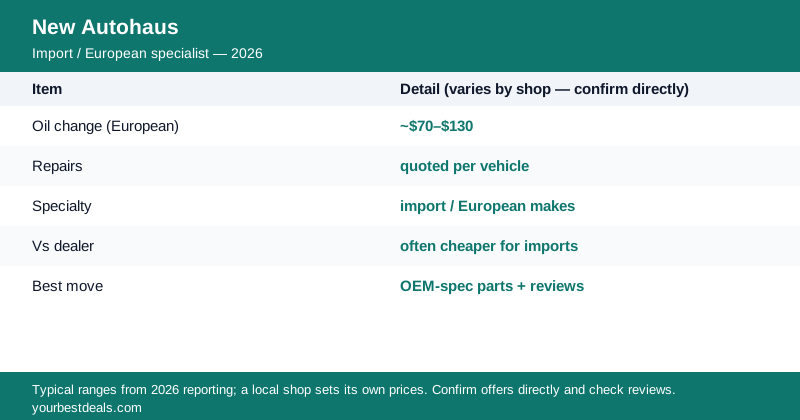
New Autohaus is a local import / European-make specialist shop – the kind of independent that focuses on BMW, Mercedes, Audi, VW, Volvo, and other European (and sometimes Asian import) vehicles. Typical prices: a European oil change roughly $70 to $130 (these cars need specific long-life, OEM-approved synthetic oil and often cost more to service); repairs quoted per vehicle. Get offers from the shop’s own site or by asking. These are typical ranges; the shop sets its own prices, so confirm directly. The key appeal: a good import specialist can be meaningfully cheaper than the dealer for European brands while using correct OEM-spec parts and fluids – which is exactly where this kind of shop earns its place.
European cars are where an independent specialist really shines – same expertise and OEM-spec parts as the dealer, often at a lower price. Here’s how to use one well.
What you’ll actually pay
Here’s the picture. The shop sets its own prices, so confirm directly.
| Service | Typical price | Notes |
|---|---|---|
| Oil change (European) | ~$70–$130 | OEM-spec long-life synthetic |
| Repairs | quoted per vehicle | Itemized estimate |
| Specialty | import / European makes | BMW, Mercedes, Audi, VW… |
| Vs dealer | often cheaper | Same OEM-spec parts |
Compare alternatives: our oil change cost guide, BMW oil change guide, and Firestone coupons guide.
Shop Talk
For a European car, an import specialist like New Autohaus is often the sweet spot between the dealer and a general shop. The dealer has the expertise and OEM parts but charges the most; a general corner shop or quick-lube may be cheaper but can get a European car wrong – wrong oil spec, missing the specific service procedure, or not having the right diagnostic tools. A dedicated import specialist gives you the dealer-level knowledge and correct OEM-spec parts and fluids, usually at a lower price than the dealer. The one thing that’s non-negotiable on European cars is the oil: they require specific long-life, manufacturer-approved synthetic (a BMW LL, Mercedes MB, VW/Audi, or Porsche approval number), so confirm the shop uses the exact approved oil for your car – that’s why the oil change costs more ($70 to $130) and why a cheap quick-lube is risky for these vehicles. For repairs, get an itemized estimate; a specialist often beats the dealer on labor for the same job. Check the shop’s reviews, especially from owners of your make. If you don’t have a trusted import specialist, the dealer is the safer fallback for a European car than a general shop – but a good specialist usually wins on price. For a BMW-specific example, see our BMW oil change guide.
Where Drivers Overpay
On European cars, drivers overpay by defaulting to the dealer when a good import specialist would do the same OEM-spec work for less – or they underpay in a risky way by taking a European car to a cheap general shop that uses the wrong oil spec, which can cost far more down the line.
The pattern: use an import specialist for European makes (dealer-level, lower price), insist on the exact OEM-approved oil and parts, get repairs itemized, and check reviews from owners of your make.
The Real Number
New Autohaus is an import/European specialist – European oil changes ~$70–$130 (OEM-approved long-life synthetic), repairs quoted per vehicle. For a European car it’s often the sweet spot: dealer-level expertise and correct OEM-spec parts at a lower price than the dealer. Insist on the exact manufacturer-approved oil and parts, get repairs itemized, and check reviews from owners of your make. A cheap general quick-lube is risky for these cars; a specialist or the dealer is the right call.
Frequently Asked Questions
How much is an oil change at an import specialist like New Autohaus?
A European-car oil change at an import specialist like New Autohaus typically runs roughly $70 to $130 – higher than a mainstream car because European vehicles require specific long-life, manufacturer-approved synthetic oil (often in larger quantities) and sometimes a pricier filter. These are typical ranges; the shop sets its own price, so confirm for your exact make and model. That price is usually still lower than the dealer for the same OEM-spec service, which is the appeal of a specialist. The critical point is the oil: your European car needs an oil meeting its specific OEM approval (a BMW Longlife, Mercedes-Benz, VW/Audi, Porsche, or similar spec), not just “synthetic,” so confirm the shop uses the exact approved oil – this is why these changes cost more and why a cheap general quick-lube is risky for these cars. For a make-specific example of what these changes cost, see our BMW oil change guide. So budget more than a mainstream change, insist on the correct OEM-approved oil, and a specialist like New Autohaus typically beats the dealer’s price for it.
Is an import specialist cheaper than the dealer?
Usually yes – a good independent import/European specialist is typically cheaper than the dealer for the same work on a European car, while using correct OEM-spec parts and fluids, which is exactly why these shops exist and thrive. Dealers charge a premium for European service; a dedicated specialist has the same expertise, the right diagnostic tools, and access to OEM or OEM-equivalent parts, but with lower overhead and more flexible labor rates, so it often undercuts the dealer meaningfully on both maintenance and repairs. The quality can be equal to the dealer’s when the specialist knows your make well. Where the dealer is still the right call is warranty work (covered repairs should go to the dealer so the manufacturer pays), recalls (dealer-only), and anything requiring the very latest factory software or a repair specific to a brand-new model. For out-of-warranty European cars, though, a trusted import specialist is frequently the best value – dealer-level service at a better price. The key is choosing a specialist with a strong reputation for your specific make (BMW, Mercedes, Audi, etc.), which reviews will show. So for a European car out of warranty, compare the specialist against the dealer; the specialist usually wins on price for comparable, correct-spec work.
Why can’t I just use a regular quick-lube for my European car?
You can for a very basic change in theory, but it’s risky, because European cars have strict oil requirements that a general quick-lube may not meet – and using the wrong oil can cause real problems and affect warranty coverage. European manufacturers (BMW, Mercedes, VW/Audi, Volvo, Porsche, etc.) specify oils meeting precise long-life OEM approval standards, not just a viscosity grade, and these engines are often sensitive to oil that doesn’t meet spec (affecting the long service intervals these cars use, and potentially causing issues over time). A budget quick-lube might stock only generic oils that don’t carry your car’s required approval, or default to the cheapest option, which is the wrong move for a European vehicle. That’s why an import specialist (or the dealer) that stocks and uses the exact OEM-approved oil is the safer choice, even though it costs more than a quick-lube. If you do use a general shop, you must confirm they have and will use the specific OEM-approved oil your car requires – if they can’t confirm that, go elsewhere. The modest savings of a cheap quick-lube aren’t worth risking an expensive European engine or a warranty dispute over wrong-spec oil. So for a European car, use a specialist or dealer with the correct approved oil, not a generic quick-lube – the oil spec is where this matters most.
How do I find a good import specialist?
Look for reviews specifically from owners of your make, confirmation that the shop regularly works on your brand with the right tools, and the professionalism signals that vet any shop. Online reviews are the starting point – but for a European car, look for feedback from other owners of your specific make (BMW, Mercedes, Audi, etc.), since a shop great with VWs may be less experienced with, say, Jaguars. Signs of a solid import specialist: technicians experienced and ideally certified on your brand, the correct diagnostic equipment and software for European cars, use of OEM or OEM-equivalent parts and the exact approved oil, a clean organized shop, and clear itemized estimates. Enthusiast forums and local owner groups for your make are excellent sources for recommended independent specialists in your area. Start with a smaller service (an oil change, with confirmation they use your car’s approved oil) to test the shop before a big repair. A good specialist becomes invaluable for a European car – dealer-level service without the dealer price. So vet via make-specific reviews and owner communities, confirm the brand expertise and correct oil/parts, and test with a small job. Once you’ve found a trusted import specialist, it’s usually your best value for an out-of-warranty European vehicle, clearly beating both the dealer (on price) and a general shop (on correctness).
Does New Autohaus work on non-European cars too?
Many import specialists work on a range of import makes, not only European ones, but their core strength and value is European and import vehicles, so it depends on the specific shop. Some “autohaus”-style specialists focus tightly on German brands (BMW, Mercedes, Audi, VW, Porsche); others handle broader European and Asian imports (Volvo, Jaguar, Land Rover, and sometimes Japanese makes). For a European car, the specialist is the clear reason to go. For a mainstream domestic or Japanese car, a specialist can certainly do the work, but you may not need the specialist premium – a general independent or chain is usually fine and possibly cheaper for a Toyota, Honda, or Chevy. So the rule of thumb: use an import specialist like New Autohaus when its expertise matches your car (European/import), and a general shop or chain for a mainstream vehicle where specialist knowledge isn’t needed. If you have both a European car and a domestic one in the household, you might use the specialist for the European car and a general shop for the other. Check with the specific shop about which makes it services; if your car is outside its focus, a general independent may serve you just as well for less. Match the shop’s specialty to your car.
Where do I find New Autohaus coupons?
Check the shop’s own website and ask directly, since import specialists – like most local independents – often have less of an online coupon presence than national chains, and the value usually comes from the competitive base price rather than a printed coupon. A good specialist’s pricing is already below the dealer’s for comparable OEM-spec work, which is the main saving; on top of that, the shop may offer a first-visit discount, a loyalty rate for regulars, or a seasonal special if you ask. Avoid third-party coupon-code sites, which rarely have valid offers for small specialists. Because European service is where the specialist’s price advantage over the dealer is the real “deal,” focus on getting the itemized quote and comparing it against the dealer rather than hunting for a coupon. For repairs, get the estimate itemized and confirm OEM-spec parts and oil. The practical move: check the shop’s site for any posted offer, ask what they can do, and compare the specialist’s price against the dealer’s for the same service – that comparison usually reveals the real savings. At an import specialist, the competitive price for correct European service is itself the deal, so the dealer comparison matters more than a coupon hunt.
What should I check before servicing a European car at New Autohaus?
A few checks make it worthwhile. First, confirm the shop regularly services your specific make and has the right diagnostic tools and software for it. Second – the critical one – confirm they’ll use the exact OEM-approved oil your car requires (the specific long-life approval, not just “synthetic”) and OEM or OEM-equivalent parts. Third, check reviews from owners of your make, and consider enthusiast forums for your brand. Fourth, for repairs, get an itemized written estimate and compare it against the dealer’s price for the same work – the specialist usually wins. Fifth, ask about any first-visit, loyalty, or seasonal discount, though the competitive base price is the main value. Sixth, keep records (especially if the car is still under warranty, so correct-spec service protects it). Do those, and you get the import specialist’s real advantage: dealer-level European service at a lower price, with the correct OEM-spec oil and parts. The oil spec is the non-negotiable for a European car, so confirm it above all – then the specialist is typically your best value over both the dealer and a general shop. For a make-specific cost example, see our BMW oil change guide.
Sources
Typical pricing and import-specialist-vs-dealer guidance verified against general European-service pricing reporting in November 2026. The shop sets its own prices and offers vary; amounts here are typical ranges, not quoted codes – confirm current offers, pricing, and the required OEM oil spec directly.
- SoFi – average cost of an oil change (2026)
- ASE – finding a certified shop
- API – engine oil standards and OEM approvals
Related Guides
- BMW Oil Change Cost
- Oil Change Cost Guide
- Firestone Coupons & Prices
- Local Auto & Tire Shop Guide
- Auto Service Coupons Hub

Diane Holcomb spent seven years as a service advisor at multi-brand dealerships in Charlotte, NC, and saw plenty of European owners sticker-shocked by dealer service – so she steers them to a reputable import specialist for dealer-level work at a lower price, with one firm rule: insist on the exact OEM-approved oil. She drives a 2019 Honda CR-V and a hand-me-down 2007 Toyota Camry, and takes no referral fees or advertising money from any shop or chain.