
Last updated: November 5, 2026 – By Diane Holcomb
November 2026 update: refreshed oil-type and by-location ranges against 2026 cost reporting and reconfirmed the DIY parts range.
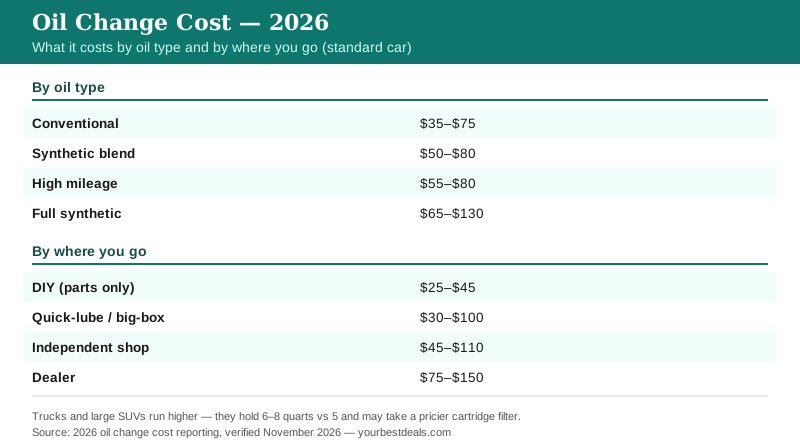
An oil change in 2026 costs $35 to $75 for conventional and $65 to $130 for full synthetic on a standard car, with most drivers on synthetic landing between $65 and $100. Where you go matters as much as the oil: doing it yourself runs $25 to $45 in parts, a quick-lube or big-box store $30 to $100, an independent shop $45 to $110, and a dealer $75 to $150 for the identical commodity oil and filter. The single biggest price mover is oil type, and the second is your vehicle’s oil capacity.
I wrote oil-change tickets for years, and the number one thing customers didn’t realize is how little the “oil change” label tells you about the price. Two cars, same three words on the invoice, forty dollars apart because one holds five quarts of conventional and the other takes seven quarts of full synthetic and a cartridge filter. So this guide breaks the cost down by the two things that actually decide it – what oil your car takes and how much of it – plus where you choose to have it done. For chain-by-chain prices and coupons, see the oil change coupons by chain guide.
Oil change cost by oil type
Oil type is the biggest lever on price. These are typical totals for a standard car holding about five quarts; more oil means more cost at every tier.
| Oil type | Typical cost | Who it’s for |
|---|---|---|
| Conventional | $35–$75 | Older cars that specify it |
| Synthetic blend | $50–$80 | A middle-ground upgrade |
| High mileage | $55–$80 | Cars over ~75,000 miles |
| Full synthetic | $65–$130 | Most modern engines (often required) |
Full synthetic is the biggest jump – often $40 more than conventional – but many newer cars require it, and it lasts longer between changes at 7,500 to 10,000 miles versus 3,000 to 5,000 for conventional. If your manufacturer requires synthetic, that’s your tier regardless of price; if it only recommends it, the longer interval partly offsets the higher cost.
Oil change cost by where you go
The same oil and filter cost very different amounts depending on who installs them, because you’re paying for labor, overhead, and convenience, not better parts.
| Where | Typical cost | Trade-off |
|---|---|---|
| DIY | $25–$45 (parts) | Cheapest; your time and disposal |
| Quick-lube / big-box | $30–$100 | Fast and cheap; watch upsells |
| Independent shop | $45–$110 | Good value, relationship |
| Dealer | $75–$150 | Priciest; logs warranty history |
For a routine oil change, the dealer’s premium rarely buys you anything the oil itself needs – it’s the same commodity part. The dealer makes sense mainly if your car is under warranty and you want the service history logged there, or if it takes an unusual oil the dealer reliably stocks. Otherwise, a chain or independent does the identical job for less.
Why your oil change costs more than the sticker
The advertised price almost always assumes a “standard car” holding five quarts. If yours holds six, seven, or eight – common on trucks and larger SUVs – you pay for the extra oil, which adds $20 to $30. Your filter matters too: some cars take a $6 spin-on, others a $22 cartridge that also takes longer to change. And full synthetic requirements can quietly move you up a tier from the conventional price you saw advertised.
Location fills in the rest. A shop in a high-rent metro pays more for the bay it’s standing in, and that shows up on your ticket regardless of who does the work. None of these are a shop cheating you – they’re the real inputs behind the number. Ask for an itemized ticket and the overage traces to oil quantity, filter type, oil grade, or local rates, in that rough order.
Straight From the Invoice: what oil changes actually cost
I pulled these from actual repair orders I either wrote or reviewed – a standard car, a truck, and a DIY comparison.
Invoice #1 – 2019 Honda CR-V, full synthetic, independent shop, Ohio
Full synthetic at $72, five quarts, standard spin-on filter – right in the middle of the fair range for a mainstream crossover at an independent. Lesson: for a standard five-quart car, full synthetic in the $65 to $90 range at a good independent is simply a fair price.
Invoice #2 – 2020 Ram 1500, full synthetic, dealer, Texas
Full synthetic came to $118 – and it was fair. The truck holds seven quarts, not five, and takes a larger filter, so the extra oil plus dealer pricing explained every dollar. Lesson: on a truck, don’t anchor to the standard-car price; the extra two quarts are a real $25 to $30 every time.
Invoice #3 – 2007 Toyota Camry, DIY vs shop, my own driveway
On my dad’s old Camry, conventional oil and a filter ran about $32 in parts doing it myself versus $55 at a shop. The $23 saved cost me thirty minutes and an oil-disposal trip. Lesson: DIY is really cheaper, but only worth it if your time and the disposal hassle are worth the roughly $20 to $30 you save.
Is a full synthetic oil change worth the cost?
When it’s required
If your manufacturer requires full synthetic, run it – no cost analysis needed. Modern engines with tight tolerances, turbochargers, or long service intervals are designed around synthetic, and running conventional risks real damage and warranty trouble. The $65 to $130 is simply the cost of maintaining the car correctly, and skimping to conventional to save $40 is a false economy that can cost an engine.
When it’s optional
If your car only recommends synthetic or specifies conventional, the math is closer. Full synthetic’s longer interval – 7,500 to 10,000 miles versus 3,000 to 5,000 – means fewer changes per year, which partly offsets the higher per-change price. For a driver who changes on schedule, annual cost between the two comes out roughly even. So on an older car that runs fine on conventional, there’s no need to pay up; on a car that benefits from synthetic’s protection, the longer interval makes it a reasonable choice.
Shop Talk
Know your car’s oil capacity and required grade before you go – it’s the two-number cheat sheet that tells you whether any quote is fair. If your manual says six quarts of full synthetic, the “from $49.99” sticker was never your price, and a $75 to $90 quote is reasonable, not a ripoff. The most common way people feel overcharged on an oil change isn’t being cheated; it’s anchoring to an advertised number built for a five-quart car that isn’t theirs. Two numbers from your owner’s manual fix that for good.
Where drivers overpay
The biggest oil-change overpay is buying more oil than your car needs – getting sold full synthetic on an older car that runs fine on conventional and that you change on the conventional schedule adds $40 for a benefit you won’t use. Check what your manufacturer requires versus recommends before accepting the upgrade. The second is defaulting to the dealer for a routine change; at $75 to $150 versus a chain’s $50 to $100, you’re paying a premium for identical commodity oil and a filter, useful only if you’re logging warranty history.
The third overpay is the add-on menu, not the oil. Quick-lubes and dealers alike surface fuel-system cleanings, flushes, and filters during the visit, and saying yes to a couple can double an honestly priced change. Decide on each add-on separately, on whether your mileage actually calls for it, and the oil change itself stays the fair price it should be.
The Real Number
Budget $35 to $75 for conventional and $65 to $130 for full synthetic on a standard car, with most synthetic drivers landing $65 to $100. Where you go moves it more than anything except oil type: DIY is cheapest, a chain or independent is the value sweet spot, and the dealer’s $75 to $150 is worth it mainly for warranty logging. Know your car’s oil capacity and required grade before you go – those two numbers tell you instantly whether a quote is fair, and they’re the fix for almost every “why did it cost so much” surprise.
Frequently Asked Questions
How much does an oil change cost in 2026?
On a standard car, $35 to $75 for conventional and $65 to $130 for full synthetic, with most synthetic drivers paying $65 to $100. Where you go changes it: DIY is $25 to $45 in parts, a quick-lube or big-box store $30 to $100, an independent $45 to $110, and a dealer $75 to $150. Trucks and large SUVs run higher because they hold six to eight quarts instead of five and may take a pricier cartridge filter. Oil type and oil capacity are the two biggest price movers.
Why is full synthetic so much more than conventional?
Full synthetic costs more to manufacture and protects better under heat and over longer intervals, so it commands a premium – often about $40 more than conventional per change. Many modern engines require it, in which case it’s simply the correct oil and not optional. The offset is that synthetic lasts longer, 7,500 to 10,000 miles versus 3,000 to 5,000 for conventional, so you buy fewer changes per year. For a driver changing on schedule, the annual cost between the two comes out roughly even despite the higher per-change price.
Is it cheaper to change your own oil?
Yes, meaningfully – DIY runs $25 to $45 in parts versus $45 to $110 at a shop, saving roughly $20 to $40 per change. The catch is your time and the oil-disposal trip, since used oil has to be recycled properly. For someone comfortable under a car with the right ramps or jack, DIY is a real saving over a year. For most people, the $20 to $30 saved isn’t worth the thirty-plus minutes and the mess, which is why quick-lubes and shops stay busy. It comes down to what your time is worth.
Is a dealer oil change worth the extra cost?
For a routine oil change, usually not. Dealers charge $75 to $150 versus a chain or independent’s $50 to $100 for the same commodity oil and filter, so the premium rarely buys anything the oil needs. The dealer makes sense in two cases: if your car is under warranty and you want the service history logged there for peace of mind, or if it takes an unusual oil spec the dealer reliably stocks. Otherwise, a reputable chain or independent does the identical job for less.
How often should I change my oil?
Follow your owner’s manual, not the windshield sticker, which is often set conservatively. Most modern engines on full synthetic go 7,500 to 10,000 miles between changes, while conventional typically wants 3,000 to 5,000. Many newer cars have an oil-life monitor that calculates the interval based on how you actually drive, and it’s more accurate than a fixed mileage. Changing more often than specified wastes money without helping the engine; going well past the interval risks sludge and wear, so the manual’s number is the one to trust.
Why did my oil change cost more than the advertised price?
Almost always oil quantity or oil type. The advertised price assumes a five-quart standard car, so if yours holds six to eight quarts, common on trucks, you pay $20 to $30 more for the extra oil. A required full synthetic can move you above the conventional price you saw, and a cartridge filter costs more than a spin-on. High-cost metros also run higher across the board. Ask for an itemized ticket and the overage almost always traces to your vehicle’s capacity, oil grade, or filter, not a hidden fee.
Does a more expensive oil change mean better quality?
No. The oil and filter are commodity parts, so a $130 dealer full synthetic and a $65 chain full synthetic in the same grade protect your engine identically. The price difference is labor, overhead, convenience, and sometimes an OEM-branded filter, not better oil. What actually matters for quality is that the oil meets your car’s required specification and viscosity, which a reputable chain, independent, or dealer all provide. Pay for the correct spec at a fair price rather than assuming a higher number means better protection.
Sources
Oil change cost ranges verified against 2026 cost reporting on November 5, 2026. Ranges are for a standard vehicle and vary by oil capacity, region, and shop; confirm your exact price locally.
- SoFi – average cost of an oil change, 2026
- NerdWallet – how much is an oil change
- Firestone – how much is an oil change (official)
Related Guides
- Oil change coupons and prices by chain
- Car repair cost estimator hub
- Walmart oil change price
- Brake pad replacement cost
- About Diane Holcomb

Diane Holcomb spent seven years writing oil-change tickets at Charlotte dealerships and two at an independent shop, where she watched identical changes price forty dollars apart over oil capacity alone. She writes the cost and pricing guides on Your Best Deals and takes no referral fees. She drives a 2019 Honda CR-V and a 2007 Toyota Camry.