
Last updated: November 3, 2026 – By Diane Holcomb
November 2026 update: refreshed guidance on evaluating a local auto & tire shop and its coupons; prices vary by shop, so confirm directly.
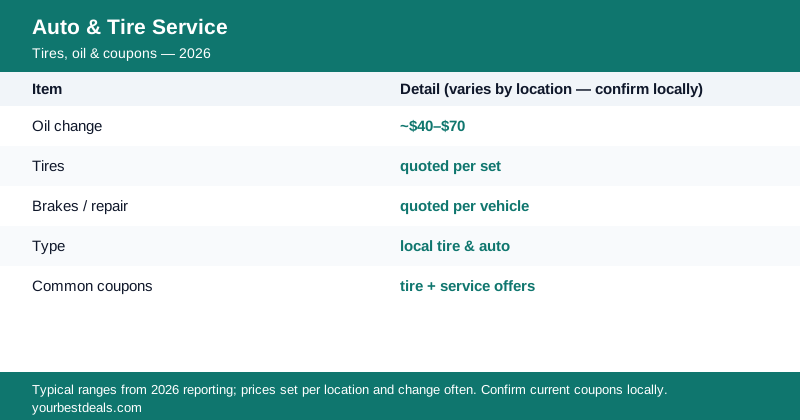
A local auto & tire shop handles tires plus oil changes, brakes, alignment, and general repair – the neighborhood tire-and-service operation. Typical prices: an oil change roughly $40 to $70; tires quoted per set; brakes and repair quoted per vehicle. Get the current coupon from the shop’s own site or by asking directly rather than third-party pages. These are typical ranges; the shop sets prices locally and they vary, so confirm directly. This guide is about how to evaluate and get the best deal at a local auto & tire shop – the discipline that applies to any such operation.
Local auto & tire shops are the backbone of car care, and the way to get a fair deal at one is simple and the same everywhere. Here it is.
What you’ll actually pay
Here’s the picture. Prices vary by shop and change, so confirm directly.
| Service | Typical price | Notes |
|---|---|---|
| Oil change | ~$40–$70 | By oil tier |
| Tires (set of four) | quoted per set | Out-the-door + rebate |
| Brakes / repair | quoted per vehicle | Itemized estimate |
| Coupons | shop site / ask | Vary |
Compare alternatives: our new tires cost guide, oil change cost guide, and Firestone coupons guide.
Shop Talk
At a local auto & tire shop, the deal often comes from the relationship as much as a printed coupon – regulars get fair pricing and honest advice, which is the whole appeal of a good neighborhood shop. Still, use the same discipline: for tires, get the out-the-door installed price (tires plus mount, balance, valve stems/TPMS, disposal, optional road hazard) and ask whether a manufacturer rebate (through the shop’s distributor) is running, then compare against Discount Tire and Costco. For repairs, get an itemized written estimate – and here independents often undercut the chains, a real advantage. For the oil change, confirm your oil tier (synthetic for most newer cars) and ask about any deal. Since a small shop may not post coupons online, just ask what they can do; many will match a competitor or knock a bit off for a regular. Check the shop’s local reviews to confirm it’s reputable before trusting it with a big repair. If you don’t have a good local shop, a full-service chain (Firestone, NTB) or Discount Tire/Costco for tires covers the same ground. The formula: reputation check, out-the-door tire price, itemized repair estimate, and just ask about discounts.
Where Drivers Overpay
At a local shop the overpay is skipping the out-the-door tire comparison and the rebate, and not asking about discounts (a small shop may not advertise them). On repairs, independents are often cheaper than chains, so not getting a local quote can mean overpaying at a chain.
The pattern: check the shop’s reviews, get the out-the-door tire price and any rebate, get repairs itemized, and simply ask what discount they can do.
The Real Number
A local auto & tire shop runs oil changes ~$40–$70, with tires and repairs quoted per vehicle. The deal often comes from the relationship, so just ask about discounts – small shops may not post coupons. For tires, get the out-the-door price and any rebate and compare against Discount Tire and Costco; for repairs, get an itemized estimate, where a good independent often beats the chains. Check reviews before a big job.
Frequently Asked Questions
How much is an oil change at a local auto & tire shop?
An oil change at a local auto & tire shop typically runs roughly $40 to $70 depending on the oil tier, with synthetic at the higher end and diesel or large engines more. These are typical ranges; the shop sets prices locally, so call or check for an exact figure, and expect a small disposal fee. The low end is conventional oil – most newer cars require synthetic, so expect the synthetic tier. A local shop may not post coupons online, so ask directly about any current oil-change deal. For how it compares with chains, see our oil change cost guide, and confirm the price for your vehicle locally. A neighborhood auto & tire shop is a convenient one-stop and often fair on price given its reliance on repeat customers – and it can bundle the oil change with a tire rotation or inspection. Just confirm your oil tier so the quote is right, and ask what deal they can do.
How do I know a local tire shop is trustworthy?
Check its reviews, look for signs of professionalism, and start with a small job before trusting it with a big one – those three steps vet most local shops. Online reviews (Google, Yelp, the Better Business Bureau) give a quick read on a shop’s reputation, especially patterns in how it handles problems and whether customers feel fairly treated. Signs of a solid shop include ASE-certified technicians, a clean and organized facility, clear itemized estimates, willingness to show you worn parts, and no pressure to approve work on the spot. A good test is to start with an oil change or a tire rotation and see how they treat you – whether they explain things, push unneeded add-ons, or respect a “not today.” For a bigger repair, get the estimate itemized and don’t hesitate to get a second opinion. A trustworthy independent often becomes more valuable over time as the shop gets to know your car and you build a relationship, which is the real advantage over a rotating cast at a chain. So vet with reviews and a small job, watch for the professionalism signals, and you’ll find whether a local auto & tire shop is one to rely on. A good one is worth keeping.
Where do I find coupons for a local auto & tire shop?
Check the shop’s own website, local advertising (mailers, local papers, community pages), and simply ask at the counter, since small independent shops often have less of an online coupon presence than national chains. A current oil-change deal, tire rebate, or loyalty discount may be posted on its site, advertised locally, or available just for asking – many shops will knock a bit off for a regular or match a nearby competitor’s price. For tires, ask whether a manufacturer rebate (through the shop’s tire distributor) is running, as that’s usually the biggest saving on a set. Avoid third-party coupon-code sites, which rarely have valid offers for small local shops. Because the relationship matters at a local shop, the “coupon” is often just a fair price you get by asking, so don’t assume you need a printed code to get a deal. Confirm any offer applies to your oil tier or service. The practical move: check the shop’s site, ask directly about current deals and any tire rebate, and compare the out-the-door tire price against other sellers regardless. At a good local shop, asking politely what they can do is often the most effective “coupon” there is.
Is a local shop cheaper than a chain?
Often for repairs, yes – a local independent auto shop is frequently cheaper than a national chain or dealer for the same repair work, because it has lower overhead and relies on fair pricing to keep regulars, so for brakes, suspension, and general repair it’s well worth getting a local quote. For tires, independents are competitive but you should still compare the out-the-door price against Discount Tire and Costco, since the big tire sellers have buying power that can make them hard to beat on the tires themselves. For oil changes, a local shop is usually in the same range as chains, sometimes a bit less, and may bundle extras. So the pattern is: local independents tend to win on repair labor, are competitive on tires (compare out-the-door), and are comparable on oil changes. The trade-off versus a chain is less of a national coupon program and warranty network, but a good independent makes up for it in price, service, and a mechanic who knows your car. So don’t assume a chain with a coupon beats a local shop – especially on repairs, get the local quote and compare. For tires specifically, put the local out-the-door price against the big sellers. The best approach uses both: a trusted local shop for repairs, and whichever seller wins out-the-door for tires.
What should I ask before a repair at a local shop?
Ask for an itemized written estimate, what’s actually needed versus recommended, whether they’ll show you the worn parts, what warranty the parts and labor carry, and the all-in total before they start. An itemized estimate (parts and labor broken out) lets you see where the money goes and compare with another shop if it’s a big job. Asking what’s needed now versus what can wait separates safety-critical repairs from nice-to-haves and helps you budget. A willingness to show you the worn part (the leaking component, the thin brake pad) is a good sign of an honest shop. The parts-and-labor warranty matters for peace of mind, and some shops offer lifetime warranties on certain parts. And confirming the all-in total up front avoids a surprise at pickup. For a bigger or costlier repair, there’s no harm in getting a second estimate elsewhere, and a good shop won’t be offended. These questions work at any shop – chain, dealer, or independent – but they’re especially easy to ask at a local shop where you can talk directly to the person doing the work. Run through them, and you’ll know whether the repair is fair and necessary before you commit, which matters far more than any coupon. For repair cost context, see our brake job cost guide and other estimator pages.
Is a local shop good for tires?
Yes, local auto & tire shops sell and install tires as a core service and can be competitive, but for tires specifically you should always compare the out-the-door price against the big tire sellers, since Discount Tire, Costco, and online retailers have scale that’s hard to beat on the tires themselves. Get the shop’s out-the-door installed price – the tire cost plus mounting, balancing, valve stems or TPMS service, disposal, and any optional road-hazard coverage – and ask whether a manufacturer rebate (through its distributor) applies, then put that net total against Costco, Discount Tire, and Tire Rack. A local shop may match or beat them, especially with a rebate and your relationship, and it handles the alignment and related work in one place. But convenience and loyalty don’t guarantee the lowest tire price, so the comparison matters. Where the local shop more reliably wins is repairs, not necessarily tires. So for tires, treat the local shop as one quote among several on out-the-door price; for repairs, lean toward it. Either way, chase any rebate and submit it promptly. For what tires typically cost installed, see our new tires cost guide, and compare the local out-the-door quote against the big sellers before buying.
What should I check before using a local shop coupon?
A few checks capture the value. First, check the shop’s site and ask directly for current offers, since independents may not post coupons online – a deal or fair price often comes from asking. Second, for tires, ask about any manufacturer rebate, get the out-the-door installed price, and compare against Discount Tire, Costco, and online. Third, for the oil change, confirm your required oil tier and ask about any deal. Fourth, for brakes or repairs, get an itemized written estimate, ask what’s needed versus recommended, and consider a second quote on a big job – while giving the independent a fair look, since it often beats chains on repair labor. Fifth, check the shop’s local reviews to confirm its reputation. Sixth, ask about any parts-and-labor warranty. Do those, and you get the value a good local shop offers: fair pricing, personal service, competitive tires (compared out-the-door), and often cheaper repairs. At a local shop, the relationship and a direct ask are frequently worth more than any printed coupon, so build that relationship with a reputable shop and ask what they can do.
Sources
Typical pricing and guidance on evaluating local shops verified against general auto-service pricing reporting in November 2026. Shops set prices locally and offers vary; amounts here are typical ranges, not quoted codes – confirm current offers and pricing directly.
- SoFi – average cost of an oil change (2026)
- ASE – finding a certified shop
- Tire Rack – tire pricing reference
Related Guides
- New Tires Cost Guide
- Oil Change Cost Guide
- Firestone Coupons & Prices
- Brake Job Cost Guide
- Auto Service Coupons Hub

Diane Holcomb spent seven years as a service advisor at multi-brand dealerships in Charlotte, NC, and became a believer in the good neighborhood shop – her advice is to vet it with reviews and a small job, then let the relationship (and a direct ask) be your best coupon, while still comparing tire prices out-the-door. She drives a 2019 Honda CR-V and a hand-me-down 2007 Toyota Camry, and takes no referral fees or advertising money from any shop or chain.