
Last updated: November 10, 2026 – By Diane Holcomb
November 2026 update: reconfirmed shock vs strut pricing and the alignment and pairs points.
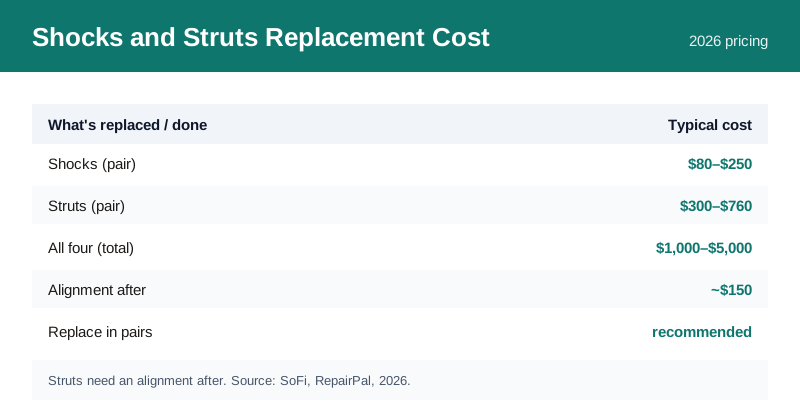
Shocks and struts do the same basic job but cost very differently. Shock absorbers run about $80 to $250 a pair, while struts (which combine the shock with a structural suspension component and the spring mount) run $300 to $760 a pair. Doing all four totals roughly $1,000 to $5,000 depending on whether your vehicle uses shocks or struts and which it is, plus about $150 for a wheel alignment. Shocks and struts dampen the suspension’s movement so the ride stays controlled and the tires stay planted on the road. When they wear out, you get excessive bouncing after bumps, nose-diving when braking, body roll and poor handling, a harsh or wallowing ride, and uneven (“cupped”) tire wear. Two key points: they’re replaced in pairs (both fronts or both rears) or all at once, and because struts are structural and affect alignment, a strut job needs an alignment afterward – a plain shock job usually doesn’t.
The big cost question is whether your car has shocks or struts, and that also decides the alignment. Let me break it down.
What you’ll actually pay
Here’s the picture. These are estimates that vary by vehicle and shop.
| Item | Cost | Notes |
|---|---|---|
| Shocks (pair) | $80–$250 | Cheaper |
| Struts (pair) | $300–$760 | Structural |
| All four (total) | $1,000–$5,000 | By type/vehicle |
| Alignment (struts) | ~$150 | Required |
Shocks and struts are the core of ride control; our strut guide, shock guide, and alignment guide cover them individually.
Shop Talk
The first thing that sets the price is whether your car uses shocks or struts. A plain shock absorber is a simpler, cheaper part that just dampens; a strut is a bigger assembly that combines the shock with a structural part of the suspension (and usually the spring seat), so it costs more and takes more labor. Many modern cars use struts up front and shocks (or struts) in the rear – so “shocks and struts” often means struts on one end and shocks on the other. A big money tip: buying a loaded (quick) strut assembly – the strut pre-assembled with a new spring and mount – costs more in parts but saves labor and avoids wrestling a dangerous compressed spring, and it refreshes the spring and mount too. Two things worth knowing. One, pairs: always do them in pairs (both fronts or both rears), because a new one on one side and a worn one on the other makes the car handle unevenly. Many people do all four at once if they’re all worn, which is common and sensible. Two, alignment: replacing struts disturbs the alignment (the strut affects camber on many cars), so budget for an alignment after a strut job – plain rear shocks usually don’t require one. And don’t ignore worn shocks/struts: beyond the floaty, bouncy ride, they lengthen stopping distances and chew up tires, so it’s a safety and a money issue, not just comfort.
Where Drivers Overpay
The cost here is mostly set by shocks-versus-struts, which you can’t change – but on a strut job, a loaded (quick) strut assembly saves labor and refreshes the spring and mount, often the better value than rebuilding your old strut with a spring compressor. Knowing that option is the save.
The waste to avoid is doing one side only (uneven handling forces you back) or skipping the required alignment after struts (which chews tires). The pattern: confirm shocks or struts, do them in pairs or all four if worn, consider loaded struts, and include the alignment on any strut job.
The Real Number
Shocks are $80 to $250 a pair; struts $300 to $760 a pair; all four $1,000 to $5,000 depending on which your car uses, plus ~$150 for the alignment struts require (shocks usually don’t). Replace in pairs or all four – never one side. On struts, a loaded (quick) assembly saves labor and refreshes the spring and mount. Worn shocks and struts lengthen braking and cup tires, so it’s safety, not just comfort.
Frequently Asked Questions
How much does it cost to replace shocks and struts?
Shock absorbers run about $80 to $250 a pair, and struts $300 to $760 a pair, because a strut is a larger structural assembly. Replacing all four totals roughly $1,000 to $5,000 depending on whether your vehicle uses shocks or struts (and which), the vehicle, and parts quality. A strut job also needs a wheel alignment afterward, about $150. These are estimates that vary by vehicle and shop. The big cost variable is shocks versus struts – struts are pricier in parts and labor. Buying loaded (quick) strut assemblies costs more in parts but saves labor. Because they’re done in pairs or all at once, budget accordingly. Confirming what your vehicle uses, and whether you’re doing one axle or all four, is key to an accurate number.
What’s the difference between shocks and struts?
Both dampen the suspension’s motion, but they’re built differently. A shock absorber is a standalone damping device that controls the up-and-down motion of the suspension; it’s not structural and the spring is separate. A strut combines the shock absorber with a structural component of the suspension – it’s a load-bearing part that also typically holds the coil spring and often serves as a steering pivot. Because a strut is structural and more complex, it costs more and its replacement affects wheel alignment. Many vehicles use struts at the front (where they double as part of the steering/suspension structure) and shocks or struts at the rear. So “shocks and struts” often means a mix. Knowing which your vehicle has at each corner determines the cost and whether an alignment is needed. A shop can tell you your setup.
What are the signs of worn shocks or struts?
Common signs include excessive bouncing after hitting a bump (the car keeps oscillating instead of settling), nose-diving when you brake and squatting when you accelerate, body roll or leaning in turns, a floaty, wallowing, or harsh ride, uneven or cupped tire wear, and sometimes fluid leaking from the shock or strut body. You might also feel the car wandering or feel less stable at speed or in crosswinds. A quick (imperfect) test is the bounce test: push down hard on a corner and let go – if it bounces more than once or twice, the damper may be worn. Because worn shocks/struts affect handling, braking distance, and tire wear, these signs are worth acting on. A shop can confirm wear and leaks. They degrade gradually, so the decline is easy to miss until it’s significant.
Do I have to replace them in pairs?
Yes, it’s strongly recommended – replace shocks or struts in pairs (both fronts together, or both rears together). The reason is balance: a new damper on one side and a worn one on the other makes the car respond unevenly side to side, which hurts handling and can feel unstable, especially in braking and cornering. New and old dampers have different characteristics, so mixing them compromises the benefit. If all four are worn (common, since they wear together), doing all four at once is sensible and often done. If only one axle is worn, you can do just that axle’s pair. But doing a single corner is not advised. So the minimum unit is a pair per axle. This also makes the alignment (on strut jobs) and labor more efficient when done together. Plan for pairs, not singles.
Why do struts need an alignment but shocks don’t?
Because struts are structural and affect the wheel’s alignment angles, while plain shocks aren’t. On many vehicles the front strut is part of the steering/suspension geometry and influences the camber angle (and sometimes caster), so removing and replacing it disturbs the alignment – meaning a wheel alignment is needed afterward to reset the angles and prevent uneven tire wear and pulling. A standalone rear shock absorber, by contrast, just bolts in to dampen motion and doesn’t change the alignment geometry, so it typically doesn’t require an alignment. That’s why a front strut job should include an alignment (about $150) in the budget, but replacing simple rear shocks usually doesn’t. If your job involves struts, factor in the alignment; if it’s only non-structural shocks, you likely can skip it. A shop will advise based on your specific setup.
What is a loaded or quick strut?
A loaded strut (also called a quick strut or complete strut assembly) is a strut that comes pre-assembled with a new coil spring, strut mount, and bearing already installed – essentially a ready-to-bolt-in unit. The alternative is a “bare” strut, where the technician has to transfer your old spring and mount onto the new strut using a spring compressor (compressing a suspension spring is dangerous and time-consuming). Loaded struts cost more in parts but save labor, reduce risk, and refresh the spring and mount (which also wear) at the same time. For many cars, loaded struts are the preferred, cost-effective choice despite the higher part price, because the labor savings and the fresh spring/mount offset it. Ask your shop whether they’re quoting loaded struts or bare struts – the parts-versus-labor trade-off and what you get (a new spring and mount) is worth understanding.
Is it safe to drive with worn shocks and struts?
It’s drivable, but worn shocks and struts are a safety and cost issue, not just comfort, so they shouldn’t be ignored for long. Worn dampers let the tires lose contact with the road more easily, which lengthens braking distances, reduces stability and control (especially in emergency maneuvers, cornering, and bad weather), and makes the car float and wander. They also cause uneven, cupped tire wear that shortens tire life and can create vibration. So beyond the deteriorated ride, you’re dealing with compromised handling and braking and accelerated tire wear. For those reasons, replacing worn shocks/struts is worthwhile rather than living with them indefinitely. If the ride has become floaty, bouncy, or unstable, or you see cupped tires or fluid leaks, it’s time. It’s a gradual decline, so many drivers don’t realize how much control they’ve lost until the new ones go in.
Sources
Price ranges verified against 2026 shock and strut pricing in November 2026. Dollar amounts are estimates that vary by vehicle and shop.
- SoFi – shocks and struts replacement cost
- RepairPal – repair cost estimator
- ASE – National Institute for Automotive Service Excellence
Related Guides
- Strut Replacement Cost
- Shock Absorber Replacement Cost
- Wheel Alignment Cost
- Lower Ball Joint Replacement Cost
- Car Repair Cost Estimator

Diane Holcomb spent seven years as a service advisor at multi-brand dealerships in Charlotte, NC, where she’d explain why struts cost more than shocks, why they’re done in pairs, and why a strut job always included the alignment. She drives a 2019 Honda CR-V and a hand-me-down 2007 Toyota Camry, and takes no referral fees or advertising money from any shop or chain.