
Last updated: November 9, 2026 – By Diane Holcomb
November 2026 update: consolidated two strut cost guides, reconciled the per-pair and parts pricing, and added the alignment-vs-shocks and drive-safety detail.
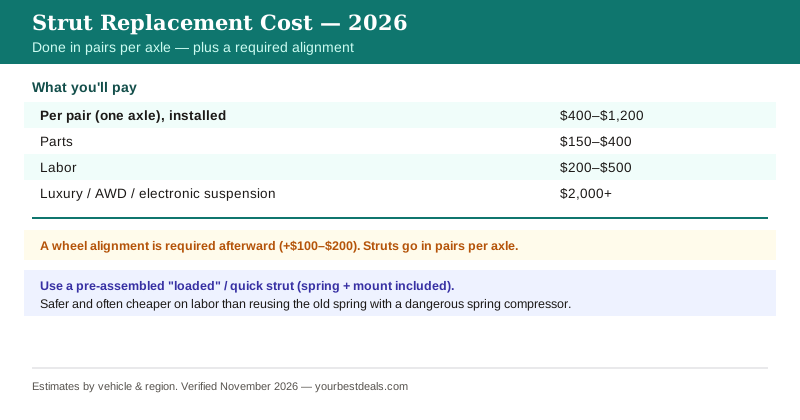
Strut replacement costs about $400 to $1,200 for a pair (one axle) installed – parts around $150 to $400 per strut (a pair of pre-assembled “loaded” struts runs roughly $300 to $760 in parts) and labor $200 to $500 – with luxury, AWD, or electronic-suspension vehicles exceeding $2,000 a pair. A national-average front pair runs roughly $580 at an independent shop and $780 at a dealer. Two things to budget for: struts are replaced in pairs per axle (for even handling), and a wheel alignment is required afterward (add $100 to $200), because replacing a strut changes the suspension geometry. The money-and-safety tip worth knowing: using a pre-assembled “loaded” or “quick” strut – which comes with the spring and mount already installed – is safer and often cheaper on labor than reusing your old spring, which requires a dangerous spring compressor.
Struts combine the shock absorber and a structural suspension role, so they’re a bigger job than shocks, and the quick-strut option changes the cost equation. Let me cover the price, the pairs-and-alignment factors, and when you actually need them.
What you’ll actually pay
Here’s the price picture. These are estimated ranges that vary by vehicle and shop.
| Item | Cost | Notes |
|---|---|---|
| Per pair (one axle), installed | $400–$1,200 | Both fronts or both rears |
| Parts (per strut / loaded pair) | $150–$400 each / $300–$760 pair | Loaded = spring + mount included |
| Labor | $200–$500 | Less with loaded/quick struts |
| National-average front pair | ~$580 indep. / ~$780 dealer | Installed |
| Luxury / AWD / electronic | $2,000+ | Adaptive dampers cost more |
| Alignment (required after) | $100–$200 | Added to the job |
A strut is both the damper and a load-bearing part of the suspension, with the coil spring mounted on it, which is why it’s a more involved job than a plain shock. The spring is under heavy tension, so swapping just the strut cartridge means compressing that spring – a job that needs a spring compressor and carries real injury risk if done wrong. That’s where loaded/quick struts come in (covered below). Budget the required alignment into any strut job. Our shock cost guide and suspension & steering guide cover the related parts.
Shop Talk
Ask for a “loaded” or “quick” strut – it’s usually the smart choice on both safety and cost. A bare strut cartridge is cheaper as a part, but installing it means transferring your old coil spring and top mount onto the new strut, which requires compressing that spring with a spring compressor. A compressed suspension spring stores enormous energy, and if it slips it can cause serious injury – it’s one of the more dangerous DIY jobs. A loaded (quick) strut comes as a complete pre-assembled unit with a new spring and mount already on it, so it bolts right in. That saves significant labor (no spring transfer), gives you a fresh spring and mount (which wear too), and removes the spring-compressor danger. The part costs a bit more, but the labor savings often make the total similar or cheaper, and it’s far safer. Two more notes: always do struts in pairs per axle – a new strut on one side and a worn one on the other makes the car handle unevenly, and if all four are worn, doing all four is common and sensible – and always include the alignment, since strut replacement disturbs your camber/toe and skipping it wears your tires. Don’t write off worn struts as just a comfort issue: they lengthen braking distances and cup your tires, so it’s a safety and money matter. And if a shop quotes a cheap strut price with no alignment, add that $100 to $200 to compare the real total.
Where Drivers Overpay
The cost surprises on struts are the alignment and the spring-transfer labor. A quote that omits the required alignment understates the real total by $100 to $200, so confirm it’s included. And paying to transfer your old spring onto a bare strut (with the spring-compressor labor and risk) can cost more than just buying loaded quick struts – ask the shop to price it both ways, because the complete unit often wins on total cost and safety.
The flip side is skipping needed struts or doing only one side. Worn struts hurt handling, braking, and tire wear, and are a safety issue, so they shouldn’t be ignored – but do them in pairs per axle (or all four if all worn), not one at a time, or the car handles unevenly. The pattern: replace struts in pairs, use loaded/quick struts for labor savings and safety, always include the alignment, and compare the all-in total (strut + alignment) rather than a bare strut price. Our ride-control wear guide covers when they’re due.
The Real Number
Struts run $400 to $1,200 per axle pair installed (a front pair averages about $580 independent, $780 dealer; luxury/AWD $2,000+), plus a required alignment ($100 to $200). Always do them in pairs per axle, and ask for loaded/quick struts – the pre-assembled unit (with new spring and mount) saves spring-transfer labor, avoids the dangerous spring compressor, and often makes the total similar or cheaper. Confirm the alignment is in the quote so you’re comparing the real all-in cost, and remember worn struts lengthen braking and cup tires, so they’re a safety repair, not just comfort.
Frequently Asked Questions
How much does it cost to replace struts?
About $400 to $1,200 for a pair (one axle) installed, with parts around $150 to $400 per strut – or $300 to $760 for a pair of loaded quick struts – and labor $200 to $500. Luxury, AWD, or electronic-suspension vehicles can exceed $2,000 a pair. A national-average front pair is roughly $580 at an independent shop and $780 at a dealer. A wheel alignment is required afterward, adding $100 to $200. Struts are replaced in pairs per axle, so pricing is per axle; doing all four when they’re all worn costs more. These are estimates that vary by vehicle and shop. Ask whether the quote includes the alignment and whether it uses loaded (quick) struts, which affect the total.
What is a strut, and how is it different from a shock?
Both are dampers that control bounce, but a strut is also a structural, load-bearing part of the suspension with the coil spring mounted on it – and often part of the front steering geometry – while a shock is a simpler standalone damper that doesn’t carry the spring. That’s why struts cost more and require an alignment (and a spring compressor for bare cartridges), while shocks are cheaper and usually don’t need an alignment. Many modern cars use struts in front and shocks or struts in the rear, so whether a corner has a strut or a shock determines the cost and the job. If you’re replacing “the struts,” you’re dealing with the structural, spring-holding units – pricier than shocks and requiring an alignment afterward. A shop can confirm your vehicle’s setup.
Why do struts need an alignment but shocks don’t?
Because struts are structural and affect the wheel’s alignment angles, while plain shocks aren’t. On most vehicles the front strut is part of the steering and suspension geometry and influences the camber angle (and sometimes caster), so removing and replacing it disturbs the alignment – meaning a wheel alignment afterward is needed to reset the angles and prevent uneven tire wear and pulling. A standalone shock absorber just bolts in to dampen motion and doesn’t change the alignment geometry, so it typically doesn’t require one. That’s why a strut job should include an alignment ($100 to $200) in the budget, while replacing simple shocks usually doesn’t. Skipping the alignment after struts quickly causes uneven, premature tire wear and can leave the car pulling, so treat it as a required finishing step, not an optional add-on.
Do struts have to be replaced in pairs?
Yes – replace struts in pairs on the same axle (both fronts together, or both rears together). A new strut on one side and a worn one on the other makes the car respond unevenly side to side, which hurts handling and can feel unstable, especially under braking and in corners, since new and worn struts have different damping characteristics. Struts on an axle also wear at a similar rate, so they’re usually due together. You don’t have to do all four at once (front and rear wear differently), though if all four are worn – common, since they wear together – doing all four is sensible and often done. If only one axle is worn, do just that axle’s pair. The minimum unit is a pair per axle; doing a single corner isn’t advised. It’s both a handling and a safety matter.
What is a loaded or quick strut, and is it worth it?
A loaded strut (also called a quick strut or complete strut assembly) is a strut that comes pre-assembled with a new coil spring, strut mount, and bearing already installed – a ready-to-bolt-in unit. The alternative is a bare strut, where the technician transfers your old spring and mount onto the new strut using a spring compressor (compressing a suspension spring is dangerous and time-consuming). Loaded struts cost a bit more in parts but save labor, reduce risk, and refresh the spring and mount (which also wear) at the same time. For many vehicles they’re the preferred, cost-effective choice despite the higher part price, because the labor savings and the fresh spring and mount offset it. So they’re usually worth it – ask your shop whether they’re quoting loaded struts or bare struts, since the parts-versus-labor trade-off, and getting a new spring and mount in the bargain, is worth understanding when comparing quotes.
What are the signs of worn struts?
Common signs are a bouncy, floaty, or unstable ride, excessive bouncing after hitting a bump (the car keeps oscillating instead of settling), the nose diving sharply when you brake or the rear squatting when you accelerate, body roll or leaning in turns, clunking or knocking over bumps, uneven or cupped tire wear, and sometimes fluid leaking from the strut body. A bounce test – pushing down hard on a corner and releasing – that keeps bouncing more than once or twice suggests a worn damper. Because worn struts affect handling, braking distance, and tire life, these signs are worth acting on rather than dismissing as just ride comfort. They degrade gradually, so the decline is easy to miss until it’s significant – many drivers don’t realize how much control they’d lost until the new struts go in.
How long do struts last?
There’s no fixed interval, but struts commonly last around 50,000 to 100,000 miles depending on road conditions, driving style, and vehicle. Rough roads, potholes, and heavy loads wear them faster. They degrade gradually, so the decline in ride and handling can be hard to notice until it’s significant. Having them inspected around 50,000 miles and beyond, or whenever you notice bouncing, nose-dive, or clunks, is the sensible approach. They’re replaced when worn or leaking, not on a strict schedule, and in pairs per axle when they’re due.
Is it safe to drive with worn struts?
It’s drivable, but worn struts are a safety and cost issue, not just comfort, so they shouldn’t be ignored for long. Worn struts let the tires lose contact with the road more easily, which lengthens braking distances, reduces stability and control (especially in emergency maneuvers, cornering, and bad weather), and makes the car float and wander. They also cause uneven, cupped tire wear that shortens tire life and can create vibration. So beyond the deteriorated ride, you’re dealing with compromised handling and braking and accelerated tire wear, which is why replacing worn struts is worthwhile rather than living with them indefinitely. If the ride has become floaty, bouncy, or unstable, or you see cupped tires or fluid leaks, it’s time. Because the decline is gradual, the loss of control is easy to underestimate, but it’s real.
Sources
Price ranges verified against 2026 suspension-repair pricing in November 2026. Dollar amounts are estimates that vary by vehicle and shop, and include a required alignment.
- RepairPal – strut replacement estimates
- SoFi – shocks and struts replacement cost
- NHTSA – vehicle safety
Related Guides
- Shock Replacement Cost
- Wheel Alignment Cost
- Car Suspension Repair Cost
- How Long Should Shocks Last?
- Car Repair Cost Estimator

Diane Holcomb spent seven years as a service advisor at multi-brand dealerships in Charlotte, NC, where a strut job meant loaded struts in pairs plus the alignment – the combination that gave customers the best value and a car that tracked straight. She writes the real-world cost guides on Your Best Deals and takes no referral fees or advertising money from any shop or chain. She drives a 2019 Honda CR-V and a hand-me-down 2007 Toyota Camry.