
Last updated: November 7, 2026 – By Diane Holcomb
November 2026 update: reconfirmed ball joint pricing and the integrated-control-arm point.
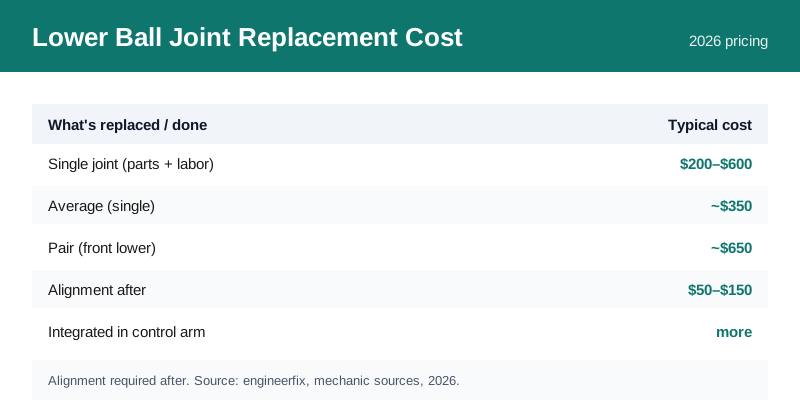
A single lower ball joint runs about $200 to $600 for parts and labor (averaging near $350), and a front pair is around $650. An alignment is required after, adding $50 to $150. On vehicles where the ball joint is integrated into the control arm (not separately replaceable), you replace the whole control arm, which costs more. The lower ball joint is a pivoting joint – like a hip joint – that connects the lower control arm to the steering knuckle, letting the front wheel steer left and right while the suspension moves up and down. When it wears, you get a clunking or knocking over bumps, loose or wandering steering, uneven tire wear, and sometimes a squeak. Here’s why it matters more than a sway bar link: a lower ball joint is a load-bearing safety part, and a badly worn one that fails completely can let the wheel collapse or separate – so this is one you don’t ride out.
Unlike a sway bar link, this is a safety joint, so let me cover the cost and why you act on it.
What you’ll actually pay
Here’s the picture. These are estimates that vary by vehicle and shop.
| Item | Cost | Notes |
|---|---|---|
| Single joint (parts + labor) | $200–$600 | Avg ~$350 |
| Front pair | ~$650 | Shared labor |
| Alignment after | $50–$150 | Required |
| Integrated in control arm | more | Whole arm |
Ball joints are part of the front suspension; our ball joint guide, control arm guide, and alignment guide cover the related parts.
Shop Talk
Treat a lower ball joint differently from a sway bar link – it’s a load-bearing safety part. The lower ball joint carries the weight and pivots as the wheel steers and the suspension moves, and if it’s badly worn and finally fails, the wheel can collapse or fold under, which is a lose-control-at-speed situation. So a clunk over bumps plus loose, wandering steering (and maybe uneven tire wear) is something to get checked and fixed, not ride out. Cost-wise, a few things matter. One, how the joint mounts: a press-in ball joint (pressed into the control arm or knuckle) takes more labor than a bolt-on one, and on many modern cars the lower ball joint is integrated into the control arm and isn’t sold separately – so you buy and install the whole control arm, which costs more but is sometimes actually easier labor. Ask which your car has. Two, pairs: if one lower ball joint is worn, the other side is the same age, and since the labor and the required alignment overlap, doing both is often sensible value – but if one’s clearly fine, you can do just the bad side. Three, the alignment: replacing a ball joint disturbs the front geometry, so an alignment afterward isn’t optional. And if a shop is in there, it’s worth having them check the other front-end wear parts (tie rod ends, other ball joints, bushings) while the suspension’s apart.
Where Drivers Overpay
The cost question here is mostly about how the joint mounts: a press-in joint is more labor than a bolt-on one, and on cars where it’s integrated into the control arm you pay for the whole arm. Knowing which your car has – and that an integrated joint means an arm, not a cheap joint – sets the right expectation and avoids surprise.
But the real point on this part isn’t saving a few dollars – it’s not ignoring it, because a failed lower ball joint can drop the wheel. The pattern: confirm the worn joint, understand press-in vs bolt-on vs integrated-arm for your car, do the pair if both are aged (shared labor and alignment), always include the alignment, and act promptly because it’s a safety part.
The Real Number
A lower ball joint is $200 to $600 per side (avg ~$350), a front pair ~$650, plus a required $50 to $150 alignment. When it’s integrated into the control arm, you pay for the whole arm. This is a load-bearing safety part – a clunk over bumps with loose, wandering steering means get it fixed, not ride it out, because a failed lower ball joint can let the wheel collapse. Do the pair if both are aged, and always include the alignment.
Frequently Asked Questions
How much does it cost to replace a lower ball joint?
A single lower ball joint runs about $200 to $600 for parts and labor, averaging near $350, and a front pair is around $650 (the labor and alignment overlap, lowering the per-joint cost). A required wheel alignment afterward adds $50 to $150. On vehicles where the lower ball joint is integrated into the control arm and not sold separately, you replace the whole control arm, which costs more. These are estimates that vary by vehicle and shop. A big cost factor is whether the joint is press-in (more labor) or bolt-on (less), and whether it’s integrated into the arm. Because the alignment is necessary after, budget for it too. Confirming the joint is worn, and understanding how it mounts on your vehicle, keeps the quote accurate.
What does the lower ball joint do?
The lower ball joint is a pivoting joint – functionally like a hip or shoulder joint – that connects the lower control arm to the steering knuckle (the part the wheel mounts to). It lets the front wheel pivot left and right as you steer, while also allowing the suspension to move up and down over bumps. On many vehicles it’s a load-bearing joint, meaning it carries the vehicle’s weight through the suspension. It has a ball-and-socket design with grease and a protective boot. Because it constantly pivots under load, it wears over time, and the boot can tear and let grease out and dirt in, accelerating wear. When it wears, there’s play in the joint, causing clunks and loose steering. Because it’s both a steering/suspension joint and often load-bearing, its condition affects both handling and safety.
What are the symptoms of a bad lower ball joint?
Common signs include a clunking or knocking noise from the front suspension, especially over bumps or when turning; loose, wandering, or vague steering; a vibration or shimmy; uneven or accelerated tire wear (particularly on the inner or outer edge); and sometimes a squeaking from a dry, worn joint. You might feel the front end wandering and needing constant correction. Because these symptoms overlap with other worn front-end parts (tie rod ends, control arm bushings, sway bar links, wheel bearings), a shop should confirm it’s the ball joint – often by checking for play in the joint with the wheel raised. Since a worn lower ball joint is a safety concern, these symptoms warrant prompt inspection. A technician can grade how worn it is and tell you how urgent replacement is, since a severely worn one shouldn’t be driven on.
Is it safe to drive with a bad lower ball joint?
This is one to take seriously, because the lower ball joint is a load-bearing safety part. A slightly worn joint with minor play may be okay to drive briefly while you arrange the repair, but a significantly worn one should not be ignored: if it fails completely, the joint can separate and let the wheel collapse or fold under the car, causing a sudden loss of control – a serious crash risk, especially at speed. So unlike a sway bar link (which mainly affects handling feel), a worn lower ball joint is a genuine safety item. If a shop tells you the joint is badly worn or has excessive play, treat it as a priority repair and avoid hard driving until it’s fixed. When in doubt about how worn it is, have it inspected and get the mechanic’s assessment of how safe it is to keep driving. Don’t gamble on a load-bearing joint.
Why do I need an alignment after replacing a ball joint?
Because replacing a ball joint disturbs the front suspension and steering geometry. The ball joint is part of what positions the wheel, so removing and replacing it (and disconnecting the related suspension/steering parts) changes the alignment angles, particularly camber and toe. Without an alignment afterward, those angles can be off, causing rapid, uneven tire wear, a steering pull, and compromised handling. So an alignment ($50 to $150) is a necessary finishing step, not an optional add-on. This is also why doing both lower ball joints at once can be efficient – one alignment covers the work. Reputable shops include or recommend the alignment with ball joint replacement. Budget for it as part of the job; skipping it to save money quickly costs more in prematurely worn tires and leaves the car handling and tracking poorly.
Should I replace both lower ball joints at once?
Often it’s sensible, though not mandatory. The two lower ball joints are the same age and wear at a similar rate, so if one is worn enough to replace, the other is typically not far behind. Because the labor to access the front suspension and the required alignment overlap, doing both at the same time usually costs less per joint than doing them separately later, and saves a second alignment. On a higher-mileage car, doing the pair is common, sensible value. However, if one joint is clearly worn and the other tests fine, you can replace just the bad side – there’s no safety rule that both must match. A good shop will show you the condition of both and let you decide. The overlapping labor and alignment are the main reasons doing both together is frequently the better value.
What if the ball joint is part of the control arm?
On many modern vehicles, the lower ball joint is integrated into the lower control arm and isn’t sold or replaceable as a separate part – so when the ball joint wears out, you replace the entire control arm (which includes a new ball joint and bushings). This costs more than a standalone ball joint because you’re buying the whole arm, but it can sometimes be less labor than pressing a new joint into an old arm, and you get fresh bushings in the bargain. Other vehicles use a separate, serviceable ball joint that bolts or presses into the control arm or knuckle. Which design your car has determines both the part cost and the repair approach, so it’s worth asking the shop. If yours has an integrated joint, a higher quote isn’t overcharging – it reflects replacing the complete control arm assembly rather than just a joint. See our control arm guide.
Sources
Price ranges verified against 2026 ball joint pricing in November 2026. Dollar amounts are estimates that vary by vehicle and shop.
- EngineerFix – lower ball joint replacement cost
- Mechanic Base – ball joint replacement cost
- ASE – National Institute for Automotive Service Excellence
Related Guides
- Ball Joint Replacement Cost
- Control Arm Replacement Cost
- Control Arm Bushing Replacement Cost
- Wheel Alignment Cost
- Car Repair Cost Estimator

Diane Holcomb spent seven years as a service advisor at multi-brand dealerships in Charlotte, NC, where a worn lower ball joint was the one front-end “clunk” she never told a customer to wait on – it’s load-bearing, and a failure drops the wheel. She drives a 2019 Honda CR-V and a hand-me-down 2007 Toyota Camry, and takes no referral fees or advertising money from any shop or chain.