
Last updated: November 1, 2026 – By Diane Holcomb
November 2026 update: reconfirmed air and hydraulic suspension component ranges.
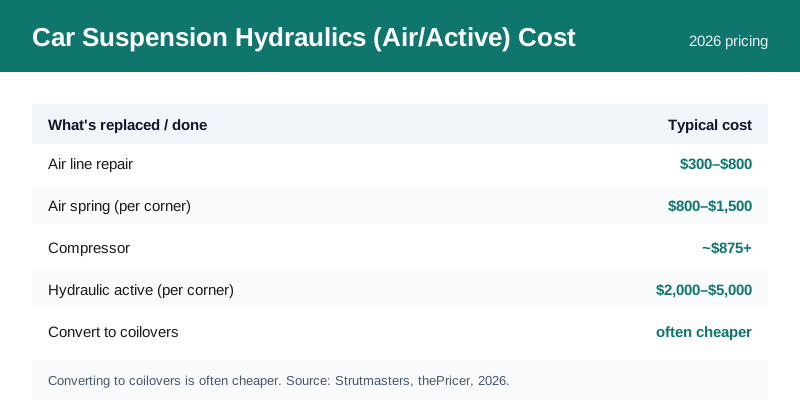
Hydraulic and air suspension costs sit in a far higher tier than conventional suspension. An air line repair runs about $300 to $800; an air spring (air bag) runs roughly $800 to $1,500 per corner; an air compressor runs about $875 and up; and a hydraulic active suspension unit runs roughly $2,000 to $5,000 per corner. A complex full-system repair can reach $2,000 to $8,000 or more. These are estimates that vary by vehicle and system. These systems use air bags or pressurized hydraulic fluid – instead of, or alongside, conventional springs – to adjust ride height and firmness, and they’re found on many luxury vehicles, large SUVs, and air-ride trucks. One cost-saving reality worth knowing up front: because the parts are so specialized, converting a failed air system to conventional coilover springs is often cheaper than repairing it.
Air and hydraulic suspension is wonderful when it works and expensive when it doesn’t – and the repair-versus-convert decision is the big money question. Let me break it down.
What you’ll actually pay
Here’s the picture. These are estimates that vary by vehicle and system.
| Repair | Cost | Notes |
|---|---|---|
| Air line | $300–$800 | Leak repair |
| Air spring (per corner) | $800–$1,500 | Common failure |
| Air compressor | $875+ | Runs constantly if leak |
| Hydraulic active unit (per corner) | $2,000–$5,000 | Luxury |
| Full system / complex | $2,000–$8,000+ | Multiple parts |
This is the high-end relative of conventional suspension; our suspension repair guide, strut guide, and shock guide cover the standard systems.
Shop Talk
If you have air or hydraulic suspension (common on luxury SUVs, air-ride trucks, and high-end cars), know two things. First, how failures cascade: the most common failure is an air spring developing a leak, which makes that corner sag (often overnight, so you find the car leaning in the morning). When a spring or line leaks, the air compressor runs constantly trying to keep up – and that overwork burns out the compressor too. So a cheap leak left unfixed can take out an expensive compressor. Catch a sagging corner or a compressor that runs nonstop early. Second, the big decision when a system fails out of warranty: repair it with OEM-style air/hydraulic parts (expensive – $800 to $1,500 per air spring, thousands for hydraulic active units), or convert the vehicle to a conventional coil-spring (coilover) suspension using an aftermarket kit. The conversion often costs less than repairing the air system and eliminates future air-system failures, at the trade-off of losing the adjustable ride height and plush ride. On an older high-mileage luxury vehicle where the air system keeps failing, the coilover conversion is frequently the smart-money move. Also: use a shop that actually knows these systems – they require specific diagnostics (scan tools that read the air/hydraulic system) and shouldn’t be guessed at. Get the fault pinpointed (which corner, which part) before approving anything, since ‘the suspension’ on these cars can mean a $400 line or a $5,000 corner.
Where Drivers Overpay
The cascade is the trap: a small air-spring or line leak that’s ignored makes the compressor run constantly until it burns out too, turning a few-hundred-dollar leak into a leak plus an $875+ compressor. Catching a sagging corner early is the cheapest intervention by far.
The bigger money decision is repair versus convert. On an older luxury vehicle whose air system keeps failing, an aftermarket coilover conversion often costs less than another round of OEM air parts and ends the failures for good. The pattern: fix leaks promptly before they kill the compressor, get the exact failed part pinpointed with proper diagnostics, and weigh a coilover conversion against repair on high-mileage vehicles.
The Real Number
Air and hydraulic suspension runs from about $300 to $800 for a line, $800 to $1,500 per corner for an air spring, $875+ for a compressor, and $2,000 to $5,000 per corner for hydraulic active units – a complex system $2,000 to $8,000+. Fix a leaking air spring promptly before the overworked compressor burns out too. On an older luxury vehicle with a repeatedly failing air system, an aftermarket coilover conversion is often cheaper than repair and ends the failures. Get the exact part pinpointed before approving work.
Frequently Asked Questions
How much does air or hydraulic suspension cost to repair?
It spans a wide, generally high range because the parts are specialized. An air line (tubing) leak repair runs about $300 to $800. An air spring, or air bag, is a common failure at roughly $800 to $1,500 per corner. The air compressor that pressurizes the system runs about $875 and up. A hydraulic active suspension unit (on high-end vehicles with systems that actively control the ride) runs roughly $2,000 to $5,000 per corner. A complex or multi-part full-system repair can total $2,000 to $8,000 or more. These are estimates that vary by vehicle and system. The cost is far above conventional spring/shock suspension because these systems add compressors, air springs or hydraulic actuators, lines, valves, sensors, and control modules – all expensive and often vehicle-specific. Because of that, the diagnosis (exactly which corner and which component failed) matters enormously, and there’s often a cheaper alternative worth considering: converting to conventional coil springs. For standard suspension by comparison, see our suspension repair guide.
What is air/hydraulic suspension and which cars have it?
It’s an advanced suspension that uses air springs (rubber-and-fabric bags filled with pressurized air by an onboard compressor) or hydraulic fluid under pressure, instead of – or in addition to – conventional steel coil springs, to support the vehicle. The big advantages are adjustable ride height (the car can raise for clearance or lower for aerodynamics/easy entry, and self-level under load) and a very smooth, often adjustable-firmness ride. Air suspension is common on luxury SUVs and sedans (many German and premium models), large SUVs and trucks (where it levels the load for towing/hauling), and air-ride pickups. More sophisticated hydraulic active suspension, which can actively counter body roll and dive, appears on high-end performance and luxury vehicles. If your vehicle lowers when parked, raises for off-road or at speed, or self-levels when loaded, it has one of these systems. The trade-off for the comfort and adjustability is complexity and cost: these systems have more parts that can fail and are much more expensive to repair than ordinary springs and shocks, which is the key thing for owners to understand about the long-term cost of a vehicle equipped this way.
What are the symptoms of a failing air suspension?
The most common and recognizable symptom is the vehicle sagging at one corner (or end), often most obvious after the car has sat overnight – you come out to find it leaning, because an air spring or line has leaked down. Other signs include the air compressor running frequently or constantly (you may hear it cycling a lot, which indicates it’s working overtime to replace leaking air), a suspension warning light or message on the dash, the ride feeling harsh or bottoming out (if a spring has lost pressure), the vehicle not raising or lowering as it should, or it failing to self-level when loaded. A compressor that’s failing may be noisy or not run at all, leaving the car sitting low. On hydraulic systems, leaks of hydraulic fluid and a sagging or erratic ride are signs. Because these systems are interconnected, an early leak symptom (a corner sagging) is important to catch, since the compressor overworking to compensate can then fail itself, compounding the repair. Any sagging corner, constant compressor cycling, or suspension warning light on an air-equipped vehicle warrants prompt diagnosis before a small leak cascades into a bigger, costlier failure.
Should I convert to regular coil springs instead?
For many owners of older, out-of-warranty vehicles with repeatedly failing air suspension, yes – a coil-spring (coilover) conversion is often the cost-effective choice, and it’s worth seriously considering. The logic: air/hydraulic parts are expensive and tend to fail again as the system ages, so repeatedly repairing an aging air system can become a money pit. Aftermarket conversion kits replace the air springs (and sometimes the struts) with conventional coil springs and shocks, and often include a module to prevent dashboard warning lights. The conversion frequently costs less than a full OEM air-system repair, and critically, it eliminates future air-system failures – no more compressors, air bags, or lines to leak. The trade-offs are real: you lose the adjustable ride height and the plush, self-leveling air ride, and the conversion changes the car’s character (and on some vehicles, a few may notice a firmer ride). For a cherished vehicle where the air ride is central to the appeal, or one still under warranty, repairing the air system makes sense. But for an older luxury SUV or sedan whose air suspension keeps failing and whose owner just wants reliable, affordable suspension, the coilover conversion is frequently the smart-money move. Weigh how much you value the air features against the recurring repair costs.
Why is air suspension so expensive compared to regular suspension?
Because it’s a far more complex system with many more expensive, specialized components. A conventional suspension is essentially steel springs and shock absorbers – simple, durable, inexpensive parts. An air (or hydraulic) suspension adds an air compressor, air springs or hydraulic actuators at each corner, a network of air lines or hydraulic hoses, valves, pressure sensors, height sensors, and an electronic control module that manages ride height and firmness. Every one of those parts is more costly than a plain spring, and many are vehicle-specific with limited aftermarket competition, keeping prices high. The air springs themselves are wear items (the rubber bladders eventually crack and leak), and the compressor is a mechanical part that works hard and wears out – so these systems have more things that fail over time, each expensive to replace. Labor can also be higher because diagnosis requires specific scan tools that read the suspension system, and the work is more involved. Add that failures often cascade (a leak overworks and kills the compressor), and the lifetime cost climbs. So the comfort and adjustability of air suspension come with a built-in ownership cost that’s dramatically higher than ordinary springs – a trade-off worth knowing before buying a vehicle equipped with it, and the reason the coil conversion is appealing once a system starts failing out of warranty.
Can I drive with a bad air suspension?
It depends on the failure, but a significantly failed air suspension is best not driven on, both for ride quality and safety, so it warrants prompt attention. If a corner has lost air and the vehicle is sagging or sitting on its bump stops, the ride will be harsh and the handling compromised, and driving far like that can damage other components (and the dragging/low corner can affect tire clearance). A system stuck too low can scrape or reduce ground clearance; one stuck in a raised or uneven state affects stability. If the compressor has failed, the car may be sitting low and unable to level itself. While you might limp a short distance to a shop at low speed, you shouldn’t drive extended distances or at highway speed on a badly failed air suspension, because the ride height and handling the system is supposed to maintain are part of how the car drives safely. There’s also the cascade risk – continuing to drive with a leak keeps the compressor overworking toward its own failure. So treat a sagging corner, a suspension warning light, or a stuck ride height as a prompt-repair item: get it diagnosed quickly rather than driving on it, both to stay safe and to keep a small leak from turning into a bigger, more expensive failure. For comparison with standard suspension safety, see our suspension repair guide.
How long does air suspension last?
It varies by vehicle and conditions, but air suspension components generally don’t last as long as conventional springs, and owners should expect to service them over a vehicle’s life. Air springs (the rubber bladders) are the typical first failure – their lifespan often runs somewhere in the range of 8 to 10+ years or roughly 50,000 to 100,000+ miles, though this varies a lot by climate (heat, cold, and road salt age the rubber faster), usage, and brand. The air compressor is a mechanical part that wears with use and can fail, especially if it’s been overworked compensating for leaks. Lines, valves, and sensors can also fail over time. By contrast, conventional coil springs can easily last the life of the car. So a vehicle with air suspension should be expected to need some air-system repair as it ages past warranty, which is exactly why the lifetime cost is higher and why the coil-conversion option becomes attractive on older vehicles. To maximize life, address leaks promptly (to spare the compressor), keep the system clean, and have it inspected if you notice any sagging or frequent compressor cycling. Buyers of used air-suspension vehicles should factor likely future repairs into the purchase, and ideally confirm the current state of the system before buying – it’s a known long-term cost of these otherwise comfortable, capable systems.
Sources
Price ranges verified against 2026 air and hydraulic suspension pricing in November 2026. Dollar amounts are estimates that vary by vehicle and system.
- RepairPal – air spring replacement cost
- Jerry – air suspension repair cost
- ASE – National Institute for Automotive Service Excellence
Related Guides
- Car Suspension Repair Cost
- Strut Replacement Cost
- Shock Replacement Cost
- Air Suspension and Compressor Cost
- Car Repair Cost Estimator

Diane Holcomb spent seven years as a service advisor at multi-brand dealerships in Charlotte, NC, where the saddest estimates she wrote were air-suspension repairs on out-of-warranty luxury SUVs – which is how she learned to walk owners through the coilover-conversion option before they sank thousands into another air spring. She drives a 2019 Honda CR-V and a hand-me-down 2007 Toyota Camry, and takes no referral fees or advertising money from any shop or chain.