
Last updated: November 8, 2026 – By Eddie Brennan
November 2026 update: refreshed the blinking-vs-steady distinction and the sensor-relearn guidance.
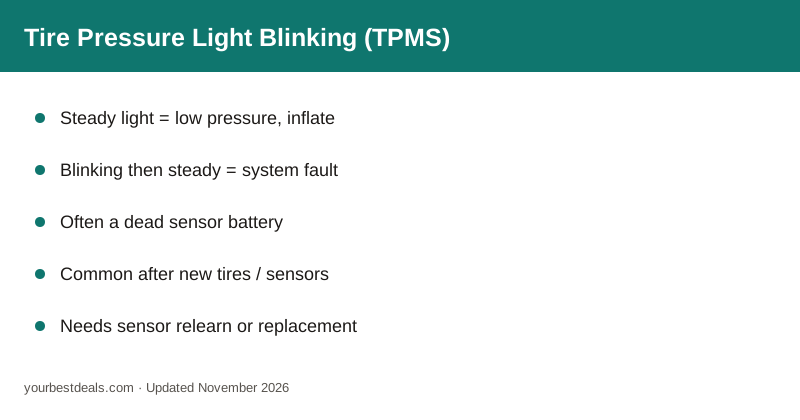
There’s an important difference between a tire pressure light that glows steady and one that blinks. A steady TPMS light means low tire pressure – check your tires and inflate to the number on the door-jamb sticker. A TPMS light that blinks (typically for about 60–90 seconds at startup) and then stays on solid means something different: a TPMS system fault, not simply low pressure. The system is telling you it can’t monitor the tires properly. The usual causes are a dead sensor battery (the sensors have built-in batteries that last years, then die), a failed or missing sensor (common after new tires, a tire change, or a battery/sensor swap), or a sensor that hasn’t been “relearned” to the car (the system doesn’t recognize it). So a blinking-then-steady light is a “fix the monitoring system” message, which is a different errand than “add air.”
The blinking TPMS light confused a lot of people, because it looks like the low-pressure light but behaves differently – flashing at startup, then going solid. That flashing is the car’s way of saying the monitoring system itself has a problem, usually a sensor that’s dead or that the car doesn’t recognize. It’s not the same as “your tire’s low,” and the fix is different.
Steady vs blinking: two different messages
TPMS (Tire Pressure Monitoring System) uses sensors to watch your tire pressures and warn you when one is low. The light communicates two distinct things depending on how it behaves. A steady, solid light is the normal low-pressure warning: one or more tires are below the recommended pressure, and you should check and inflate them (and investigate a possible leak if it keeps recurring). A light that blinks for roughly a minute at startup and then stays on solid is the system’s way of signaling a malfunction in the TPMS itself – it’s telling you it can’t reliably monitor the tires, which is a different problem from the tires simply being low. Because the behaviors look similar at a glance (both involve the same symbol), many drivers don’t realize the blinking has a distinct meaning. Knowing which you have tells you whether you need air or a system repair.
Common causes of a blinking TPMS light
A dead sensor battery. Each TPMS sensor has a small built-in battery that typically lasts several years (often in the range of 5–10). When one dies, the sensor stops transmitting, and the system flags a fault – a very common cause of a blinking-then-steady light on an older car. The sensor (battery sealed inside) is replaced as a unit.
A failed or missing sensor, often after tire work. Sensors can fail, get damaged during a tire change, or be absent (for example, if tires were mounted on wheels without sensors, or a sensor wasn’t reinstalled). A missing or non-functioning sensor triggers the system fault.
A sensor that wasn’t relearned. Many vehicles require the TPMS to be “relearned” (re-registered) after a sensor is replaced or tires are rotated/changed, so the car knows which sensor is at which wheel. If that relearn procedure wasn’t done, the system may not recognize the sensor and will show a fault. This is a frequent cause right after new tires or a sensor swap.
Less commonly, receiver/wiring faults or interference can cause it. For sensor replacement cost, see our TPMS sensor guide.
Shop Talk
The key thing to internalize: a blinking TPMS light is a system problem, not a low-tire warning, so adding air won’t fix it. If your light flashes for about a minute when you start the car and then glows steady, don’t just pump up your tires and expect it to go out – the car is telling you it can’t monitor one or more tires, usually because a sensor is dead or unrecognized. Here’s the practical catch that comes with that: while the TPMS is faulted, it isn’t watching your tires, so you lose the low-pressure warning you’d normally rely on. That means you should go back to checking your tire pressures manually with a gauge (to the door-sticker number) until the system is fixed, because a tire could go low and you wouldn’t get the usual alert. Two common scenarios worth knowing: first, if the light came on right after you got new tires or had tire work done, the most likely cause is a sensor that wasn’t relearned/registered to the car, or one that was damaged or left out – go back to the shop that did the work, as fixing it (a relearn, or replacing a damaged sensor) is often quick. Second, if it appeared on its own on an older car with original sensors, a dead sensor battery is the usual culprit, and since the battery is sealed inside, the sensor is replaced as a unit. A shop with a TPMS tool can quickly read which sensor is faulty and relearn the system.
What Gets Misdiagnosed
The central confusion is blinking versus steady. People see the TPMS symbol, add air, and are puzzled when a blinking-then-steady light stays on – because that light isn’t low pressure, it’s a system fault, and air doesn’t fix it. Recognizing that the blinking pattern means “system malfunction” (not “low tire”) is the whole key, and it changes the fix from inflating a tire to repairing or relearning a sensor.
The other is not realizing that a faulted TPMS stops monitoring your tires. While the light is in its fault state, you’re not getting low-pressure warnings, so a tire could actually go low without the usual alert. People sometimes ignore a “malfunction” light as less urgent than a low-pressure one, but it means you’ve temporarily lost your pressure monitoring and should check pressures manually until it’s fixed.
The Real Number
A steady TPMS light means low pressure – check and inflate to the door-sticker number. A light that blinks for about a minute at startup and then stays solid means a TPMS system fault, not low pressure, so adding air won’t clear it. The usual causes are a dead sensor battery, a failed or missing sensor (common after new tires), or a sensor that wasn’t relearned to the car. While the system is faulted it isn’t monitoring your tires, so check pressures manually with a gauge until it’s fixed. If it started after tire work, go back to that shop. For sensor cost, see our TPMS sensor guide.
Frequently Asked Questions
What does a blinking tire pressure light mean?
A blinking tire pressure light – one that flashes for roughly 60 to 90 seconds when you start the car and then stays on solid – means there’s a fault in the tire pressure monitoring system (TPMS) itself, not simply that a tire is low, so it’s a signal that the system can’t properly monitor your tires and needs attention, which is different from the steady light that indicates low pressure. This blinking-then-solid pattern is specifically how most vehicles indicate a TPMS malfunction, as opposed to a steady illumination that is the normal low-pressure warning. The distinction matters because the two call for completely different responses: a steady light means check and inflate your tires, while the blinking light means the monitoring system has a problem (a sensor or related fault) that adding air won’t resolve. The common causes of the blinking fault are a dead TPMS sensor battery (the sensors have sealed internal batteries that last years and then die), a failed or missing sensor (frequently after new tires or tire work, if a sensor was damaged, left out, or not reinstalled), or a sensor that hasn’t been relearned/registered to the vehicle after replacement or tire service. Because many drivers don’t know the blinking has a distinct meaning, they’re puzzled when inflating the tires doesn’t clear it. If your TPMS light blinks at startup and then stays on, interpret it as a system fault, have it diagnosed (a shop can read which sensor is at fault with a TPMS tool), and in the meantime check your tire pressures manually since the system isn’t watching them. For sensor repair, see our TPMS sensor guide.
How is a blinking TPMS light different from a steady one?
The difference is what they’re telling you: a steady (solid) TPMS light is the normal low-pressure warning, meaning one or more tires are below the recommended pressure and you should check and inflate them, while a blinking light (that flashes for about a minute at startup, then goes solid) indicates a malfunction in the TPMS system itself – a sensor or related fault – which is not fixed by adding air. Both use the same tire-pressure symbol, which is why they’re easily confused, but their behavior encodes different messages. The steady light is the one you want to respond to by checking your tire pressures with a gauge and inflating any low tire to the door-jamb sticker specification (and investigating a leak if it recurs); it’s a direct, actionable “your pressure is low” alert. The blinking-then-solid light is the system’s self-diagnostic warning that it has detected a problem preventing it from monitoring the tires reliably – commonly a dead sensor battery, a failed or missing sensor, or a sensor not relearned to the car – and it requires a system repair (replacing or registering a sensor) rather than inflation. Recognizing which behavior you’re seeing tells you whether your errand is “add air” or “fix the monitoring system.” A further practical implication: when the light is in the blinking/fault state, the TPMS isn’t actively monitoring your tires, so you lose the low-pressure protection and should check pressures manually until it’s repaired. So watch how the light behaves at startup – steady from the start means low pressure; flashing first, then solid, means a system fault. For the repair side, see our TPMS sensor guide.
Why did my TPMS light start blinking after I got new tires?
If your TPMS light started blinking after getting new tires (or any tire service), the most likely reasons are that a sensor wasn’t “relearned”/registered to the car during the service, a sensor was damaged during the tire change, or a sensor was left out or not reinstalled – all of which cause the system to report a fault, and all of which trace back to the recent tire work rather than being a coincidence. Many vehicles require the TPMS to be relearned after tires are mounted, rotated, or sensors are handled, so the car knows which sensor is at which wheel; if the shop didn’t perform that relearn procedure, the system may not recognize the sensors and will flag a malfunction (the blinking light). It’s also possible a sensor was accidentally damaged during mounting/dismounting of the tire (the sensors are attached to the valve stem area inside the wheel and can be nicked by the tire machine), or that during the service a sensor wasn’t reinstalled or the new tires were put on wheels without functioning sensors. Because the timing points directly at the tire work, the best first step is to return to the shop that did it and explain the light started right afterward – fixing it is often quick (performing the relearn, or replacing a sensor that was damaged), and if they caused it, they should address it. This is one of the most common scenarios for a blinking TPMS light, precisely because tire service is when sensors get handled. In the meantime, check your tire pressures manually, since the faulted system isn’t monitoring them. For sensor cost if one needs replacing, see our TPMS sensor guide.
Can I just add air to fix a blinking TPMS light?
No – adding air will not fix a blinking TPMS light, because the blinking (flashing at startup then staying solid) indicates a malfunction in the monitoring system itself, not low tire pressure, so inflating your tires doesn’t address the underlying sensor or system fault that’s causing the light. This is the key practical takeaway and a common point of confusion: the steady TPMS light is the one that responds to adding air (it means a tire is low), while the blinking-then-solid light means the system can’t properly monitor the tires – usually due to a dead sensor battery, a failed or missing sensor, or a sensor not relearned to the car – and that requires a repair or relearn, not inflation. You could fill all four tires to perfect pressure and the blinking light would remain, because the problem isn’t the air, it’s the system’s ability to read the sensors. So if you’ve been topping off your tires trying to clear a blinking light and it won’t go out, that’s the signal that you’re dealing with a system fault rather than a pressure issue. The right response is to have the TPMS diagnosed – a shop with a TPMS scan tool can quickly identify which sensor is faulty or unregistered and perform a relearn or replace a dead sensor. In the meantime, because the faulted system isn’t watching your tires, keep an eye on your pressures manually with a gauge. So save yourself the frustration: a blinking light is a “fix the system” job, not an “add air” one. For what the repair costs, see our TPMS sensor guide.
Is it safe to drive with the TPMS light blinking?
You can drive with a blinking TPMS light in the sense that the fault itself doesn’t disable the car, but it’s not ideal to leave it unaddressed, because while the system is faulted it is not monitoring your tire pressures – so you lose the low-pressure warning you’d normally rely on, meaning a tire could go low or develop a slow leak without the usual alert, which is a safety consideration. The blinking light indicates a TPMS malfunction, not an immediate mechanical danger, so the car drives normally and you’re not in immediate peril simply from the light being on. The real issue is what you’ve lost: TPMS exists to warn you of low tire pressure, which affects handling, braking, fuel economy, tire wear, and blowout risk, and when the system is faulted, that safety net is down. So the practical guidance is that driving with a blinking TPMS light is okay in the short term, but you should (1) check your tire pressures manually with a gauge, and keep checking them periodically, until the system is repaired, since you won’t get automatic warnings, and (2) get the fault diagnosed and fixed reasonably soon to restore the monitoring. It’s also worth confirming your tires are actually at proper pressure right now, since the system won’t tell you. So it’s not an emergency to drive with it, but treat it as “my pressure monitoring is temporarily off, so I need to watch my tires myself,” and get it repaired to restore the automatic warning. If you also notice a tire looking low or the car handling oddly, check pressures immediately. For sensor repair, see our TPMS sensor guide.
How long do TPMS sensors last, and why do their batteries die?
TPMS sensors typically last several years – often in the range of about 5 to 10 years – before their internal batteries die, because each sensor is a self-contained unit with a small sealed battery that powers it to transmit pressure readings, and that battery gradually depletes over years of use until the sensor can no longer function, at which point the whole sensor is replaced (the battery can’t be swapped separately). The sensors live inside each wheel (usually at the valve stem), constantly or periodically transmitting tire pressure data to the car’s receiver, and that transmission is powered by the built-in battery. Because the battery is sealed inside the sensor for durability (it has to survive inside a wheel), it isn’t replaceable on its own, so when it dies, you replace the entire sensor. The lifespan varies with how much the car is driven and conditions, but many sensors reach the end of their battery life somewhere in that 5-to-10-year window, which is why a blinking TPMS fault light commonly appears on older vehicles with their original sensors – the batteries have simply reached the end of their life. When one sensor’s battery dies, the system detects the missing signal and flags the fault (the blinking light). Often, if one original sensor’s battery has died of age, the others may not be far behind, so some owners replace multiple sensors around the same time, though you can replace just the failed one. If your TPMS fault light appeared on an older car without any recent tire work, a dead sensor battery is the most likely cause. For replacement cost, see our TPMS sensor guide.
What does it cost to fix a TPMS fault?
The cost to fix a TPMS fault depends on the cause: a simple relearn/registration (when a sensor just needs to be re-registered to the car) can be quick and inexpensive – sometimes free if the shop that did your recent tire work caused it – while replacing a failed sensor involves the cost of the sensor plus labor to mount it in the wheel and relearn the system, which is a moderate per-sensor cost, so the total ranges from minimal to a few sensors’ worth depending on how many have failed. If the fault is just that a sensor wasn’t relearned after tire service, the fix is performing the relearn procedure, which takes a shop with a TPMS tool only a few minutes and is cheap (or should be no-charge if it stemmed from work they just did). If a sensor has failed or its battery has died, you replace that sensor – the part is a moderate cost, plus labor to break down the tire, install the sensor, reseal and balance the tire, and relearn the system; this is more involved than a relearn but still a mid-range repair per sensor. On an older car where sensors are dying of age, you might replace one or several, which raises the total accordingly. Because the causes range from a free relearn to replacing multiple sensors, getting the fault diagnosed first (a shop can read which sensor is at fault) tells you which situation you’re in before committing. If the light appeared right after tire work, start by returning to that shop, as a relearn or their-error fix may cost nothing. For a detailed cost breakdown, see our TPMS sensor replacement guide.
Sources
TPMS blinking-light and sensor information verified against standard tire-pressure-monitoring service practice in November 2026. Check tire pressures manually while the system is faulted.
- NHTSA – tire safety and TPMS
- ASE – National Institute for Automotive Service Excellence
- Tire Rack – tire and TPMS information
Related Guides
- TPMS Sensor Replacement Cost
- Correct Tire Pressure
- Reading Tire Wear Patterns
- Tire Rotation Cost
- Warning Lights Guides

Eddie Brennan is an ASE Master Certified technician (A6 Electrical/Electronic Systems) who spent 11 years in an independent shop in Columbus, OH, before a back injury moved him into writing. The blinking TPMS light confused a lot of people – it looks like the low-pressure light but means the monitoring system itself has a fault, and no amount of air fixes that. He drives a 2015 Subaru Outback with over 250,000 miles and a 2020 Ford F-150, and takes no referral fees or advertising money from any shop or chain.