


Up to $20 Back on Select Oil Changes at Goodyear
Purchase a qualifying oil change or maintenance service and receive a rebate sponsored by Valvoline. Purchase a qualifying oil change or service and receive up to $20 in rebates from Valvoline. Rebate form available in-store.
Deal Activated, no coupon code required!
Purchase a qualifying oil change or maintenance service and receive a rebate sponsored by Valvoline. Purchase a qualifying oil change or service and receive up to $20 in rebates from Valvoline. Rebate form available in-store.
Expires: Expires January 1, 2027
Submitted: 2 hours ago
$69.99 Limited Time Full Synthetic Oil Change at Goodyear
Deal Activated, no coupon code required!
Limited Time Offer! Get our Best Oil Change (Full Synthetic) for only $69.99 (up to 5 quarts) at participating Goodyear Auto Service and Just Tires locations.
Expires: Expires December 1, 2026
Submitted: 4 hours ago
Last updated: November 10, 2026 – By Diane Holcomb
November 2026 update: rechecked Goodyear Auto Service pricing basis and the tire-rebate practice; amounts rotate, so this page points to the live source.
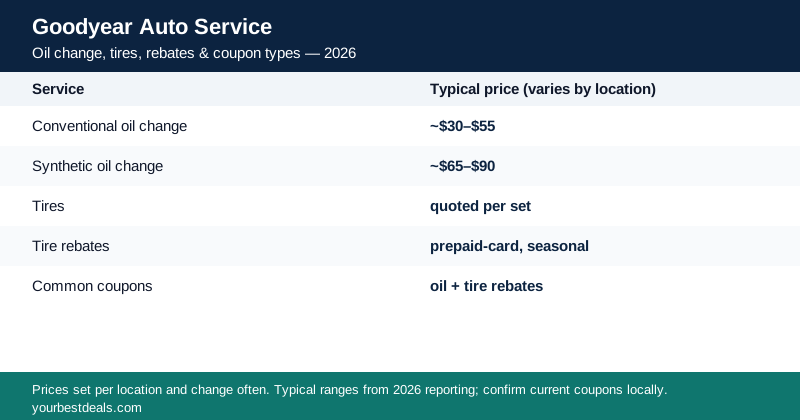
Goodyear Auto Service is a tire-first full-service chain – it does oil changes, brakes, and repairs, but tires are the headline, and its most valuable offers are tire rebates (often paid as a prepaid card after you buy a qualifying set). Get the current rebate or coupon from Goodyear’s official site rather than third-party pages. Typical prices: a conventional oil change around $30 to $55, synthetic around $65 to $90, and tires quoted per set. These are typical ranges; Goodyear locations are franchised and set prices locally, so confirm with your store. When Goodyear (or a tire maker) is running a rebate on a set of four, that’s usually the biggest saving available – far more than an oil-change coupon.
Goodyear is a tire company first, so I treat its coupons the way I treat any tire purchase – chase the rebate on a set of four, and get the out-the-door number. Here’s the approach.
What you’ll actually pay
Here are the typical ranges. Goodyear prices vary by location and change often, so treat these as estimates and confirm locally.
| Service | Typical price | Notes |
|---|---|---|
| Conventional oil change | ~$30–$55 | Often the coupon anchor |
| Synthetic oil change | ~$65–$90 | Varies by vehicle |
| Tires (set of four) | quoted per set | Watch for rebates |
| Tire rebate | prepaid card, seasonal | Biggest saving |
Comparing tire sellers helps; our new tires cost guide, oil change cost guide, and Firestone coupons guide cover the alternatives.
Shop Talk
Time your tire purchase to a rebate. Goodyear (and the tire makers whose tires it sells) run seasonal rebates – frequently spring and fall – that pay back a chunk on a qualifying set of four, usually as a prepaid card after you submit a form. On a $600–$1,000 set, that rebate dwarfs any oil-change coupon, so if your tires can wait a few weeks for the next rebate window, waiting pays. Two things to watch: first, the rebate is a mail-in or online submission with a deadline, so submit it promptly or you lose it – a lot of people forget and leave money on the table. Second, compare the out-the-door installed price (tires plus mount, balance, valve stems/TPMS, disposal, optional road hazard) minus the rebate against Costco, Discount Tire, and online sellers, because the rebate doesn’t automatically make Goodyear cheapest. On oil changes, the low advertised price is conventional; synthetic costs more. And Goodyear sometimes bundles an oil change with a free rotation or offers financing through its credit card – ask what’s current.
How to compare a Goodyear oil-change quote
Before booking, ask the local Goodyear service center for the total price for your vehicle, required oil type, and engine. Confirm whether the quote covers the oil filter, the full amount of oil your engine needs, any extra-quart charge, taxes, shop fees, and the fluid checks included in the service. The estimated price ranges above are a starting point, not a guaranteed price for every vehicle or location.
If you are also booking tires or an alignment, request both a standalone oil-change quote and a combined quote. Compare the final totals rather than assuming a package saves money. Ask the store to confirm any applicable promotion and its conditions before scheduling.
Where Drivers Overpay
The classic Goodyear overpay is forgetting to submit the tire rebate. It’s usually a mail-in or online claim with a deadline, and unclaimed rebates are pure lost money – so submit it the day you buy.
The other is assuming a rebate makes Goodyear automatically cheapest; it doesn’t until you compare out-the-door installed prices. The pattern: buy tires during a rebate window, submit the claim immediately, and compare the net installed price against other sellers before committing.
The Real Number
Goodyear Auto Service runs oil-change deals (conventional ~$30–$55, synthetic ~$65–$90), but its biggest saving is a tire rebate on a set of four – often a prepaid card worth far more than an oil coupon. Time a tire purchase to a rebate window, submit the claim immediately (people forget and lose it), and compare the net out-the-door installed price against Costco, Discount Tire, and online before buying. Get current offers from Goodyear’s official site.
Frequently Asked Questions
How much is an oil change at Goodyear?
A conventional oil change at Goodyear Auto Service typically runs around $30 to $55, and a synthetic change roughly $65 to $90, with diesel and large engines higher. These are typical ranges; Goodyear locations are franchised and set their own prices, so check the Goodyear site or your local store for an exact figure, and expect shop or disposal fees on top. The lowest advertised price is for conventional oil – if your car needs synthetic, you’ll pay the synthetic tier regardless of a conventional coupon. Oil changes usually include a courtesy inspection and often a tire rotation (fitting, since tires are Goodyear’s focus). As a full-service shop it can handle brakes and repairs too, but weigh any recommendation against your maintenance schedule. Grab the current oil-change coupon from Goodyear’s site, though the chain’s biggest savings are on tires, not oil. For how it compares with other chains, see our oil change cost guide, and confirm the price for your vehicle locally.
Where do I find current Goodyear coupons and rebates?
Goodyear’s official website posts current coupons and, importantly, tire rebates – which is the reliable source, since third-party code sites often list expired offers. For tires, look specifically for the current rebate (frequently a prepaid-card offer on a qualifying set of four), because that’s usually the largest saving Goodyear offers and it rotates seasonally. Pull the offer right before your visit, and note the rebate’s submission requirements and deadline. Goodyear centers are often franchised, so confirm your location honors a given coupon. It’s also worth asking whether a Goodyear credit card or financing promotion applies, and whether an oil change is currently bundled with a free rotation. The main point: go to Goodyear’s official offers page for current coupons and tire rebates, prioritize the tire rebate when buying a set, and submit any rebate promptly to actually receive it. Because tires are where Goodyear saves you the most, the rebate – not a flat oil-change coupon – is the offer to build your visit around when you need a new set.
How do Goodyear tire rebates work?
A Goodyear tire rebate is typically a dollar amount back when you buy a qualifying set of tires (often four), paid not as an instant discount but as a prepaid card or check after you submit a rebate claim – so you pay the full installed price up front and get money back afterward. The rebate is usually tied to specific tire models and a promotional window (often seasonal, like spring and fall), and it may come from Goodyear, the tire manufacturer, or a combination. To get it, you generally submit a form online or by mail with your receipt by a deadline. The catch is that deadline: many people forget to submit and forfeit the rebate, so do it the day you buy. When comparing Goodyear against other tire sellers, factor the rebate into the net price, but compare the full out-the-door installed cost (tires plus mounting, balancing, valve stems/TPMS, disposal, optional road hazard) minus the rebate – a rebate doesn’t automatically make Goodyear cheapest. Used well, a rebate meaningfully lowers a tire purchase; just read the terms, keep your receipt, and submit the claim promptly. For tire pricing context, see our new tires cost guide.
Is Goodyear good for tires specifically?
Yes – Goodyear is one of the best-known tire names, and its auto-service centers are a natural place to buy and install tires, with the brand’s own lines plus other makes, full installation, alignment, and road-hazard options. The advantages are brand familiarity, wide availability, frequent rebates, and the ability to handle alignment and related work in one stop. Whether it’s the cheapest depends on the comparison: get the out-the-door installed price (tire cost plus mounting, balancing, valve stems or TPMS, disposal, and optional road-hazard coverage), subtract any current rebate, and compare that net total against Costco, Discount Tire, Pep Boys, NTB, and online sellers like Tire Rack. Goodyear is competitive, especially during a rebate window, but not automatically lowest, so the comparison matters. If you specifically want Goodyear-brand tires, its service centers are an obvious choice; if you’re brand-flexible, price the same or comparable tires elsewhere too. For what a set typically costs installed, see our new tires cost guide. Buy during a rebate, submit the claim, and compare net installed prices to make sure Goodyear is the best deal for your set.
Does Goodyear do brakes and other repairs?
Yes – Goodyear Auto Service centers are full-service, so beyond tires they handle oil changes, brakes, batteries, alignment, suspension and steering, belts and hoses, heating and air conditioning, and general maintenance and repair. That makes a Goodyear store a one-stop option if a tire visit or oil-change inspection flags other work. For brakes and repairs, the usual full-service-chain guidance applies: brakes are quoted per vehicle after inspection, so get an itemized written estimate, question “while we’re in there” add-ons, and on a bigger job get a second quote since an independent shop may be cheaper. Goodyear service coupons can help on these bills when applied to a verified, fair estimate. The chain’s strength remains tires, but the repair capability is genuine and convenient. So you can use Goodyear for routine maintenance and common repairs, not just tires – just apply the same scrutiny to repair estimates you would anywhere, and reserve the tire rebate as the big-ticket saving. For brake pricing context, see our brake job cost guide. Verify the estimate, then use the current coupon on a fair total.
Is a Goodyear rebate better than an oil-change coupon?
For saving money, a tire rebate is almost always the bigger deal, because tires are a far larger purchase than an oil change – so if you need both, build your visit around the rebate. A set of four tires runs several hundred to over a thousand dollars, and a rebate takes a meaningful chunk off that, whereas an oil-change coupon saves a modest amount on a much smaller service. So when you need tires, the rebate is the offer to prioritize and time your purchase around, and it dwarfs any concurrent oil-change discount. That said, the two aren’t mutually exclusive in value: you can still use a current oil-change coupon on that service, and sometimes a tire rebate (from the manufacturer) can coexist with a Goodyear install offer. The practical hierarchy is: pursue the tire rebate first when buying tires (submit it promptly), use an oil-change coupon on the oil change, and don’t expect the small oil coupon to matter much next to the rebate. If you only need an oil change and no tires, then the oil coupon is simply your saving. Match the offer to the purchase, and prioritize the rebate whenever tires are involved.
What should I check before buying tires or using a coupon at Goodyear?
A few checks maximize your saving. First, get current offers from Goodyear’s official site – both oil-change coupons and, crucially, any tire rebate – since these are reliable and third-party codes are often expired. Second, for tires, time the purchase to a rebate window if you can, and read the rebate’s qualifying models, submission method, and deadline. Third, get the out-the-door installed price (tires plus mounting, balancing, valve stems/TPMS, disposal, optional road hazard), subtract the rebate, and compare that net total against Costco, Discount Tire, Pep Boys, NTB, and online sellers. Fourth, submit any rebate immediately so you don’t forfeit it. Fifth, for oil changes, confirm the oil tier your car needs and grab the current coupon. Sixth, for repairs, get an itemized estimate before any coupon. And confirm your local franchise honors the offers. Do those, and you capture Goodyear’s real savings – the tire rebate on a set, plus smaller coupons on service – rather than overpaying or leaving a rebate unclaimed. The rebate submission is the step people most often miss, so make it a habit the day you buy.
Sources
Coupon and rebate practices and typical pricing verified against Goodyear’s official offers page and third-party pricing reporting in November 2026. Goodyear franchises set prices locally and rotate offers; amounts here are typical ranges, not quoted codes – confirm current offers, rebates, and pricing locally.
- Goodyear – official tire savings / rebates page
- Goodyear Auto Service – offers / coupons
- SoFi – average cost of an oil change (2026)
Related Guides
- New Tires Cost Guide
- Oil Change Cost Guide
- Firestone Coupons & Prices
- Pep Boys Coupons & Prices
- Auto Service Coupons Hub

Diane Holcomb spent seven years as a service advisor at multi-brand dealerships in Charlotte, NC, where she watched customers buy a rebate-eligible set of tires and then never mail the form – so she learned to hand them the rebate slip and say “do this today.” She drives a 2019 Honda CR-V and a hand-me-down 2007 Toyota Camry, and takes no referral fees or advertising money from any shop or chain.
Loading comments....