
Last updated: November 9, 2026 – By Eddie Brennan
November 2026 update: consolidated two oil-pan cost guides, reconciled the price ranges, and added the drain-plug, damaged-pan, and bundle-the-labor detail.
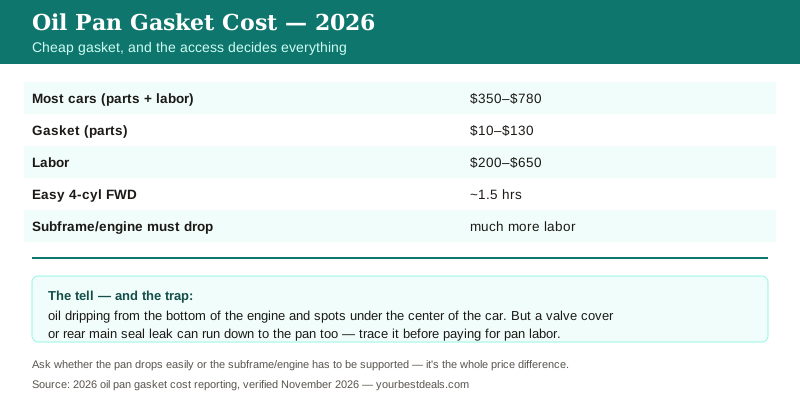
Oil pan gasket replacement runs $350 to $780 for most cars – RepairPal’s average is higher, about $552 to $759, reflecting labor-heavy, hard-to-reach engines – and once again the gasket itself is cheap, $10 to $130, so the price is almost entirely labor and access. A full oil pan replacement, if the pan is cracked or dented, runs roughly $400 to $800. On a simple four-cylinder front-wheel-drive car the pan drops in about 1.5 hours, but on some engines the subframe has to come down or the engine has to be supported and lifted to clear the pan, which turns a cheap gasket into a big labor bill. Access is the whole story here.
The oil pan bolts to the bottom of the engine and holds the oil, and its gasket leaks with age, leaving drips and spots under the car. I did plenty of these, and two things decide your experience: how your car’s pan is packaged, which sets the labor, and whether the leak is actually the pan gasket and not oil running down from a higher leak. This guide covers both so the number doesn’t blindside you.
Oil pan gasket cost breakdown
These are parts-and-labor figures. The pan’s accessibility drives the range far more than the gasket does.
| Item | Cost | Notes |
|---|---|---|
| Most cars (parts + labor) | $350–$780 | By access |
| RepairPal average | $552–$759 | Labor-heavy cars |
| Gasket (parts) | $10–$130 | Cheap; labor is the rest |
| Labor | $200–$650 | Access-dependent |
| Easy 4-cylinder FWD | ~1.5 hrs labor | Pan drops with a little clearance |
| Subframe / engine must move | much more labor | Pushes toward the high end |
| Full pan replacement | $400–$800 | Cracked or dented pan |
On a car where the pan clears with the engine in place, the job is on the lower end. On many engines, though, the pan sits close to the subframe or a crossmember, so the subframe has to be lowered or the engine supported and raised to slip the pan out – and that extra teardown is what pushes the labor toward $650 and the total toward $780. Ask the shop which situation your car is, because it’s the entire difference between the low and high end. An oil leak has many possible sources, so our oil leak guide, rear main seal guide, and valve cover gasket guide cover the leaks that get blamed on the pan.
What gets misdiagnosed
Oil dripping from the bottom of the engine and spots under the center of the car look like an oil pan gasket leak, but oil runs downhill, and the pan is the lowest point on the engine – so oil from almost any higher leak ends up dripping off the pan. A valve cover gasket, a cam or crank seal, an oil filter housing, or the rear main seal can all leak higher up and run down to drip off the pan’s edge, making it look like the pan when it isn’t. There’s also a much cheaper culprit right at the pan itself: the drain plug. A stripped plug or a bad sealing washer leaks at the pan but is a far smaller fix than the gasket – sometimes just a new plug, washer, or thread repair – so it’s worth ruling out before any big job.
The pan gasket is the actual source when a cleanup and dye trace the oil to the pan’s sealing surface itself, not just to where it drips off. A good tech degreases the area, runs the engine, and follows the oil to its origin rather than assuming the lowest wet spot is the leak. This matters because an oil pan gasket and, say, a rear main seal are very different jobs and prices, and the pan being the lowest point makes it the most-blamed and sometimes wrongly-blamed leak on the engine.
Straight From the Invoice: oil-leak jobs
These are jobs I either did myself or watched come through the bay – an easy pan, a subframe-drop pan, and a leak that was the rear main.
Invoice #1 – 2015 Hyundai Elantra, oil pan gasket, independent, Ohio
Leak traced to the pan gasket, and the pan cleared with the engine in place. About 1.5 hours, $360. Easy access. Lesson: on a simple four-cylinder front-driver, an oil pan gasket is a $350-to-$450 job – the gasket is cheap and the pan drops without a fight.
Invoice #2 – 2014 Ford truck, pan behind the subframe, Charlotte NC
Same cheap gasket, but the pan couldn’t clear without lowering the subframe and supporting the engine – hours of extra labor brought it to $720. Lesson: when the subframe or engine has to move to drop the pan, the labor is real and the job lands near the top of the range.
Invoice #3 – 2013 Toyota Camry, leak that was the rear main seal, Texas
Oil dripping off the pan, owner assumed the pan gasket. Dye showed it was the rear main seal above, running down to the pan – a different, bigger job. Lesson: the pan is the lowest point, so oil from higher leaks drips off it; trace the source before paying for a pan gasket that won’t fix a rear main leak.
Is it worth fixing an oil pan gasket leak?
Weigh the leak against the labor
A small oil pan gasket weep that drops a spot on the driveway but doesn’t meaningfully lower your oil level can sometimes be monitored, especially on a car where the pan requires a subframe drop and the labor is high. On an easy-access car, the fix is cheap enough to just do. The deciding factors are how fast you’re losing oil and how much labor your car’s pan takes – a cheap, easy job is worth doing; an expensive subframe-drop job for a minor weep can reasonably wait while you watch the oil level.
Keep the oil topped up
As with any oil leak, the real danger isn’t the drip – it’s running the engine low. A slow pan gasket weep uses little oil, but if you’re deferring the repair, check your dipstick regularly and top up, because low oil damages the engine far more than a gasket leak ever will. Don’t let a known leak, deferred for good labor reasons, quietly run the oil down between checks. The gasket is cheap; a starved engine is not.
Shop Talk
Two questions before you pay: is the leak actually the pan gasket or oil running down from higher, and does the pan drop easily or does the subframe have to come down? The pan is the lowest point on the engine, so a rear main seal or valve cover leak drips right off it and gets blamed on the pan – a cleanup and dye settle it. Don’t skip the cheapest possibility either: if the oil is coming from the drain plug (stripped threads or a bad washer) rather than the gasket, that’s a much smaller fix. And the access answer is the difference between a $360 job and a $720 one on the same few-dollar gasket. One more: because nearly all the cost is the labor to reach the pan, it’s smart to renew the cheap related items while it’s off – a new drain plug and washer, the oil pickup O-ring on some engines, and fresh oil and a filter since the oil’s drained anyway – so you’re not paying that same access labor twice. Get those answers up front and there are no surprises at the counter.
What actually drives the price
Access, entirely. The gasket is $10 to $130 on nearly any car, so the whole cost is whether the pan drops with the engine in place or needs the subframe lowered and the engine supported. An easy four-cylinder front-driver is a $350-to-$450 job; a car requiring a subframe drop is $600 to $780 for the identical cheap gasket. Ask the shop which yours is before you’re surprised by the labor line.
The avoidable cost is paying for an oil pan gasket when the oil was coming from a higher leak or the drain plug. Because the pan is the lowest point, it catches and drips oil from a rear main seal, a valve cover, or a cam seal above it, and gets blamed for their leaks. A degrease and dye trace the oil to its real origin. Confirm the pan is the source and know your car’s access, and this is either a cheap job or a fairly-priced one, but not a mystery.
The Real Number
Budget $350 to $780 (RepairPal’s average is $552 to $759 on labor-heavy cars), with an easy four-cylinder front-driver near $360 and a subframe-drop job toward the top – the gasket is only $10 to $130, so it’s all access. A full pan, if cracked or dented, is $400 to $800. Ask whether the pan drops easily or needs the subframe lowered, and confirm the leak is actually the pan gasket and not a rear main seal, valve cover, or drain plug (all cheaper to address). Since the labor is the whole bill, do the drain plug and cheap seals while the pan’s off, and keep the oil topped up so a known leak never starves the engine.
Frequently Asked Questions
How much does oil pan gasket replacement cost in 2026?
Most cars run $350 to $780, with RepairPal’s average higher at $552 to $759 on labor-heavy engines. The gasket itself is only $10 to $130, so labor of $200 to $650 is nearly the whole cost. Access is the deciding factor: a simple four-cylinder front-wheel-drive car takes about 1.5 hours and lands near $350 to $450, while an engine that needs the subframe lowered or supported to clear the pan runs toward $780. A full oil pan replacement, if the pan is cracked or dented, is roughly $400 to $800. Ask the shop whether the pan drops easily on your car, because that access answer is the entire difference between the low and high end.
What does the oil pan do?
The oil pan is the metal or aluminum reservoir bolted to the bottom of the engine that holds the oil when it’s not circulating. The oil pump draws oil from the pan through a pickup tube, sends it through the engine to lubricate everything, and the oil drains back down into the pan to be recirculated. The pan also carries the drain plug you remove during an oil change, and a gasket seals the pan to the engine block. Because it’s at the lowest point of the engine, the pan is exposed to road debris and can be dented or cracked by impacts, and its gasket can fail with age and heat cycling. Either way, a compromised pan or gasket leaks oil and lowers the level.
Why is the labor so expensive for a cheap gasket?
It’s all about access. The oil pan sits at the very bottom of the engine, and on many modern vehicles it’s blocked by the front subframe or crossmember, steering parts, exhaust sections, or engine mounts. To remove the pan, the technician may have to support and partially lift the engine, drop the subframe, or remove exhaust and other parts, which takes significant time. So even though the gasket costs only $10 to $130, the labor to reach it, remove the pan, clean the sealing surfaces, fit the new gasket, reassemble, and refill the oil can be several hundred dollars. On vehicles where the pan is easily accessible the job is cheaper; where the engine must be lifted, it’s at the high end. The labor, not the part, drives the price.
What are the symptoms of an oil pan gasket leak?
Oil dripping from the bottom of the engine, oil spots under the center or front of the car after it’s parked, oil coating the lower engine and pan, and sometimes a burning smell if oil reaches hot exhaust components. A gradually dropping oil level can accompany a worse leak. The important catch is that the pan is the lowest point on the engine, so oil from higher leaks drips off it too – meaning these symptoms point to the pan but don’t confirm it. The source has to be traced.
How do I know if it’s the oil pan gasket or something higher?
Have the shop degrease the area, run the engine, and follow the oil to its actual origin, often with UV dye. An oil pan gasket leak comes from the pan’s sealing surface itself. Because the pan is the lowest point, oil from a rear main seal, valve cover, cam seal, or oil filter housing above it runs down and drips off the pan, looking like a pan leak when it isn’t. And check the drain plug – a stripped plug or bad washer leaks right at the pan but is a much cheaper fix than the gasket. The pan gasket and those other leaks are very different jobs and prices, so confirming the true source before paying is what saves you from fixing the wrong thing.
Can the oil pan itself be damaged, and when do I replace the whole pan?
Yes. Because the oil pan is the lowest part of the engine, it’s vulnerable to impacts – hitting a curb, a rock, road debris, speed bumps, or bottoming out can dent or crack it, especially on vehicles with steel pans or low ground clearance. A cracked pan leaks oil and needs replacement, roughly $400 to $800. A dented pan may still seal but can restrict oil pickup if badly deformed. The drain plug threads can also be stripped by over-tightening, which sometimes requires a new pan or a thread repair. So while gasket failure is the common reason for pan service, physical damage is another – and that’s when you replace the whole pan rather than just the gasket. If you’ve bottomed out hard or hit something and then notice an oil leak, the pan itself may be the culprit.
Is it safe to drive with an oil pan leak?
It depends on how fast it’s leaking. A small weep is usually not an emergency, but the risk is running the engine low on oil, which causes far more damage than the leak. A minor leak uses little oil, so it can often be monitored – especially on a car where the repair requires an expensive subframe drop – as long as you check the oil level regularly and top up between changes. A fast leak that drops the level quickly is more urgent. Dripping oil can also be a fire or environmental concern and can foul other components. So you can usually keep driving a slowly leaking car short-term if you maintain the oil level diligently, but don’t ignore it indefinitely, and never let a known leak quietly run the engine low – a starved engine is a catastrophic, expensive failure.
Should I replace the oil pan or just the gasket, and do the drain plug and seals while it’s off?
Usually just the gasket, unless the pan itself is damaged – most oil pan leaks are the gasket hardening with age, and a new gasket seals it. Replacing the whole pan is only necessary if it’s dented, cracked, badly rusted, or has stripped threads or a damaged drain-plug boss. Either way, since nearly all the cost is the labor to reach and remove the pan, it’s smart to renew cheap related items while everything’s accessible: a new drain plug and sealing washer (especially if the old one was weeping or the threads are marginal), the oil pickup tube O-ring or gasket on some engines, and fresh oil and a filter since the oil’s drained anyway. Doing these now avoids paying that same big access labor again if one fails soon – the same logic as doing the water pump with a timing belt. A good shop will point out the cheap pieces worth renewing.
Can I just use a stop-leak additive instead?
Stop-leak additives can slow a minor gasket weep temporarily by softening and swelling the seal, but they’re a band-aid, not a fix, and they don’t work on a significant leak or a hardened, cracked gasket. On a high-labor pan, an additive might buy time while you decide, but the real repair is replacing the gasket. Be cautious with additives on newer or higher-mileage engines, since results vary and they don’t address the actual worn gasket. For a lasting fix, replace the gasket rather than relying on an additive.
Sources
Oil pan gasket cost ranges verified against 2026 parts-and-labor reporting in November 2026. Ranges vary by engine access and region; confirm your exact price locally.
- RepairPal – oil pan gasket replacement cost estimate
- Jerry – oil pan replacement cost
- AutoNation Mobile Service – oil pan replacement cost
Related Guides
- Oil Leak Repair Cost
- Rear Main Seal Replacement Cost
- Valve Cover Gasket Replacement Cost
- Oil Change Cost
- Car Repair Cost Estimator

Eddie Brennan is an ASE Master Certified technician who spent 11 years at an independent shop in Columbus, OH, tracing oil leaks to their real source instead of blaming the pan just because it drips there. He writes the repair and diagnostic guides on Your Best Deals and takes no referral fees. He drives a 250,000-mile 2015 Subaru Outback and a 2020 Ford F-150.