
Last updated: November 2, 2026 – By Diane Holcomb
November 2026 update: reconfirmed the cost range, the transmission-removal labor, and the while-it’s-out timing.
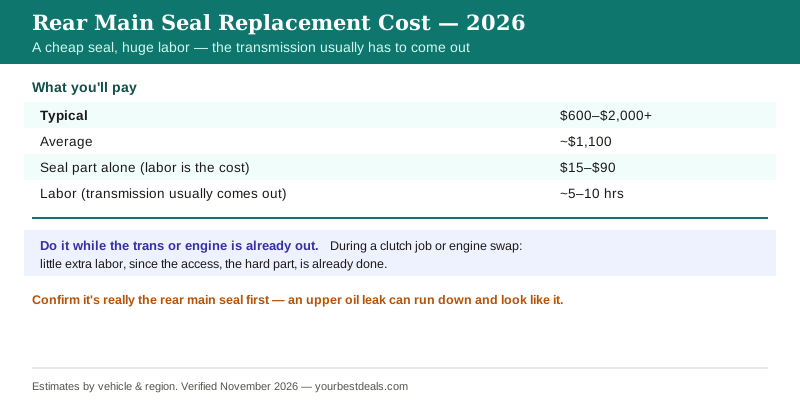
A rear main seal replacement costs about $600 to $2,000 or more, averaging around $1,100. As with other seals, the part is dirt cheap – just $15 to $90 – and the cost is almost entirely labor. The reason it’s so expensive is location: the rear main seal sits where the crankshaft exits the back of the engine to meet the transmission, so reaching it usually means removing the transmission, roughly 5 to 10 hours of work. Trucks, all-wheel-drive vehicles, and models with tight engine bays push toward $1,500 to $2,000 or more. It’s one of the priciest oil leaks for exactly this reason. The big money tip: if the transmission or engine is already out for another job – a clutch replacement or an engine swap – replace the rear main seal at the same time for little extra labor, since the hard part (the access) is already done.
The rear main seal is the most expensive common oil-leak repair, purely because of where it hides. Let me cover the cost, why it’s so labor-heavy, and the timing that can make it nearly free.
What you’ll actually pay
Here’s the price picture. These are estimated ranges that vary by vehicle and shop.
| Item | Cost | Notes |
|---|---|---|
| Typical total | $600–$2,000+ | Average around $1,100 |
| Seal part alone | $15–$90 | Cheap; labor dominates |
| Labor | ~5–10 hours | Transmission usually comes out |
| Truck / AWD / tight bay | $1,500–$2,000+ | Harder access |
The rear main seal keeps oil from leaking out where the crankshaft meets the transmission. Because the transmission (and on some cars more) has to come off to reach it, the labor is the entire cost – the seal itself is a few dollars. That’s why the same tiny part can cost $600 on one car and $2,000 on another, depending on how hard the access is. Our oil leak repair cost guide compares it to cheaper leak sources, and the engine oil guide covers leaks generally.
Shop Talk
Two things matter most on a rear main seal. First, confirm it’s actually the rear main seal before authorizing a four-figure, transmission-out job, because oil leaks love to fool you. Oil from a higher leak – a valve cover, an oil pan, a timing cover seal – runs down and back with airflow and pools at the bottom rear of the engine, looking exactly like a rear main seal leak. Replacing the rear main seal when the real leak was an upper gasket means you’ve paid the biggest oil-leak labor on the car and still have a leak. So insist on a proper dye trace (UV dye in the oil, black light to find the true source) before anyone pulls the transmission. Second, the timing trick that can make this nearly free: if you’re already having the transmission out for another reason – a clutch replacement on a manual, or an engine swap, or a torque-converter/transmission job – have the rear main seal replaced at the same time. The seal is cheap and the access is already done, so it’s a small add-on versus a standalone $1,100-ish job later. On a manual car getting a clutch, doing the rear main seal then is almost automatic for a good shop. And on an old, low-value car with a slow rear main seep, weigh whether it’s worth the big labor at all, or whether just topping off oil and monitoring it is the sensible call.
Where Drivers Overpay
The costliest mistake is pulling the transmission to replace the rear main seal when the real leak was an upper source running down. Because that’s the most expensive oil-leak labor on the car, a wrong diagnosis here is very costly – so insist on a dye trace to confirm the rear main seal is really the source before authorizing the job. Oil from a valve cover, oil pan, or timing seal commonly mimics a rear main leak.
The flip side – a real saving – is timing. If the transmission is already coming out for a clutch job or an engine swap, adding the rear main seal then is a small part-and-time add-on rather than a separate $1,100-ish job. So if you’re facing clutch or transmission work on a car with any rear seep, do the seal at the same time. And on an old, low-value car with a slow seep, consider whether topping off and monitoring is smarter than the big labor at all. The pattern: confirm with a dye trace, bundle it with any trans-out job, and weigh the labor against the car’s value for a minor leak.
The Real Number
A rear main seal is $600 to $2,000+ (avg ~$1,100) – a $15-to-$90 seal with 5-to-10 hours of labor because the transmission comes out. Confirm it’s really the rear main seal with a dye trace before this big job, since an upper leak can run down and mimic it. The huge saving: do it while the transmission is already out for a clutch or engine job – the access is paid for, so the seal is a small add-on. On an old car with a slow seep, monitoring may beat the labor.
Frequently Asked Questions
How much does a rear main seal replacement cost?
About $600 to $2,000 or more, averaging around $1,100. The seal itself is cheap at $15 to $90 – the cost is almost entirely labor, because the rear main seal sits where the crankshaft meets the transmission, so the transmission usually has to be removed, roughly 5 to 10 hours of work. Trucks, AWD vehicles, and tight engine bays push toward the higher end. These are estimates that vary by vehicle and shop. Because the labor is so high, confirm the rear main seal is actually the leak source before authorizing the job, and do it while the transmission is out for another reason if possible.
Why is a rear main seal so expensive when the part is cheap?
Because of where it’s located. The rear main seal seals the back of the crankshaft where it exits the engine to meet the transmission, so reaching it requires removing the transmission (and sometimes the flywheel/flexplate and more) – a labor-intensive job of 5 to 10 hours. The seal is a few dollars, but that heavy access labor is the entire cost, which is why the total runs $600 to $2,000 depending on how hard your vehicle is to work on. This “cheap part, enormous access” nature makes it the priciest common oil-leak repair.
How do I know the leak is really the rear main seal?
You often can’t tell by where the oil pools, because oil from a higher leak – a valve cover, oil pan, or timing cover seal – runs down and back and collects at the bottom rear of the engine, looking just like a rear main seal leak. The reliable way to confirm is a dye trace: a shop adds UV dye to the oil, runs the car, and uses a black light to find the true source. Because the rear main seal job is so expensive (transmission out), insist on that confirmation before authorizing it – you don’t want to pay the biggest oil-leak labor and still have a leak from an upper source.
Should I replace the rear main seal during a clutch job?
Yes, if there’s any rear seep, it’s usually smart. On a manual-transmission car, a clutch replacement already requires removing the transmission – which is exactly the labor a rear main seal needs – so adding the seal then is a small part-and-time add-on rather than a separate $1,100-ish job later. Many good shops recommend doing the rear main seal (and sometimes the pilot bearing) whenever they’re in there for a clutch. The same logic applies to any transmission-out job. So if you’re facing clutch or transmission work and have a rear seep, do the seal at the same time.
Can I drive with a leaking rear main seal?
A slow rear main seal seep can often be managed short-term by monitoring and topping off the oil, but you shouldn’t ignore a significant leak. Losing oil risks running the engine low, which can cause serious damage, and a worsening leak drops the level faster. On a newer or higher-value car, fix it. On an old, low-value car with a slow seep, some owners reasonably choose to just keep the oil topped off and monitor it rather than pay the big transmission-out labor – a judgment call based on the car’s worth and the leak’s severity. Either way, keep a close eye on the oil level.
Will a rear main seal stop-leak additive work?
An oil stop-leak additive that softens and swells aging seals can sometimes slow a minor rear main seep, and on an old, low-value car where the big labor isn’t worth it, it’s a cheap thing to try as a stopgap. But it’s not a reliable permanent fix, won’t address a significant leak, and can’t substitute for replacing the seal. Given how expensive the proper repair is, trying a quality seal-conditioner additive first is more reasonable here than on cheaper-to-fix leaks – but manage expectations. For a car worth the repair, replacing the seal (ideally during other trans-out work) is the dependable solution.
What causes a rear main seal to leak?
Usually age and wear – the rubber seal hardens, dries, and cracks over time and miles, eventually letting oil seep past. Contributing factors include high mileage, infrequent oil changes (degraded oil and sludge are harder on seals), a clogged PCV system raising crankcase pressure that pushes oil past the seal, and sometimes a car sitting unused letting the seal dry out. Because a stuck PCV valve can raise crankcase pressure and worsen seal leaks, checking that cheap part is worthwhile. Mostly, though, a leaking rear main seal is an age-and-mileage wear item on higher-mileage engines.
Sources
Price ranges verified against 2026 repair pricing in November 2026. Dollar amounts are estimates that vary by vehicle and shop.
- Endurance – rear main seal replacement cost
- CarParts.com – rear main seal replacement
- ASE – National Institute for Automotive Service Excellence
Related Guides
- Oil Leak Repair Cost by Source
- Engine Replacement Cost
- Signs of a Bad PCV Valve
- Engine Oil Guide
- Car Repair Cost Estimator

Diane Holcomb spent seven years as a service advisor at multi-brand dealerships in Charlotte, NC, where a rear-main-seal quote meant a dye trace to confirm it and a push to bundle it with any clutch or transmission job. She drives a 2019 Honda CR-V and a hand-me-down 2007 Toyota Camry, and takes no referral fees or advertising money from any shop or chain.