
Last updated: November 4, 2026 – By Diane Holcomb
November 2026 update: reconfirmed IAC pricing and the clean-first step.
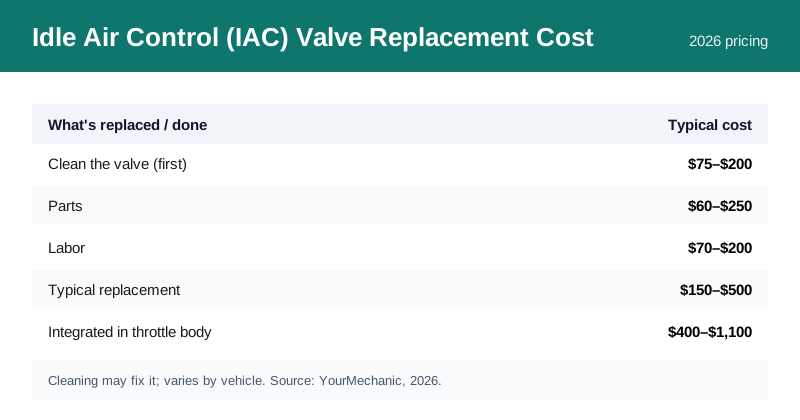
An idle air control (IAC) valve replacement runs about $150 to $500, with parts at roughly $60 to $250 and labor $70 to $200. Often, though, the first step is cheaper: cleaning the valve runs about $75 to $200 and frequently fixes the problem, because carbon buildup is a common cause. On many newer cars idle control is built into the electronic throttle body rather than a separate IAC valve, and replacing that integrated unit runs $400 to $1,100. The IAC valve controls how much air bypasses the throttle plate when your foot’s off the gas, which sets the idle speed. A faulty or gummed-up IAC causes a rough idle, stalling (especially at stops or when cold), a surging or hunting idle, or an idle that’s too high or too low. The good news: because carbon is so often the culprit, cleaning is worth trying before replacing.
Clean before you replace – that’s the theme here. Let me break down the cost and when the IAC is even the right part.
What you’ll actually pay
Here’s the picture. These are estimates that vary by vehicle and shop.
| Item | Cost | Notes |
|---|---|---|
| Clean the valve (first) | $75–$200 | Try this first |
| Parts / labor | $60–$250 / $70–$200 | Separate IAC |
| Typical replacement | $150–$500 | Most cars |
| Integrated in throttle body | $400–$1,100 | Newer cars |
When idle control lives in the throttle body, this overlaps with our throttle body guide and electronic throttle control guide.
Shop Talk
Try cleaning before you replace – on an older car with a separate IAC valve, a dirty valve is more common than a dead one. The IAC lives on or near the throttle body and, like the throttle plate, collects carbon and oily residue over the years. That gunk makes it stick, which shows up as a rough or stalling idle, especially right after a cold start or when you come to a stop. Pulling the valve and cleaning it (and the port it sits in) with throttle-body or carb cleaner often restores a smooth idle for the price of a can of cleaner. If it’s really worn out electrically, then you replace it – and on most older cars the part isn’t expensive. Two things worth knowing. One, a lot of newer cars don’t have a separate IAC valve at all; the electronic throttle body handles idle, so a “bad IAC” diagnosis on a drive-by-wire car usually means the throttle body, which is a bigger part. Two, rough idle and stalling have other cheap causes – a vacuum leak, a dirty throttle body, or an aging spark plug – so it’s worth ruling those out before buying an IAC. A quick scan and a look for vacuum leaks keeps you from replacing a valve that wasn’t the problem.
Where Drivers Overpay
The overpay is replacing an IAC valve that only needed cleaning. Carbon buildup makes the valve stick and idle rough, and a $75–$200 cleaning fixes that far cheaper than a full replacement. On an older car with a separate valve, cleaning first is almost always worth it.
The second trap is buying an IAC for a rough idle that was actually a vacuum leak, a dirty throttle body, or a tired spark plug – or, on a newer car, assuming there’s a separate IAC when idle is handled by the throttle body. The pattern: scan and check for vacuum leaks, clean the valve first, and confirm your car even has a separate IAC before replacing one.
The Real Number
An IAC valve replacement is $150 to $500 (parts $60 to $250, labor $70 to $200), but a cleaning at $75 to $200 often fixes a sticking, carbon-fouled valve first. Rule out a vacuum leak, dirty throttle body, or worn plugs before buying one, since those cause the same rough idle. And on many newer cars there’s no separate IAC – idle lives in the throttle body, a $400 to $1,100 part – so confirm what your car actually has.
Frequently Asked Questions
How much does it cost to replace an IAC valve?
A typical idle air control valve replacement runs about $150 to $500, with parts at roughly $60 to $250 and labor $70 to $200. Cleaning the valve instead of replacing it runs about $75 to $200 and often resolves the problem, since carbon buildup is a common cause. On newer vehicles where idle control is built into the electronic throttle body rather than a separate IAC valve, replacing that integrated unit runs $400 to $1,100. These are estimates that vary by vehicle and shop. Because a dirty valve is so common, many shops try cleaning first, which can save you the replacement cost. Confirming whether your car even has a separate IAC valve is an important first step.
What does the idle air control valve do?
The idle air control (IAC) valve manages the engine’s idle speed. When your foot is off the gas, the throttle plate is nearly closed, so the engine needs a controlled amount of air to idle smoothly – the IAC valve provides that by letting a metered amount of air bypass the closed throttle, under the computer’s control. It adjusts to keep a steady idle as conditions change: higher when the engine is cold or the AC is on, lower once warm. When the IAC sticks or fails, the engine can’t regulate idle properly, causing stalling, rough idle, or surging. On many modern cars with electronic (drive-by-wire) throttles, there’s no separate IAC valve; the throttle body itself handles idle air.
What are the symptoms of a bad IAC valve?
The classic symptoms are all idle-related: a rough or unstable idle, stalling (especially at a stop, when coming to idle, or with a cold engine), an idle that surges or hunts up and down, and an idle that’s too high or too low. You might notice the engine nearly dies when you take your foot off the gas, or it idles fast and won’t settle. A check engine light may accompany it. Because these symptoms overlap with a vacuum leak, a dirty throttle body, or worn spark plugs, a bad IAC should be confirmed rather than assumed. If your car has a separate IAC valve and it’s carbon-fouled, cleaning may fix it. A scan and a check for vacuum leaks help pin down the real cause.
Should I clean the IAC valve or replace it?
On an older car with a separate IAC valve, cleaning is worth trying first. The valve collects carbon and oily residue over time, which makes it stick and causes rough or stalling idle – and removing it and cleaning it (plus its port) with throttle-body or carb cleaner often restores a smooth idle for the cost of a can of cleaner, around $75 to $200 if a shop does it. If cleaning doesn’t help and the valve is electrically worn out, then replacement (parts $60 to $250) is the next step. So cleaning first can save you the replacement cost when carbon is the issue, which it often is. If the valve is physically damaged or the motor inside has failed, cleaning won’t fix it and it needs to be replaced.
Can a bad IAC valve cause stalling?
Yes – stalling is one of the most common symptoms. The IAC valve supplies the air the engine needs to idle when the throttle is closed, so if it’s stuck closed or not working, the engine can be starved of idle air and stall, especially when you come to a stop, let off the gas, or start a cold engine. A valve stuck open can cause a high or surging idle instead. Because stalling is disruptive and can be unsafe (losing power steering and brakes assist at a stop), it’s worth diagnosing promptly. That said, stalling has other causes too – vacuum leaks, fuel delivery problems, a dirty throttle body – so the IAC should be confirmed as the cause. Cleaning a carbon-fouled valve often cures IAC-related stalling.
Do all cars have an IAC valve?
No, and this is important before you buy one. Many older and mid-age vehicles use a separate idle air control valve. But a lot of newer cars with electronic (drive-by-wire) throttle control don’t have a dedicated IAC valve at all – the electronic throttle body itself manages idle by adjusting the throttle plate directly. So on a newer car, a “bad IAC” symptom (rough idle, stalling) usually points to the throttle body, a vacuum leak, or another cause, not a standalone IAC valve that doesn’t exist on that engine. That’s why confirming whether your specific vehicle has a separate IAC valve is the right first step; otherwise you might chase a part your car doesn’t have. A quick lookup or a shop can tell you which system you have.
What else causes a rough idle besides the IAC valve?
Plenty, which is why the IAC shouldn’t be assumed. A vacuum leak (a cracked hose or intake gasket letting in unmetered air) is a very common cause of rough or high idle. A dirty throttle body, worn or fouled spark plugs, a failing ignition coil, a dirty mass air flow sensor, a clogged PCV system, or a weak fuel injector can all cause rough idle and stalling too. Because so many things produce the same symptom, a proper diagnosis – scanning for codes, checking for vacuum leaks, and inspecting the throttle body – is what points to the real culprit. Replacing an IAC valve for a rough idle that was actually a vacuum leak is a classic wasted repair. Rule out the cheap, common causes first.
Sources
Price ranges verified against 2026 idle air control valve pricing in November 2026. Dollar amounts are estimates that vary by vehicle and shop.
- YourMechanic – idle control valve replacement estimate
- RepairPal – repair cost estimator
- ASE – National Institute for Automotive Service Excellence
Related Guides
- Throttle Body Replacement Cost
- Electronic Throttle Control Replacement Cost
- Mass Air Flow Sensor Replacement Cost
- Spark Plugs Replacement Cost
- Car Repair Cost Estimator

Diane Holcomb spent seven years as a service advisor at multi-brand dealerships in Charlotte, NC, where a rough idle got a cleaning and a vacuum-leak check before anyone wrote up a new IAC valve. She drives a 2019 Honda CR-V and a hand-me-down 2007 Toyota Camry, and takes no referral fees or advertising money from any shop or chain.