
Last updated: November 9, 2026 – By Diane Holcomb
November 2026 update: reconfirmed gas vs. diesel pricing and the clean-before-replace point.
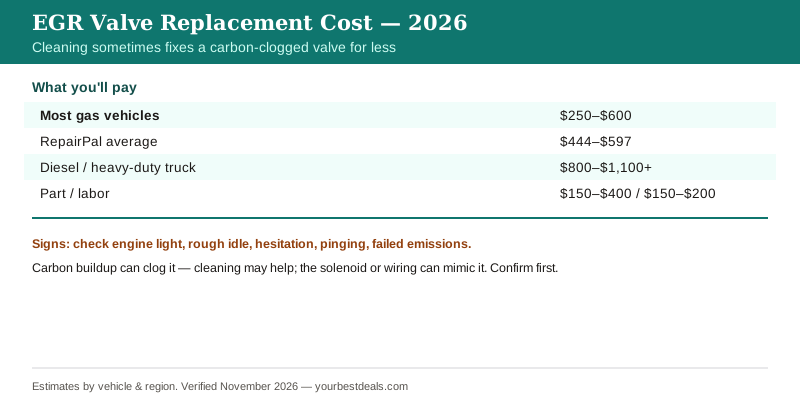
An EGR valve replacement runs about $250 to $600 for most gasoline vehicles, parts and labor, with a RepairPal average around $444 to $597. Diesel and heavy-duty trucks run higher, often $800 to $1,100 or more. The valve part is roughly $150 to $400 and labor about $150 to $200. The EGR (exhaust gas recirculation) valve routes a small amount of exhaust back into the intake to lower combustion temperatures and emissions, so when it sticks or fails you get a check engine light, rough idle, hesitation, pinging/knock, and sometimes a failed emissions test. The useful money tip: because the failure is often carbon buildup clogging the valve, cleaning it sometimes fixes the problem for far less than a replacement – and the cheaper EGR solenoid or wiring can cause the same codes, so confirm the valve is actually the fault before replacing it.
EGR problems are usually carbon, not a dead valve, so a cleaning or a cheap solenoid is often the real fix. Let me cover the cost, the clean-first option, and the look-alikes.
What you’ll actually pay
Here’s the price picture. These are estimated ranges that vary by vehicle and shop.
| Item | Cost | Notes |
|---|---|---|
| Most gas vehicles | $250–$600 | RepairPal avg $444–$597 |
| Diesel / heavy-duty truck | $800–$1,100+ | Pricier parts/labor |
| Part / labor | $150–$400 / $150–$200 | Access-dependent |
EGR failures are frequently carbon clogging rather than an electrical fault, so cleaning is worth considering first. Our EGR solenoid guide and check engine light guide cover the cheaper related part and the codes.
Shop Talk
Most EGR problems aren’t a broken valve – they’re carbon. The EGR valve and its passages route hot, sooty exhaust, so over time carbon builds up and makes the valve stick open or closed, which throws an EGR code (often P0401 for insufficient flow or P0402 for excessive flow), a rough idle, hesitation, or pinging. On a lot of cars, removing and cleaning the valve and its ports (and sometimes the EGR passages) restores proper flow and clears the code for the cost of a cleaning rather than a new valve. So it’s worth asking the shop whether a cleaning is a reasonable first step on your engine before buying the part. Two other things can cause the same codes for less than a valve: the EGR solenoid (the cheap electrical control) and the wiring or vacuum lines that operate the valve – so a proper diagnosis confirms it’s the valve itself and not one of those. When the valve is really worn out or won’t hold a seal after cleaning, replacement is the fix. And note diesels are a different world: their EGR systems are pricier and more complex, so budget more there. Bottom line on a gas engine: clean or confirm before you replace, because a carbon problem doesn’t always need a new valve.
Where Drivers Overpay
The common overpay is replacing the EGR valve when the real issue was carbon buildup that a cleaning would have cleared, or when the cheaper EGR solenoid or wiring was actually at fault. All three throw similar EGR codes, so a proper diagnosis – and trying a cleaning where appropriate – before buying a valve is the key save.
On diesels and heavy-duty trucks, the EGR system is pricier and more complex, so confirming the specific failed component matters even more there. The pattern: scan the codes, consider cleaning a carbon-clogged valve first, rule out the solenoid and wiring, and only replace the valve when it’s confirmed worn out or won’t seal after cleaning.
The Real Number
An EGR valve is $250 to $600 on gas engines ($800 to $1,100+ on diesels and heavy-duty trucks). But most EGR problems are carbon buildup, so cleaning the valve sometimes fixes it for less – and the cheaper EGR solenoid or wiring can throw the same codes. Scan the codes, try a cleaning where appropriate, and confirm it’s the valve before replacing it.
Frequently Asked Questions
How much does it cost to replace an EGR valve?
About $250 to $600 for most gasoline vehicles, parts and labor, with a RepairPal average around $444 to $597. Diesel and heavy-duty trucks run higher, often $800 to $1,100 or more, because their EGR systems are pricier and more complex. The valve part is roughly $150 to $400 and labor about $150 to $200, depending on access. These are estimates that vary by vehicle and shop. Because many EGR problems are carbon buildup rather than a failed valve, and the cheaper EGR solenoid can cause similar codes, confirming the valve is the actual fault – or trying a cleaning first – can avoid an unnecessary replacement.
What are the signs of a bad EGR valve?
Common signs include a check engine light with an EGR-related code (such as P0401 for insufficient flow or P0402 for excessive flow), a rough or unstable idle, hesitation or stumbling under acceleration, engine pinging or knocking, reduced performance, and a failed emissions test. A valve stuck open can cause rough idling and stalling, while one stuck closed can cause pinging and higher emissions. Because carbon buildup is the usual culprit, these symptoms often come on gradually. Since the EGR solenoid, wiring, and vacuum lines can cause similar codes, the specific trouble code and testing are used to confirm the valve itself is the problem before replacing it.
Can cleaning the EGR valve fix it instead of replacing it?
Often, yes, on gasoline engines. The most common EGR failure is carbon buildup that makes the valve stick or restricts its passages, and removing and cleaning the valve (and sometimes the EGR ports and passages) can restore proper flow and clear the code for the cost of a cleaning rather than a new valve. So cleaning is a reasonable first step to consider when the symptom is a flow-related code and the valve isn’t electrically dead. If the valve is really worn out, has a failed electronic actuator, or won’t hold a seal after a thorough cleaning, then replacement is the right fix. Ask your shop whether cleaning is viable for your engine before committing to a replacement.
Could the problem be the EGR solenoid or wiring instead?
Yes, and those are cheaper. The EGR system includes the valve plus the control solenoid (which opens the valve via vacuum or signal) and the wiring and vacuum lines. A failed solenoid or a wiring/vacuum problem can prevent the valve from operating and throw EGR codes that look just like a bad valve – but the solenoid and wiring are far less expensive to fix. That’s why a proper diagnosis matters: confirming whether the fault is the valve, the solenoid, or the wiring before replacing the pricier valve. If a shop quotes an EGR valve, it’s reasonable to ask whether the solenoid and wiring were checked, since replacing the valve won’t help if the real issue is upstream.
Can I drive with a bad EGR valve?
You can often drive short-term, but it’s not ideal. A faulty EGR valve typically causes drivability issues (rough idle, hesitation, pinging) and a check engine light rather than an immediate breakdown, so the car usually still runs. However, a valve stuck open can cause stalling and poor running, pinging from a stuck-closed valve can over time stress the engine, and you’ll fail an emissions test. The persistent check engine light also masks other codes. So while a bad EGR valve isn’t usually an emergency, it should be addressed reasonably soon – especially if there’s pinging or stalling – and it’s worth confirming whether a cleaning or a cheaper solenoid will fix it before replacing the valve.
Why do EGR valves fail?
Carbon and soot buildup is the leading cause – the valve handles dirty exhaust gas, so deposits accumulate and make it stick open or closed or clog its passages, which is why cleaning often helps. The electronic or vacuum actuator that operates the valve can also fail, and wiring or vacuum-line problems can stop it working. Short-trip driving and certain fuel/engine conditions accelerate carbon buildup. Diesels, with heavier soot, are especially prone to EGR fouling. There’s no scheduled replacement; the valve is serviced or replaced when it fails. Because deposits are the main enemy, keeping up with maintenance and occasionally cleaning the EGR system on carbon-prone engines can extend its life.
Is replacing an EGR valve a DIY job?
On many gasoline engines where the valve is accessible, yes – it’s typically held by a couple of bolts and an electrical or vacuum connection, so removing it (to clean or replace) is within reach for a DIYer. Cleaning the valve and its ports yourself is a common, cheap first step. The keys are confirming with a scan that the valve (not the solenoid or wiring) is the issue, using a new gasket, and clearing the code afterward. On engines where the EGR valve is buried or on diesels with complex EGR systems, it’s more involved and better left to a shop. For an accessible gas-engine valve with a confirmed diagnosis, cleaning or replacing it is a manageable DIY.
Sources
Price ranges verified against 2026 EGR valve repair pricing in November 2026. Dollar amounts are estimates that vary by vehicle and shop.
- RepairPal – EGR valve replacement cost
- CostInsightHub – EGR valve replacement cost
- ASE – National Institute for Automotive Service Excellence
Related Guides
- EGR Solenoid Replacement Cost
- EGR Cooler Replacement Cost
- Check Engine Light Guide
- Catalytic Converter Replacement Cost
- Car Repair Cost Estimator

Diane Holcomb spent seven years as a service advisor at multi-brand dealerships in Charlotte, NC, where an EGR code often cleared with a cleaning or a cheap solenoid – so she had the techs confirm the valve before writing up the pricier part. She drives a 2019 Honda CR-V and a hand-me-down 2007 Toyota Camry, and takes no referral fees or advertising money from any shop or chain.