
Last updated: November 7, 2026 – By Diane Holcomb
November 2026 update: reconfirmed throttle body pricing and the clean-and-relearn-first step.
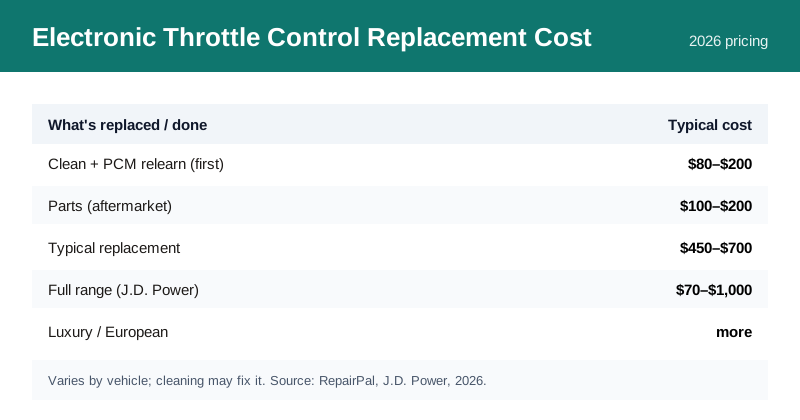
Replacing an electronic throttle body runs about $450 to $700 for most vehicles, with a full range of roughly $70 to $1,000 depending on the car. The part is about $100 to $200 aftermarket for mainstream vehicles; luxury and European models cost more. Before that, though, a throttle body cleaning plus a PCM relearn ($80 to $200) is worth trying first – carbon buildup on the throttle plate causes a lot of rough-idle and hesitation complaints that mimic a failed unit. “Electronic throttle control” (ETC, sometimes shown as an ETC warning light or a little lightning-bolt icon) is the modern drive-by-wire setup: instead of a cable from the pedal to the throttle, a pedal sensor tells the computer, which runs a motor on the throttle body. A warning light can mean a sensor or wiring fault, carbon buildup, or a throttle body problem – not automatically a full replacement.
The important move here is to confirm what’s actually wrong before buying a throttle body. Let me walk through the cost and the cheaper first steps.
What you’ll actually pay
Here’s the picture. These are estimates that vary by vehicle and shop.
| Item | Cost | Notes |
|---|---|---|
| Clean + PCM relearn (first) | $80–$200 | Try this first |
| Part (aftermarket) | $100–$200 | Mainstream |
| Typical replacement | $450–$700 | Parts + labor |
| Full range | $70–$1,000 | By vehicle |
This overlaps with our throttle body guide and the accelerator pedal position sensor guide, since the pedal sensor is the other half of the drive-by-wire system.
Shop Talk
Before anyone sells you a throttle body, two cheap things should happen first. One, clean it. The throttle plate collects a ring of oily carbon over the years, and that gunk causes rough idle, stumbling, and sometimes a check engine light – symptoms that look exactly like a failing throttle body. A proper cleaning (removing it or carefully cleaning in place with throttle-body cleaner, not just spraying brake cleaner in) plus a throttle relearn can fix it for a fraction of a replacement. Two, do the relearn. Many cars need the throttle position “relearned” by the computer after cleaning or disconnecting the battery, and a car that idles rough right after service sometimes just never got that relearn done. If cleaning and relearn don’t fix it and the throttle body’s motor or sensor is actually bad, then replacement is the call – and on most mainstream cars the part isn’t expensive; you’re paying for a correct diagnosis and the relearn. One safety note: if you get a throttle-control warning light and the car goes into a reduced-power “limp” mode, that’s the system protecting you – get it scanned before driving far, because it can also be a pedal sensor or wiring issue, not the throttle body at all.
Where Drivers Overpay
The overpay is buying a throttle body for what a cleaning and relearn would have fixed. Carbon on the throttle plate causes rough idle and hesitation that read like a failed unit, and at $80–$200 a clean-and-relearn is far cheaper than a $450–$700 replacement. Trying it first is the save.
The second trap is assuming the throttle body is the culprit when a warning light appears. The same ETC light can come from the accelerator pedal position sensor or wiring – a different, sometimes cheaper part. So a scan that identifies the actual fault matters. The pattern: scan the code, clean and relearn the throttle body first, and replace it only once its motor or sensor is confirmed bad.
The Real Number
An electronic throttle body replacement is $450 to $700 for most cars (range $70 to $1,000), but a cleaning plus a PCM relearn at $80 to $200 fixes a lot of rough-idle complaints and should come first. An ETC warning light can also be the accelerator pedal sensor or wiring, so get it scanned. Replace the throttle body only once its motor or sensor is confirmed bad – don’t buy the part to chase a symptom a cleaning would cure.
Frequently Asked Questions
How much does it cost to replace an electronic throttle body?
For most vehicles, about $450 to $700 including parts and labor, with a full range of roughly $70 to $1,000 depending on the car. The part is about $100 to $200 aftermarket for mainstream vehicles, while luxury and European models cost more. These are estimates that vary by vehicle and shop. Before replacing, many shops first try a throttle body cleaning plus a PCM relearn, which runs about $80 to $200 and resolves a lot of rough-idle and hesitation complaints caused by carbon buildup. So the replacement figure applies once the unit’s motor or sensor is confirmed bad. Getting the trouble code scanned first ensures you’re replacing the right part, since a throttle-control warning can also come from the pedal sensor or wiring.
What is electronic throttle control?
Electronic throttle control (ETC), also called drive-by-wire, replaces the old mechanical cable between the gas pedal and the engine’s throttle. Instead of a cable physically opening the throttle, a sensor on the accelerator pedal reads how far you press, sends that to the computer (PCM), and the computer runs a small motor on the throttle body to open the throttle plate the right amount. This lets the system blend in cruise control, traction control, and stability control smoothly. The trade-off is more electronics that can fault. An ETC warning light (sometimes a lightning-bolt icon) signals a problem somewhere in that chain – the throttle body, the pedal sensor, or the wiring – and often triggers a reduced-power limp mode to keep things safe.
Can I clean the throttle body instead of replacing it?
Very often, yes, and it should be the first step. Over the years the throttle plate and bore collect a ring of oily carbon, and that buildup causes rough idle, stumbling, hesitation, and sometimes a check engine light – the same symptoms as a failing throttle body. Carefully cleaning it with throttle-body cleaner (not just spraying brake cleaner in), followed by a throttle relearn so the computer re-sets the idle position, can restore normal operation for a fraction of a replacement, around $80 to $200. If cleaning and a relearn don’t fix it and the throttle body’s motor or position sensor is actually faulty, then replacement is warranted. So trying a cleaning first can save you from buying a part you didn’t need.
Why is my electronic throttle control warning light on?
The ETC light (often a lightning-bolt symbol) means the computer has detected a fault in the drive-by-wire throttle system. The cause can be the throttle body itself (a bad motor or throttle position sensor, or heavy carbon buildup), the accelerator pedal position sensor, or wiring and connector problems between them. The car may drop into a reduced-power “limp” mode to protect itself, which is normal and intentional. Because several parts can trigger the same light, the right move is to have it scanned for trouble codes rather than guessing. The code narrows it down – a pedal sensor fault and a throttle body fault point to different, differently priced repairs. Don’t assume the throttle body is bad until the scan confirms it.
Is it safe to drive with an electronic throttle control problem?
It depends on how the car is behaving. If the ETC warning light is on and the car has entered a reduced-power limp mode, it’s intentionally limiting power to keep you safe; you can usually drive gently a short distance, but you should get it scanned before going far, since the underlying fault could worsen or cause stalling. If the car is surging, hesitating badly, or losing power unpredictably, that’s not something to keep driving on – have it towed or checked promptly. The throttle system is central to how the car accelerates, so erratic behavior is a get-it-looked-at-now situation. A quick code scan tells you whether it’s a sensor, wiring, or the throttle body, and how urgent it is.
What is a throttle relearn and why does it matter?
A throttle relearn is a procedure where the computer re-establishes the throttle plate’s closed and idle positions. It matters because after cleaning the throttle body, replacing it, or even disconnecting the battery, the computer’s stored idle settings can be off, leaving the car idling rough, stalling, or hunting. The relearn – done with a scan tool or, on some cars, a specific key-and-pedal sequence – resets those values so the idle is smooth again. A common complaint after throttle service is “it idles worse now,” and the fix is simply that the relearn wasn’t performed. So whether you clean or replace the throttle body, the relearn is part of doing the job right. Ask the shop to confirm it’s included.
What’s the difference between the throttle body and the pedal sensor?
They’re the two ends of the drive-by-wire system. The accelerator pedal position sensor sits at the gas pedal and tells the computer how far you’re pressing. The throttle body, on the engine’s intake, contains the motor and throttle plate that actually open to let air in, plus its own position sensor so the computer knows the plate’s real position. The computer connects the two: you press the pedal, the sensor reports it, and the computer commands the throttle body to open accordingly. Because a fault in either can trigger the same warning light and limp mode, telling them apart requires a scan. Replacing the wrong one is a common, avoidable expense – see our pedal position sensor guide.
Sources
Price ranges verified against 2026 throttle body pricing in November 2026. Dollar amounts are estimates that vary by vehicle and shop.
- J.D. Power – throttle body replacement cost
- RepairPal – throttle body replacement cost
- ASE – National Institute for Automotive Service Excellence
Related Guides
- Throttle Body Replacement Cost
- Accelerator Pedal Position Sensor Replacement Cost
- Mass Air Flow Sensor Replacement Cost
- MAP Sensor Replacement Cost
- Car Repair Cost Estimator

Diane Holcomb spent seven years as a service advisor at multi-brand dealerships in Charlotte, NC, where a lot of “bad throttle body” complaints turned out to be carbon buildup fixed by a cleaning and a relearn. She drives a 2019 Honda CR-V and a hand-me-down 2007 Toyota Camry, and takes no referral fees or advertising money from any shop or chain.