
Last updated: November 7, 2026 – By Diane Holcomb
November 2026 update: reconfirmed sensor-vs-whole-pedal pricing and the scan-the-codes-first point.
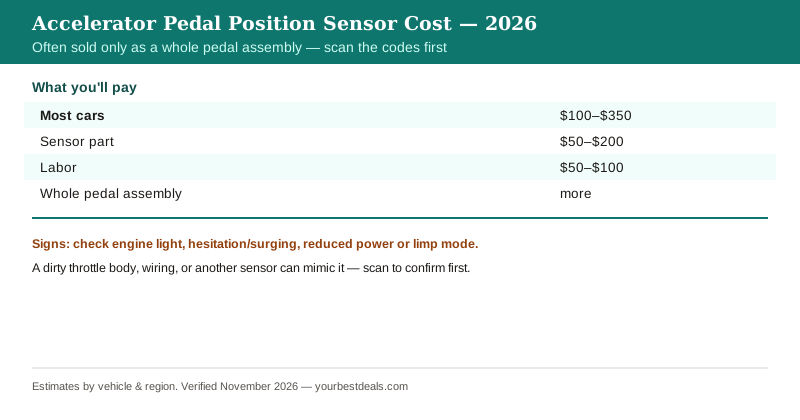
An accelerator pedal position sensor (APPS) replacement runs about $100 to $350 for most cars – the sensor part is roughly $50 to $200 and labor about $50 to $100. The catch on many modern vehicles is that the sensor is built into the accelerator pedal assembly and isn’t sold separately, so you replace the whole pedal, which costs more. On a drive-by-wire car, this sensor tells the computer how far you’ve pressed the gas, so a failing one shows up as a check engine light, hesitation or surging when you accelerate, reduced power or limp mode, and sometimes an unresponsive throttle. Because a dirty throttle body, a wiring or connector fault, or a related sensor can cause similar symptoms, it’s worth scanning the codes to confirm the pedal sensor is actually the problem before replacing it.
This is a cheap electronic part whose price mostly hinges on whether it’s separate or part of the pedal – and whether it’s even the real culprit. Let me cover the cost, the whole-pedal question, and the confirm-first rule.
What you’ll actually pay
Here’s the price picture. These are estimated ranges that vary by vehicle and shop.
| Item | Cost | Notes |
|---|---|---|
| Most cars | $100–$350 | Sensor or pedal assembly |
| Sensor part | $50–$200 | If sold separately |
| Labor | $50–$100 | Usually quick |
| Whole pedal assembly | more | Common on modern cars |
The pedal assembly is usually accessible in the footwell, so labor is modest; the variable is the part. Our throttle body cost guide and check engine light guide cover related drive-by-wire components and reading the codes.
Shop Talk
On a modern drive-by-wire car there’s no cable from the pedal to the engine – the pedal has a sensor that tells the computer your throttle request, and the computer opens the electronic throttle. So when this sensor acts up, you get really alarming symptoms: sudden hesitation, surging, a dead spot when you press the gas, or the car dropping into limp mode with almost no power. Two things to know before spending. First, confirm it’s really the pedal sensor. The trouble codes usually distinguish a pedal (APP) sensor fault from a throttle body (TPS) fault or a wiring problem, and those are different fixes – a dirty throttle body or a corroded connector can throw similar drivability complaints for less. A quick scan saves you from replacing the wrong part. Second, know whether your car sells the sensor alone or only as a complete pedal assembly. Many do the latter, so the “sensor” job is really a pedal replacement, which costs more in parts but is usually still a quick bolt-in job in the footwell. The good news is labor is generally low because the pedal is easy to reach; the price mostly comes down to the part. And don’t ignore these symptoms – unpredictable throttle response is a safety issue, so get it diagnosed promptly.
Where Drivers Overpay
The main overpay is replacing the pedal sensor when the real fault was elsewhere. Drive-by-wire drivability complaints – hesitation, surging, limp mode – can come from a dirty throttle body, a wiring or connector problem, or the throttle position sensor rather than the pedal sensor, and the codes usually tell them apart. A scan before buying parts prevents paying for the wrong one.
The second is not knowing whether your car sells the sensor alone or only as a full pedal assembly, which changes the part cost. The pattern: scan the codes to confirm it’s the pedal (APP) sensor, check whether the sensor is separate or part of the pedal, and address it promptly since erratic throttle response is a safety concern.
The Real Number
An accelerator pedal position sensor is $100 to $350 (more if your car sells it only as a whole pedal assembly). Labor is usually low because the pedal is easy to reach; the part is the variable. Scan the codes first – hesitation, surging, or limp mode can also be a dirty throttle body, wiring, or the throttle position sensor, which are different fixes. Erratic throttle response is a safety issue, so get it diagnosed promptly.
Frequently Asked Questions
How much does an accelerator pedal position sensor cost to replace?
About $100 to $350 for most cars. The sensor itself runs roughly $50 to $200, and labor is about $50 to $100 since the pedal is usually easy to reach in the footwell. On many modern vehicles the sensor isn’t sold separately – it’s integrated into the accelerator pedal assembly – so you replace the whole pedal, which raises the part cost. These are estimates that vary by vehicle and shop. Because labor is generally modest, the main variable is whether you’re buying just a sensor or a complete pedal assembly, so it helps to know which your car uses when comparing quotes.
What are the signs of a bad accelerator pedal sensor?
Common signs include a check engine light, hesitation or a stumble when you press the gas, surging or uneven acceleration, reduced engine power, and the car dropping into limp mode (a reduced-power safety mode). You may also notice an unresponsive or delayed throttle. Because the pedal sensor is what tells a drive-by-wire car how much throttle you want, a fault directly affects how the car responds to the gas pedal. These symptoms can feel alarming and unpredictable. Since similar symptoms can come from the throttle body or wiring, the specific trouble codes are used to confirm the pedal sensor is the cause rather than another drive-by-wire component.
Is the sensor separate or part of the whole pedal?
It depends on the vehicle. On some cars the accelerator pedal position sensor can be replaced on its own; on many modern vehicles it’s integrated into the accelerator pedal assembly and sold only as a complete unit, so the fix is a whole-pedal replacement. That makes the part more expensive, though the labor is usually similar since the pedal assembly bolts into the footwell either way. When you get a quote or shop for parts, check whether your specific car offers a standalone sensor or only the full pedal – it’s the main thing that moves the price on this repair, and it explains why estimates for the “sensor” can vary.
Can I drive with a bad accelerator pedal sensor?
It’s not advisable. A failing pedal sensor can cause unpredictable throttle response – hesitation, surging, sudden power loss, or limp mode – which is a real safety concern, especially when you need to accelerate to merge or cross traffic. Many cars intentionally drop into limp mode (limited power) when they detect a pedal sensor fault, precisely to keep you safe, but that leaves you with very little power. So while the car may still move, erratic or unreliable throttle behavior should be diagnosed and fixed promptly rather than driven on. If the car is in limp mode or the throttle is behaving erratically, treat it as a repair to handle soon, not something to put off.
Why scan the codes before replacing the sensor?
Because the symptoms overlap with other drive-by-wire problems, and scanning prevents replacing the wrong part. Hesitation, surging, reduced power, and limp mode can be caused by the accelerator pedal (APP) sensor, the throttle body/throttle position (TPS) sensor, a dirty throttle body, or wiring and connector faults. The stored trouble codes usually point to which component or circuit is at fault – distinguishing a pedal-sensor code from a throttle-body code, for instance. Replacing the pedal sensor on a guess, when the real issue was a dirty throttle body or a corroded connector, wastes money and doesn’t fix the car. A scan is quick and cheap insurance against misdiagnosis on this repair.
Is replacing the accelerator pedal sensor a DIY job?
On many cars, yes – the accelerator pedal assembly is usually bolted into the footwell with a couple of fasteners and an electrical connector, so swapping it (or a standalone sensor, if offered) is within reach for a confident DIYer. The important part is diagnosis: you should confirm with a scan tool that the pedal sensor is actually the fault before buying the part, since the symptoms overlap with other components. Some vehicles may need the computer to recognize the new sensor or a brief relearn, though many are plug-and-play. If the diagnosis is clear and the part is accessible, it’s a manageable job; if you can’t confirm the fault, have it diagnosed first.
What causes an accelerator pedal sensor to fail?
Electronic wear and contamination are the usual causes. The sensor contains components that can wear or develop faults over time and mileage, and dirt, moisture, or corrosion at the connector can disrupt its signal. Heat and vibration in the footwell area contribute. Sometimes the issue isn’t the sensor itself but the wiring or connector feeding it, which is why diagnosis matters. Spilled liquids into the footwell can also damage the pedal electronics. There’s no scheduled replacement for this part – it’s replaced when it fails and causes drivability symptoms. Because a connector or wiring problem can masquerade as a failed sensor, confirming the actual cause ensures you fix the real issue rather than just swapping the part.
Sources
Price ranges verified against 2026 accelerator pedal sensor pricing in November 2026. Dollar amounts are estimates that vary by vehicle and shop.
- RepairPal – accelerator pedal sensor estimates
- Jerry – throttle/pedal position sensor cost
- ASE – National Institute for Automotive Service Excellence
Related Guides
- Throttle Body Replacement Cost
- Check Engine Light Guide
- Camshaft Position Sensor Replacement Cost
- Mass Air Flow Sensor Replacement Cost
- Car Repair Cost Estimator

Diane Holcomb spent seven years as a service advisor at multi-brand dealerships in Charlotte, NC, where a “the gas pedal feels dead” complaint always got a scan first, because it was sometimes the pedal sensor and sometimes the throttle body. She drives a 2019 Honda CR-V and a hand-me-down 2007 Toyota Camry, and takes no referral fees or advertising money from any shop or chain.