
Last updated: November 8, 2026 – By Diane Holcomb
November 2026 update: reconfirmed relay pricing and the check-the-relay-before-the-motor point.
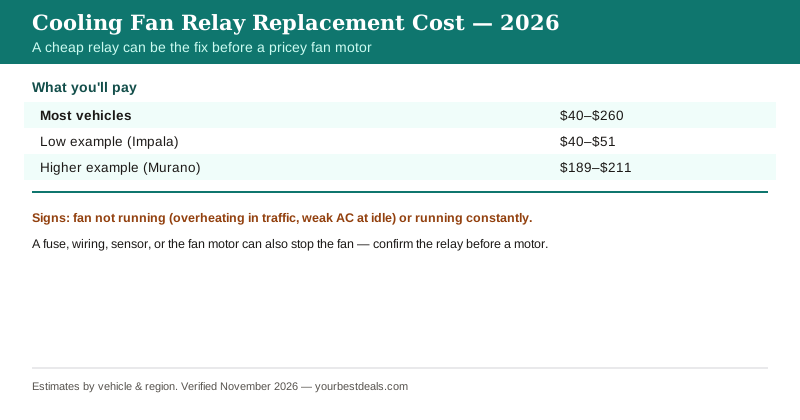
A cooling fan relay replacement runs roughly $40 to $260 depending on the vehicle – examples range from about $40 to $51 on a Chevrolet Impala up to $189 to $211 on a Nissan Murano where the part is pricier. Labor is usually small because the relay just plugs into a fuse or relay box. The relay switches power to the radiator and AC cooling fan, so a failed one can leave the fan not running (causing overheating in slow traffic and weak AC at idle) or, in some failure modes, running constantly. The valuable thing to know: a bad relay, a blown fuse, wiring, a temperature sensor, or the fan motor itself can all stop the fan – and because the relay is cheap and easy to swap, a scan and a simple relay swap-test can confirm the relay before anyone replaces the much pricier fan motor.
The cooling fan relay is one of the cheapest possible fixes for a fan that won’t run – and checking it first can save a fan-motor bill. Let me cover the cost, the symptoms, and the swap-test.
What you’ll actually pay
Here’s the price picture. These are estimated ranges that vary by vehicle and shop.
| Item | Cost | Notes |
|---|---|---|
| Most vehicles | $40–$260 | Relay + small labor |
| Low example (Impala) | $40–$51 | Cheap relay |
| Higher example (Murano) | $189–$211 | Pricier part |
The relay usually lives in the under-hood fuse/relay box and pulls out by hand, so labor is minimal – most of the cost is the part. Our cooling fan cost guide and cooling system guide cover the fan motor and the system it protects.
Shop Talk
When a cooling fan isn’t running, the relay is one of the first and cheapest things to check – and checking it first can save you from paying for a fan motor you don’t need. The relay is a small switch, usually sitting in the under-hood fuse and relay box, that sends power to the fan when the computer or temperature sensor calls for it. A classic, nearly-free diagnostic trick: many cars use the same relay type in several spots, so a tech can swap the suspected fan relay with an identical one (say, the horn or a non-critical circuit) and see if the fan starts working – if it does, you just confirmed a bad relay for the price of a $20 part. The symptoms to watch for are the engine creeping up in temperature in slow traffic or at idle (but fine at speed), and weak AC when you’re stopped, which is the fan not pulling air through the radiator and condenser. The catch is that the same symptoms come from a blown fuse, corroded wiring, a bad temperature sensor telling the fan when to run, or the fan motor itself – so the relay is the cheap thing to rule in or out first, before anyone condemns the much more expensive fan motor. Don’t ignore a non-running fan, though: repeated overheating in traffic can damage the engine, so get the cause pinned down promptly.
Where Drivers Overpay
The big avoidable cost is replacing the fan motor when a cheap relay was the culprit. Because a failed relay and a failed fan motor produce the same symptom – a fan that won’t run – skipping the relay check and going straight to the motor means potentially paying hundreds for a part when a $20 relay would have fixed it. The swap-test (trying an identical relay from another circuit) confirms it almost for free.
The other cheap suspects – a blown fuse, corroded wiring, a temperature sensor – should also be ruled out before the motor. The pattern: when the fan won’t run, check the relay (swap-test), fuse, wiring, and sensor first, and only condemn the pricier fan motor once those are cleared – while fixing it promptly, since overheating damages engines.
The Real Number
A cooling fan relay is $40 to $260 – mostly the part, since it plugs into the fuse box. When the fan won’t run (overheating in traffic, weak AC at idle), the relay is the cheapest thing to check: a tech can swap in an identical relay from another circuit to confirm it almost for free. Rule out the relay, a fuse, wiring, and the temperature sensor before condemning the much pricier fan motor – and fix it promptly, since overheating damages engines.
Frequently Asked Questions
How much does a cooling fan relay cost to replace?
Roughly $40 to $260 depending on the vehicle. Examples range from about $40 to $51 on a Chevrolet Impala to $189 to $211 on a Nissan Murano, where the relay part is pricier. Labor is usually minimal because the relay plugs into the under-hood fuse/relay box and pulls out by hand, so most of the cost is the part. These are estimates that vary by vehicle and shop. Because the relay is cheap and easy to swap, checking and replacing it is inexpensive – and doing so before condemning the fan motor can save a much larger repair if the relay turns out to be the cause of a non-running fan.
What does the cooling fan relay do?
It’s an electrical switch that sends power to the radiator (and AC condenser) cooling fan when the engine computer or a temperature sensor signals that cooling is needed. Rather than running a heavy fan-motor current through the control circuitry, the system uses the relay to handle the high current, triggered by a low-current signal. So the relay turns the fan on and off as the engine heats up or the AC runs. When the relay fails, the fan may not get power (so it won’t run when needed) or, in some failure modes, may get stuck on (so it runs constantly). Because it controls the fan, a relay fault directly affects engine cooling and AC performance at low speeds.
What are the signs of a bad cooling fan relay?
The most common sign is the cooling fan not running when it should, which shows up as the engine temperature creeping up in slow or stop-and-go traffic and at idle (but staying normal at highway speed, where airflow doesn’t need the fan), and weak AC when stopped. In a stuck-on failure, the fan runs constantly, even with a cold engine or the car off, which can drain the battery. You might also notice overheating warnings in traffic. Because a fuse, wiring, temperature sensor, or the fan motor itself can cause the same fan-not-running symptom, the relay is checked (often by swapping in an identical one) to confirm it’s the cause.
How do I know if it’s the relay or the fan motor?
That’s exactly what the diagnosis sorts out, and the relay is the cheap thing to check first. A common, near-free test: many cars use the same relay in several locations, so a technician swaps the suspected fan relay with an identical one from a non-critical circuit (like the horn) and sees if the fan starts working – if it does, the relay was bad. Testing for power and ground at the fan, checking the fuse, and scanning for codes also help. If the relay, fuse, wiring, and temperature sensor all check out but the fan still won’t run with power applied, then the fan motor is the culprit. Doing it in that order avoids replacing an expensive motor when a cheap relay was the problem.
Can I drive with a bad cooling fan relay?
Cautiously and not for long. If the relay failure means the fan won’t run, the engine can overheat in slow traffic, at idle, or in hot weather – and repeated or sustained overheating can cause serious, expensive engine damage. On the highway, airflow from motion may keep it cool, but city driving is risky. If the relay is stuck on and the fan runs constantly, the immediate risk is a drained battery rather than overheating. Either way, it should be fixed promptly, and it’s an inexpensive fix. If your temperature gauge climbs into the hot range in traffic, stop and let the engine cool rather than risk damage while you get the relay sorted out.
Is replacing a cooling fan relay a DIY job?
Usually yes – it’s one of the easiest electrical repairs. The relay typically lives in the under-hood fuse and relay box, and you pull the old one out and push the new one in; there’s a diagram on the box lid or in the manual showing which relay is the fan relay. The main step is confirming the relay is actually the fault first (the swap-test with an identical relay is a great DIY check), and buying the correct replacement. Because it’s a plug-in part with no tools usually required, DIY saves the labor and the part is inexpensive. If swapping the relay doesn’t fix the fan, the issue is elsewhere (fuse, wiring, sensor, or motor) and may need a shop.
What causes a cooling fan relay to fail?
Relays fail from the wear of their internal contacts over many on/off cycles, from heat in the engine bay, and from corrosion or moisture affecting the contacts or connector. The high current a fan motor draws is hard on the relay contacts, so they can burn or stick over time. Age and heat cycling are the usual backdrop. A failing fan motor that draws excessive current can also stress and shorten the life of its relay. There’s no scheduled replacement; the relay is replaced when it fails. Because it’s a cheap, common electrical failure, it’s always worth checking when a fan stops working – both for the easy fix and to protect the pricier fan motor from a misdiagnosis.
Sources
Price ranges verified against 2026 cooling fan relay pricing in November 2026. Dollar amounts are estimates that vary by vehicle and shop.
- RepairPal – radiator fan relay replacement estimates
- ASE – National Institute for Automotive Service Excellence
- AAA – auto repair resources
Related Guides
- AC / Cooling Fan Replacement Cost
- Coolant & Cooling System Guide
- 9 Reasons Your Engine Is Overheating
- Coolant Temperature Sensor Replacement Cost
- Car Repair Cost Estimator

Diane Holcomb spent seven years as a service advisor at multi-brand dealerships in Charlotte, NC, where the techs’ first move on a dead cooling fan was to swap the relay with an identical one – a $20 confirmation before anyone wrote up a fan motor. She drives a 2019 Honda CR-V and a hand-me-down 2007 Toyota Camry, and takes no referral fees or advertising money from any shop or chain.