
Last updated: November 3, 2026 – By Diane Holcomb
November 2026 update: reconfirmed sensor pricing and the confirm-before-replacing point.
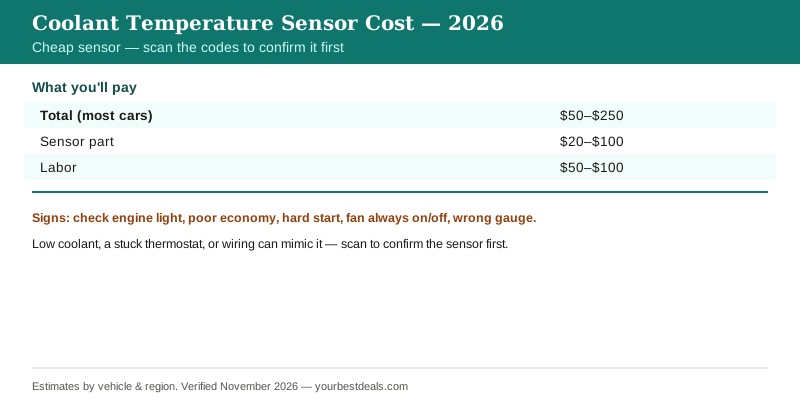
An engine coolant temperature (ECT) sensor replacement runs about $50 to $250 total for most cars – the sensor part is cheap at roughly $20 to $100, and labor is about $50 to $100 (some vehicles run higher). This sensor tells the engine computer how hot the engine is, and the computer uses that to set the fuel mixture, control the cooling fans, and drive the temperature gauge. So a failing sensor can cause a check engine light, poor fuel economy (from a wrong mixture), hard starting, cooling fans that run constantly or not at all, and a temperature gauge that reads wrong or erratically. Because low coolant, a stuck thermostat, or a wiring fault can mimic some of these symptoms, scan the codes to confirm the sensor is the cause before replacing it – and top off the coolant if the system has to be opened.
This is a cheap sensor that quietly influences fueling, fans, and the gauge, so a bad one causes a range of odd symptoms. Let me cover the cost, what it affects, and why a scan comes first.
What you’ll actually pay
Here’s the price picture. These are estimated ranges that vary by vehicle and shop.
| Item | Cost | Notes |
|---|---|---|
| Total (most cars) | $50–$250 | Parts + labor |
| Sensor part | $20–$100 | Inexpensive |
| Labor | $50–$100 | Access-dependent |
Some engines place the sensor where coolant must be drained a bit or other parts moved, raising labor. Note the ECT sensor is different from the dashboard temperature-gauge sending unit on some older cars. Our cooling system guide and check engine light guide cover the system and the codes.
Shop Talk
The coolant temperature sensor is a cheap part that punches above its weight, because the computer leans on its reading for a lot: how much fuel to inject (a cold reading makes the engine run rich), when to turn the cooling fans on, and what the gauge shows. So a bad sensor can throw a surprising spread of symptoms – a check engine light, worse fuel economy, hard cold or hot starts, fans that run nonstop or never kick on, and a gauge that’s wrong. The trap is that other things cause the same symptoms: actually low coolant, a stuck thermostat (which makes the engine run cold or hot for real), or a corroded connector or wiring fault at the sensor. A corroded connector in particular can throw a sensor code without the sensor being bad. So the right move is a scan to read the codes and, ideally, to look at the sensor’s live temperature data versus actual engine temperature – if the sensor reads implausibly (like way too cold on a warm engine), it’s suspect. The part is cheap and often easy to reach, so it’s a satisfying, inexpensive fix when it’s really the sensor; just confirm it first and check the connector, and top off coolant if any was lost getting to it.
Where Drivers Overpay
The sensor is cheap, so the overpay here is misdiagnosis – replacing the ECT sensor when the real issue was low coolant, a stuck thermostat, or a corroded connector that throws a similar code. A scan (plus checking the sensor’s live data against actual engine temperature and inspecting the connector) confirms the sensor before you spend.
The related trap is a wiring or connector fault feeding a good sensor; swapping the sensor won’t fix that. And a really stuck thermostat causes real temperature problems the sensor just reports. The pattern: scan the codes, compare the sensor’s reading to reality, check the connector and wiring, and rule out low coolant and a stuck thermostat before replacing the inexpensive sensor.
The Real Number
A coolant temperature sensor is $50 to $250 – a $20-to-$100 part plus labor. It affects fueling, the cooling fans, and the gauge, so a bad one causes a check engine light, poor economy, hard starting, and fan or gauge oddities. But low coolant, a stuck thermostat, or a corroded connector can mimic it, so scan the codes, compare the sensor’s reading to reality, and check the wiring before replacing the cheap part.
Frequently Asked Questions
How much does a coolant temperature sensor cost to replace?
About $50 to $250 total for most cars. The sensor itself is inexpensive at roughly $20 to $100, and labor is about $50 to $100, with some vehicles running higher if the sensor is hard to reach or coolant must be drained to access it. These are estimates that vary by vehicle and shop. Because the part is cheap, the cost is modest and driven mainly by access and any coolant top-off. The bigger issue is confirming the sensor is actually the problem before replacing it, since low coolant, a stuck thermostat, or wiring faults can cause similar symptoms and a scan is quick insurance against buying the wrong fix.
What does the coolant temperature sensor do?
It measures the engine’s coolant temperature and reports it to the engine computer (ECU/PCM). The computer uses that reading for several important functions: adjusting the fuel mixture (a cold engine needs more fuel, a warm one less), deciding when to turn the cooling fans on and off, managing ignition timing, and – on many cars – driving the dashboard temperature gauge. Because so many functions depend on an accurate temperature signal, a faulty sensor can disrupt fuel economy, starting, cooling, and the gauge reading. It’s a small, inexpensive sensor, but its input is central to how the engine manages itself, which is why a bad one produces a variety of seemingly unrelated symptoms.
What are the signs of a bad coolant temperature sensor?
Common signs include a check engine light, poor fuel economy (the computer may run the engine too rich if it thinks the engine is cold), hard starting (cold or hot), rough running, cooling fans that run constantly or never come on, and a temperature gauge that reads inaccurately or erratically. In some cases the engine may run poorly until it warms up, or overheat warnings may appear that don’t match reality. Because these symptoms overlap with low coolant, a stuck thermostat, and wiring issues, the trouble codes and the sensor’s live data are used to confirm it. If several of these appear together, the coolant temperature sensor is a cheap, worthwhile suspect to check.
Could the problem be the thermostat or low coolant instead?
Yes, and those should be ruled out. A stuck thermostat causes real temperature problems – stuck open makes the engine run cold, stuck closed causes overheating – which the sensor accurately reports, so the symptom isn’t the sensor’s fault. Really low coolant (from a leak) also causes temperature and overheating issues. A corroded connector or damaged wiring at the sensor can throw a sensor code without the sensor being bad. This is why a scan and a check of the sensor’s live reading against actual engine temperature matter: they distinguish a truly faulty sensor from a real cooling problem or a wiring fault. Replacing the cheap sensor won’t help if the actual issue is a stuck thermostat or low coolant.
Can I drive with a bad coolant temperature sensor?
You can often drive short-term, but it’s not ideal and depends on the symptom. A sensor giving a falsely cold reading makes the engine run rich, hurting fuel economy and potentially fouling spark plugs or the catalytic converter over time, and it can cause hard starting and rough running. More concerning, if the sensor affects the cooling fans or masks a real temperature problem, you could risk overheating. Because you also can’t trust the temperature gauge when the sensor is bad, you might not get a true overheating warning. So while a short trip may be fine, a confirmed bad sensor should be replaced promptly – it’s cheap – and you should watch for any real overheating in the meantime.
Why scan the codes before replacing the sensor?
Because the symptoms overlap with several other issues, and scanning prevents replacing a good part. A check engine light, poor economy, fan problems, and gauge issues can come from the coolant temperature sensor, a stuck thermostat, low coolant, or a wiring/connector fault. The trouble codes narrow it down, and viewing the sensor’s live temperature data lets a technician see whether it reads plausibly (for example, implausibly cold on a warmed-up engine indicates a bad sensor or connection). A good tech also checks the connector for corrosion. Since the sensor is cheap, people are tempted to just swap it, but confirming with a scan and live data ensures the fix actually addresses the problem rather than leaving it unsolved.
Is replacing a coolant temperature sensor a DIY job?
Often yes, when the sensor is accessible. Many ECT sensors thread into the engine or a coolant passage and are held by a single connector, so replacing one is a quick job once the fault is confirmed and the engine is cool. You may need to drain or lose a little coolant depending on the sensor’s location, so have coolant on hand to top off, and use the correct type. The key steps are confirming with a scan that the sensor is the fault (not the thermostat, coolant level, or wiring), checking the connector for corrosion, and working only on a cool engine. For an accessible sensor with a confirmed diagnosis, it’s a manageable, inexpensive DIY repair.
Sources
Price ranges verified against 2026 coolant temperature sensor pricing in November 2026. Dollar amounts are estimates that vary by vehicle and shop.
- RepairPal – coolant temperature sensor estimates
- YourMechanic – coolant temperature sensor replacement
- ASE – National Institute for Automotive Service Excellence
Related Guides
- Coolant & Cooling System Guide
- Thermostat Replacement Cost
- Check Engine Light Guide
- Coolant Leak Repair Cost
- Car Repair Cost Estimator

Diane Holcomb spent seven years as a service advisor at multi-brand dealerships in Charlotte, NC, where a cheap coolant temp sensor was a satisfying fix – as long as the tech confirmed it wasn’t really a stuck thermostat or a corroded plug. She drives a 2019 Honda CR-V and a hand-me-down 2007 Toyota Camry, and takes no referral fees or advertising money from any shop or chain.