
Last updated: November 3, 2026 – By Diane Holcomb
November 2026 update: reconfirmed cost-by-source ranges and the find-the-leak-first point.
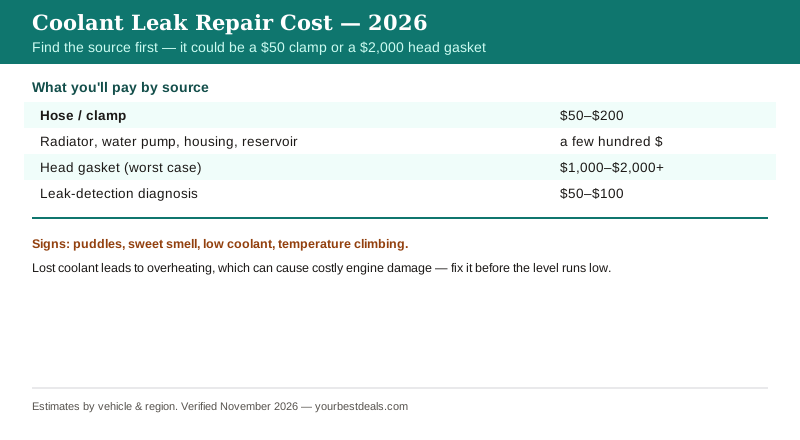
Coolant leak repair costs depend entirely on where the leak is coming from, which is why finding the source is the first and most important step. A loose hose clamp or a hose is cheap – roughly $50 to $200. A leaking radiator, water pump, thermostat housing, or coolant reservoir runs a few hundred dollars each. A blown head gasket is the worst case, at about $1,000 to $2,000 or more. A leak-detection diagnosis runs roughly $50 to $100 and is well worth it, because the fixes span such a wide range. The danger is the same no matter the source: lost coolant can lead to overheating, which can cause expensive engine damage – so a coolant leak should be found and fixed before the level runs low. Signs include puddles under the car, a sweet smell, low coolant, and the temperature gauge climbing.
A coolant leak can be a $50 clamp or a $2,000 head gasket, so the diagnosis matters as much as the repair. Let me cover the costs by source, why finding it first pays, and the overheating risk.
What you’ll actually pay
Here’s the price picture by source. These are estimated ranges that vary by vehicle and shop.
| Source | Cost | Notes |
|---|---|---|
| Hose / clamp | $50–$200 | Cheapest, common |
| Radiator, water pump, housing, reservoir | a few hundred $ each | Mid-range |
| Head gasket (worst case) | $1,000–$2,000+ | Major labor |
| Leak-detection diagnosis | $50–$100 | Worth it first |
Common leak points include hoses, the radiator, the water pump, the thermostat housing, the coolant reservoir, the heater core, and gaskets. Our cooling system guide and overheating guide cover the system and its failure points.
Shop Talk
The most important dollar you spend on a coolant leak is the one on finding where it’s coming from, because the price range is enormous: a loose hose clamp is a few minutes and a few dollars, while a head gasket is a thousand-plus. A shop uses a cooling-system pressure test (pumping the system up and watching where it drips) and often UV dye to pinpoint the source, which is well worth the modest diagnostic fee before you authorize anything. Common leak points, roughly cheapest to priciest: a hose or clamp, the coolant reservoir, the radiator, the water pump, the thermostat housing, the heater core (labor-heavy, behind the dash), and the head gasket (the big one). A couple of clues help: a sweet smell and visible puddle usually mean an external leak (hose, radiator, pump); white smoke from the tailpipe, coolant disappearing with no puddle, a milky look to the oil, or bubbles in the coolant can point to an internal leak like a head gasket, which is the costly scenario. Whatever the source, don’t keep driving a car that’s losing coolant – running low leads to overheating, and overheating is what turns a cheap leak into a wrecked engine. Top off to get to the shop, but get the source found and fixed.
Where Drivers Overpay
The real risk with a coolant leak is overpaying through delay, not diagnosis. Because the price ranges from a $50 clamp to a $2,000-plus head gasket, the smart money is a leak-detection diagnosis ($50 to $100) to pinpoint the source before authorizing any repair – so you fix the actual leak and know what you’re facing.
The bigger cost is ignoring it: a car that keeps losing coolant runs low, overheats, and overheating can warp the head or blow the head gasket – turning a cheap leak into a major engine repair. The pattern: get the source found with a pressure test, fix the actual leak (cheap clamp or hose first, if that’s it), and never keep driving a low-coolant car – top off only to reach the shop.
The Real Number
A coolant leak ranges from a $50-to-$200 hose or clamp, to a few hundred dollars for a radiator, water pump, housing, or reservoir, to $1,000 to $2,000+ for a head gasket. Spend $50 to $100 on a pressure-test diagnosis first, since the fixes span such a range. And don’t keep driving a car losing coolant – running low causes overheating, which can turn a cheap leak into a wrecked engine. Top off only to reach the shop.
Frequently Asked Questions
How much does it cost to fix a coolant leak?
It depends entirely on the source. A loose hose clamp or a hose is cheap at roughly $50 to $200. A leaking radiator, water pump, thermostat housing, or coolant reservoir runs a few hundred dollars each. A blown head gasket is the worst case at about $1,000 to $2,000 or more because of the major labor. A leak-detection diagnosis runs about $50 to $100. These are estimates that vary by vehicle and shop. Because the range is so wide, finding exactly where the coolant is escaping is the key to knowing what you’ll pay – a pressure test and dye pinpoint the source before you commit to a repair.
How do shops find a coolant leak?
The main method is a cooling-system pressure test: a tool pressurizes the system (cold) and the technician watches for where coolant drips or sprays, which reveals external leaks at hoses, the radiator, the water pump, housings, or the reservoir. UV dye added to the coolant, viewed under a UV light, helps trace slow or hidden leaks. For suspected internal leaks (like a head gasket), they look for other signs – white exhaust smoke, coolant loss with no external puddle, oil contaminated with coolant (milky), bubbles or combustion gases in the coolant, or a chemical test for exhaust gases in the coolant. This diagnosis, typically $50 to $100, is worth doing first because it determines whether you’re facing a cheap hose or an expensive head gasket.
What are the common sources of a coolant leak?
From cheapest to most expensive to fix, common sources include: a loose clamp or a worn/cracked hose; the coolant reservoir (overflow tank); the radiator (corrosion or a cracked plastic tank); the water pump (a failing seal); the thermostat housing (often a gasket); the heater core (behind the dash, labor-heavy); and the head gasket (the costly internal leak). The radiator cap and various gaskets can also leak. Because the sources range so widely in cost, identifying the specific one is essential. External leaks (hoses, radiator, pump) usually leave a visible puddle and sweet smell, while internal leaks (head gasket) often show up as coolant vanishing with no puddle, white exhaust smoke, or milky oil.
Is it safe to drive with a coolant leak?
Only very cautiously and briefly. A coolant leak means the system is losing the fluid that keeps the engine from overheating, and running low leads to overheating – which can cause severe, expensive engine damage like a warped head or blown head gasket. So you shouldn’t keep driving a car that’s actively losing coolant. If you must move it, top off the coolant (engine cool), watch the temperature gauge closely, and get it to a shop promptly, stopping immediately if it starts to overheat. A small, slow leak gives you a little more leeway than a large one, but either way the leak should be found and fixed before the low coolant causes damage. Overheating is the real danger, not the leak itself.
Why is a head gasket leak so much more expensive?
Because it’s an internal leak requiring major engine labor to fix. The head gasket seals between the engine block and the cylinder head; when it fails, coolant can leak externally, into the oil, or into the combustion chambers. Replacing it means removing the cylinder head – hours of skilled labor, plus often machining the head, new gaskets and bolts, and refilling fluids – which is why it runs $1,000 to $2,000 or more. By contrast, an external leak at a hose or clamp is quick and cheap. That huge gap is exactly why diagnosing the source matters: confirming whether you have a simple external leak or a head gasket tells you whether you’re facing a minor repair or a major one, and sometimes a decision about the car’s worth.
Can I use a stop-leak product for a coolant leak?
Cooling-system stop-leak products exist and can sometimes temporarily slow a very small leak, but they’re generally a short-term, last-resort measure, not a real fix, and they carry risks – the sealant can clog the radiator, heater core, or small passages and cause other problems. For a known cheap leak (a hose or clamp), it’s far better to just fix the actual source. For a head gasket, stop-leak is at best a temporary stopgap on a car you’re nursing along, not a repair. Most shops advise against relying on stop-leak for anything other than an emergency get-home situation. The reliable approach is to find and fix the real leak source, which the diagnosis identifies.
What are the warning signs of a coolant leak?
Watch for a puddle of coolant under the car (usually green, orange, pink, or yellow and slightly sweet-smelling), a sweet syrup-like odor, the coolant level in the reservoir dropping, the temperature gauge climbing or an overheating warning, and steam from under the hood. White crusty residue around hoses, the radiator, or the water pump indicates a slow seep. Signs pointing to an internal (head gasket) leak include white smoke from the tailpipe, coolant disappearing with no visible puddle, milky or foamy oil, and bubbles in the coolant. Any of these means the cooling system is losing coolant and should be diagnosed promptly, because the overheating that follows a low coolant level is what causes the expensive damage.
Sources
Price ranges verified against 2026 cooling-system repair pricing in November 2026. Dollar amounts are estimates that vary by vehicle and shop.
- RepairPal – cooling system repair estimates
- Jerry – coolant leak causes and costs
- ASE – National Institute for Automotive Service Excellence
Related Guides
- Coolant & Cooling System Guide
- 9 Reasons Your Engine Is Overheating
- Radiator Hose Replacement Cost
- Head Gasket Replacement Cost
- Car Repair Cost Estimator

Diane Holcomb spent seven years as a service advisor at multi-brand dealerships in Charlotte, NC, where a coolant leak could be a $50 clamp or a $2,000 head gasket – so she never quoted one without a pressure test to find the source first. She drives a 2019 Honda CR-V and a hand-me-down 2007 Toyota Camry, and takes no referral fees or advertising money from any shop or chain.