
Last updated: November 8, 2026 – By Eddie Brennan
November 2026 update: refreshed radiator parts and labor ranges against 2026 reporting and reconfirmed the OEM-versus-aftermarket and independent-versus-dealer gaps.
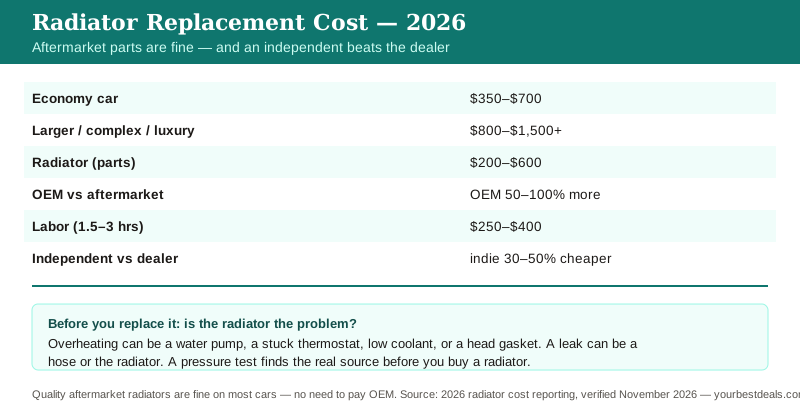
Radiator replacement in 2026 runs $350 to $700 on an economy car and $800 to $1,500 or more on larger vehicles or those with pricey parts. The radiator itself is $200 to $600, and a quality aftermarket radiator is perfectly fine on most cars – OEM costs 50 to 100 percent more without adding anything a normal car needs. Two things save you real money here: choosing an independent over a dealer, which runs 30 to 50 percent cheaper, and making sure the radiator is actually the problem before you replace it.
The radiator sheds the engine’s heat, and when it leaks or clogs you get overheating or coolant on the ground. I handled plenty of these, and the trap is that overheating has several possible causes that all move the same temperature gauge. Replacing a radiator when a stuck thermostat or a failing head gasket was the real issue means you’re hot again on a new part. This guide covers the real cost and how to confirm it’s the radiator first.
Radiator cost by vehicle
These are parts-and-labor totals. Vehicle size and parts choice drive the range more than anything.
| Vehicle / choice | Cost | Notes |
|---|---|---|
| Economy car | $350–$700 | Simpler bay, cheaper part |
| Larger / complex / luxury | $800–$1,500+ | Pricier part, tighter access |
| Radiator part | $200–$600 | Aftermarket to OEM |
| OEM vs aftermarket | OEM 50–100% more | Rarely needed |
| Labor (1.5–3 hrs) | $250–$400 | By engine-bay access |
An independent shop runs 30 to 50 percent below a dealer for the same radiator job, and since this is routine cooling-system work, the independent is the value choice. On parts, a quality aftermarket radiator from a reputable brand fits and performs fine on a mainstream car – save OEM for a luxury or newer vehicle that’s particular, or where exact fitment matters.
What gets misdiagnosed
Overheating gets blamed on the radiator, but the radiator is one of several suspects. A car overheats from a bad radiator, but also from a failing water pump, a stuck thermostat, low coolant, a bad radiator fan, or a failing head gasket – and those range from a $20 thermostat to a multi-thousand-dollar head-gasket job. A coolant leak, likewise, can be the radiator, a hose, the water pump, or the thermostat housing. Replacing the radiator when the thermostat was stuck means you overheat again on a new radiator.
The radiator is the culprit when a pressure test traces a leak to the radiator core or its plastic end tanks, when it’s visibly clogged or corroded, or when the fins are damaged enough to hurt cooling. A good tech pressure-tests the system to find the actual leak, checks the thermostat and fan, and rules out a head gasket before condemning the radiator. On overheating, insist on that diagnosis – a stuck thermostat and a leaking radiator both peg the gauge but cost wildly different money.
Straight From the Invoice: cooling jobs
These are jobs I either did myself or watched come through the bay – a real radiator, an aftermarket-parts win, and an overheat that wasn’t the radiator.
Invoice #1 – 2014 Honda Civic, radiator, independent, Ohio
Coolant leak pressure-tested to a cracked plastic end tank on the radiator. Quality aftermarket radiator installed for $480. Real leak, confirmed at the source. Lesson: a radiator leak traced to the core or end tank is a genuine $350-to-$700 job on an economy car, and aftermarket is fine.
Invoice #2 – 2016 Ford Escape, OEM vs aftermarket, Charlotte NC
Dealer quoted an OEM radiator at $560 for the part alone; a quality aftermarket radiator was $260 and fit perfectly. The independent job came to $620 all-in versus over $1,000 at the dealer. Lesson: OEM and the dealer both add cost a mainstream car doesn’t need – aftermarket at an independent is the value play.
Invoice #3 – 2013 Toyota Camry, overheat that was a fan, Columbus
Overheating in traffic, owner braced for a radiator. The radiator was fine – the cooling fan had failed, so the car only overheated at idle and low speed. A fan fix, not a radiator. Lesson: overheating only at low speed points to the fan, not the radiator; the diagnosis saved a needless part.
Aftermarket vs OEM, and independent vs dealer
Aftermarket is fine on most cars
A quality aftermarket radiator from a reputable brand fits and cools just as well as OEM on a mainstream car, for 50 to 100 percent less. The radiator is a fairly simple part, so paying dealer OEM pricing rarely buys anything the car needs. Save OEM for a luxury or newer vehicle that’s fussy about fitment or has integrated components, or when you simply want the exact factory part. For everyday cars, quality aftermarket is the smart, proven choice.
Independent beats the dealer
Radiator replacement is routine cooling-system work, and a reputable independent does it for 30 to 50 percent less than a dealer, using the same quality parts. Unless you’re under warranty, there’s no reason to pay the dealer premium here. Between choosing aftermarket over OEM and an independent over a dealer, you can often cut a radiator job nearly in half from the worst-case dealer-plus-OEM quote – the same repair, done just as well, for far less.
Shop Talk
Two questions cut a radiator bill down fast: can you use a quality aftermarket radiator instead of OEM, and can an independent do it instead of the dealer? Both are yes on almost every mainstream car, and together they can nearly halve the price. But before any of that, if you’re overheating rather than just leaking, insist on a pressure test and a check of the thermostat, fan, and head gasket – a car that overheats only at idle is usually a dead fan, not a bad radiator, and a stuck thermostat is a fraction of a radiator’s cost.
What actually drives the price
Vehicle size, parts choice, and shop type. A compact car with an easy bay and an aftermarket radiator is a $350-to-$700 job; a larger or luxury vehicle with a pricey OEM part and tight access is $800 to $1,500-plus. You control two of those three: choosing aftermarket over OEM and an independent over a dealer takes a big bite out of the total without any downside on a mainstream car.
The avoidable cost is replacing a radiator that wasn’t the problem. Overheating from a stuck thermostat, a dead fan, low coolant, or a head gasket all present at the temperature gauge, and only a pressure test and a proper cooling-system check tell them apart. Confirm the leak is in the radiator or that the radiator is really clogged, then use aftermarket parts and an independent shop, and this stays an affordable repair.
The Real Number
Budget $350 to $700 on an economy car and $800 to $1,500 on a larger or luxury one. You can cut a lot off the top by choosing a quality aftermarket radiator over OEM and an independent over a dealer, which runs 30 to 50 percent cheaper – together they can nearly halve the worst-case quote. But if you’re overheating rather than leaking, get a pressure test and a check of the thermostat, fan, and head gasket first, because those cost anywhere from $20 to thousands and all move the same gauge as a bad radiator.
Frequently Asked Questions
How much does radiator replacement cost in 2026?
An economy car runs $350 to $700, while larger vehicles or those with pricey parts run $800 to $1,500 or more. The radiator part is $200 to $600, with OEM costing 50 to 100 percent more than quality aftermarket, and labor is $250 to $400 for 1.5 to 3 hours. An independent shop runs 30 to 50 percent below a dealer. Choosing aftermarket parts and an independent shop can nearly halve the worst-case dealer-plus-OEM quote on a mainstream car without any downside.
Is an aftermarket radiator as good as OEM?
On most mainstream cars, yes. A quality aftermarket radiator from a reputable brand fits and cools just as well as OEM for 50 to 100 percent less, because the radiator is a fairly simple part where dealer OEM pricing rarely buys anything the car needs. Save OEM for a luxury or newer vehicle that’s fussy about fitment or has integrated components, or when you specifically want the exact factory part. For everyday vehicles, quality aftermarket is the proven, cost-effective choice that any good shop will stand behind.
How do I know if I need a radiator or something else?
Get a pressure test and a cooling-system check, because overheating has several causes. The radiator is the culprit when a pressure test traces a leak to its core or plastic end tanks, or when it’s visibly clogged or corroded. But overheating can also be a failing water pump, a stuck thermostat, low coolant, a dead cooling fan, or a head gasket – ranging from $20 to thousands. A car that overheats only at idle usually has a bad fan, not a radiator. Insist the shop confirm the source before replacing the radiator.
Should I replace my radiator at a dealer or independent?
An independent, for almost every car. Radiator replacement is routine cooling-system work, and a reputable independent charges 30 to 50 percent less than a dealer using the same quality parts. Unless you’re under warranty, the dealer premium buys nothing the job needs. Combined with choosing a quality aftermarket radiator over OEM, using an independent can nearly halve the total versus a dealer-plus-OEM quote. The one thing that matters more than shop type is a correct diagnosis, so use a shop that pressure-tests before replacing.
Can I drive with a leaking radiator?
Only very briefly and carefully, because a radiator leak leads to low coolant and overheating, and overheating can destroy an engine. A tiny seep might let you limp to a shop while watching the temperature gauge closely, but a significant leak will drain coolant fast and put you at real risk of cooking the engine. Never keep driving a car that’s actually overheating – pull over and let it cool. A radiator is a moderate repair; an engine ruined by driving it hot is a far bigger one.
What are the symptoms of a bad radiator?
Coolant leaking under the front of the car, overheating, low coolant that keeps returning, visible corrosion or clogging, and sometimes discolored or rusty coolant. Steam from under the hood and a sweet coolant smell are common too. The catch is that these overlap with a water pump, thermostat, hose, or head gasket problem, so the symptoms point toward the cooling system without confirming the radiator specifically. A pressure test locating the leak at the radiator, or a clearly clogged core, is what confirms it before you replace the part.
How long does a radiator last?
Most radiators last 8 to 10 years or well over 100,000 miles, though modern radiators with plastic end tanks can crack sooner, especially with age, heat cycles, or neglected coolant. Keeping fresh coolant in the system on the manufacturer’s schedule helps a radiator last, since old, corrosive coolant attacks the internals. If your car is well past a decade old and you’re seeing seeps or a cracked end tank, that’s normal wear. Replacing coolant on schedule is cheap insurance against premature radiator and cooling-system failure.
Sources
Radiator cost ranges verified against 2026 parts-and-labor reporting on November 8, 2026. Ranges vary by vehicle, parts choice, and region; confirm your exact price locally.
- ConsumerAffairs – cost to replace a radiator, 2026
- RepairPal – radiator replacement cost estimate
- AutoZone DIY – cost to replace a radiator
Related Guides
- Water pump replacement cost
- Car repair cost estimator hub
- Exhaust leak repair cost
- About Eddie Brennan – ASE Master technician

Eddie Brennan is an ASE Master Certified technician who spent 11 years at an independent shop in Columbus, OH, pressure-testing cooling systems and fitting quality aftermarket radiators before moving to writing full time in 2023. He writes the repair and diagnostic guides on Your Best Deals and takes no referral fees. He drives a 250,000-mile 2015 Subaru Outback and a 2020 Ford F-150.