
Last updated: November 2, 2026 – By Diane Holcomb
November 2026 update: reconfirmed state inspection-fee examples and the fee-versus-repairs distinction.
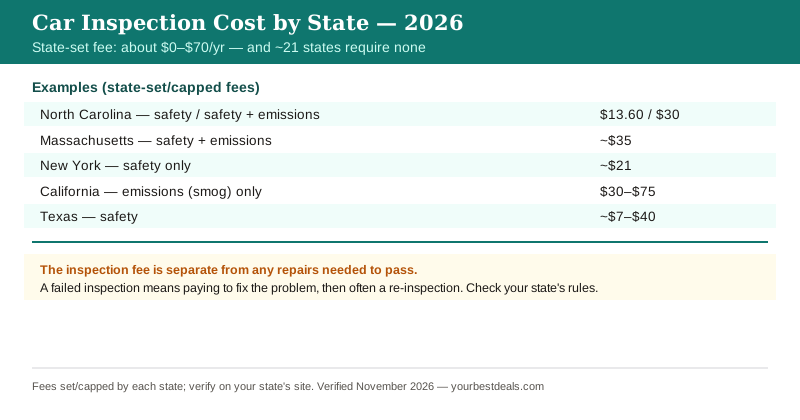
A state vehicle inspection – safety, emissions, or both – typically costs about $0 to $70 a year, and in roughly 21 states there’s no periodic inspection required at all, so the cost is nothing. Where it is required, the fee is usually set or capped by the state, so it’s not something you shop around much. Rough examples: North Carolina is about $13.60 for safety only and $30 for safety plus emissions; Massachusetts about $35 combined; New York about $21 for safety only; California’s emissions (smog) check about $30 to $75; Texas safety roughly $7 to $40; and Pennsylvania often totals around $70 for safety plus emissions. The one thing to keep separate in your mind: the inspection fee is not the same as the cost of any repairs needed to pass – a failed inspection means paying to fix the problem, then often a re-inspection.
Inspection is one of the few car costs that’s set by your state rather than the shop, so the “price” question is really “what does my state require and charge.” Let me cover the typical fees, the state-by-state variation, and why the fee is separate from repair costs.
What you’ll actually pay
Here are example state fees. These are set or capped by each state and can change – always verify on your state’s official site.
| State (example) | Fee | Type |
|---|---|---|
| ~21 states | $0 | No periodic inspection required |
| North Carolina | $13.60 / $30 | Safety / safety + emissions |
| New York | ~$21 | Safety only |
| Texas | ~$7–$40 | Safety |
| Massachusetts | ~$35 | Safety + emissions |
| California | $30–$75 | Emissions (smog) only |
| Pennsylvania | ~$70 | Safety + emissions (varies by station) |
Requirements vary widely: some states require an annual safety inspection, some require only emissions testing (often in metro areas for air-quality rules), some require both, and many require neither. The fee is typically capped by the state, so one shop can’t charge much more than another for the inspection itself. Because rules and fees change and vary even by county, check your state’s DMV or inspection-program website for the current requirement and fee. Our maintenance guide covers keeping a car inspection-ready.
Shop Talk
The inspection fee itself is small and fixed – the money that actually varies is what it takes to pass. So the smart move is to go in knowing the difference. The state-capped inspection fee is $0 to $70; what can cost real money is repairs the inspection flags: a safety inspection can fail you for bad tires, worn brakes, broken lights, cracked windshield, or bad wipers, and an emissions test can fail you for a check engine light, a not-ready emissions monitor, or high tailpipe readings. A few practical tips. First, never clear a check engine light right before an emissions test to hide a problem – the test also checks whether the emissions “readiness monitors” have completed, and clearing the light resets them to “not ready,” which fails you just as surely as the light being on. Fix the actual cause, then drive enough to let the monitors re-run before testing. Second, do a quick pre-check yourself: make sure all lights work, wipers are good, tires have tread, and there’s no check engine light, so you don’t pay an inspection fee only to fail and pay a re-inspection. Third, many states give a grace window and a free or discounted re-inspection after you fix a failure, so ask. And watch for a shop that “finds” a long list of needed repairs at inspection time – get a second opinion on anything big, since the inspection itself should be an objective pass/fail, not a sales pitch.
Where Drivers Overpay
The inspection fee itself is state-capped, so there’s little room to overpay on that – the money is in repairs to pass. The overpay to watch for is a shop that turns an inspection into a long list of recommended work; the inspection should be an objective pass/fail against state criteria, so get a second opinion on any big repair “found” at inspection time rather than authorizing it on the spot. Legitimate safety failures (bald tires, worn-out brakes, dead lights) are real, but upsells beyond the actual failure criteria aren’t the inspection.
The other way to waste money is failing unnecessarily. Doing a quick self pre-check – lights, wipers, tires, no check engine light – before you go avoids paying the inspection fee only to fail and owe a re-inspection. And never clear a check engine light to sneak through emissions; it resets the readiness monitors to “not ready,” which fails the test anyway, so you’ve accomplished nothing but delay. The pattern: the fee is fixed and small, pre-check to avoid a needless failure, fix the real cause of an emissions issue (don’t hide it), and get a second opinion on any large repair surfaced at inspection.
The Real Number
A state inspection fee is about $0 to $70 a year (and ~21 states require none), set or capped by the state, so you don’t shop it around. The real cost is any repairs needed to pass – that’s separate from the fee. Pre-check your lights, wipers, tires, and check engine light before going to avoid a needless failure and re-inspection, never clear a CEL to sneak through emissions (it fails the readiness check), and get a second opinion on any big repair “found” at inspection. Verify your state’s rule and fee on its official site.
Frequently Asked Questions
How much does a car inspection cost?
A state safety or emissions inspection typically costs about $0 to $70 a year, and in roughly 21 states there’s no periodic inspection required at all. Where required, the fee is usually set or capped by the state – for example, North Carolina is about $13.60 safety / $30 with emissions, Massachusetts about $35 combined, New York about $21 safety, California emissions $30 to $75, and Texas safety roughly $7 to $40. These are examples that change and vary by state and county, so verify on your state’s official site. The fee is separate from any repairs needed to pass.
Which states don’t require a car inspection?
Roughly 21 states require no periodic safety or emissions inspection at all, so there’s no routine inspection cost in those states. The specifics vary and change: some states require only emissions testing (often just in metropolitan areas with air-quality rules), some require only a safety inspection, some require both, and many require neither. Because the requirements differ by state and sometimes by county, and they do change over time, the reliable way to know your situation is to check your state’s DMV or vehicle-inspection-program website rather than relying on a general list.
What can make my car fail inspection?
For a safety inspection, common failures include worn-out brakes, bald or damaged tires, broken or burned-out lights, a cracked windshield in the driver’s view, bad wipers, and problems with steering or suspension. For an emissions test, you can fail for an illuminated check engine light, incomplete emissions “readiness monitors,” or high tailpipe emissions. The inspection fee is the same whether you pass or fail, but a failure means paying to fix the problem and often a re-inspection. A quick self-check of lights, wipers, tires, and the check engine light before you go helps avoid a surprise failure.
Is the inspection fee the same as the cost to pass?
No, and it’s important to separate them. The inspection fee ($0 to $70, state-capped) is just the charge to perform the inspection. If your car fails, the cost to pass is whatever repairs it needs – new tires, brakes, lights, or emissions-related fixes – which can range from a few dollars to a lot, plus often a re-inspection fee. So budget for two separate things: the small fixed inspection fee, and the potentially larger (and variable) cost of any repairs to meet the standard. Pre-checking your car helps you avoid unexpected repair costs at inspection time.
Can I clear my check engine light to pass an emissions test?
No – it backfires. Clearing the check engine light does turn the light off, but it also resets the emissions “readiness monitors” to “not ready,” and emissions tests check that those monitors have completed. So a car with recently cleared codes fails for incomplete monitors even with no light showing, just as surely as it would fail with the light on. The right approach is to fix the actual cause of the check engine light, then drive enough (often several drive cycles over days) to let the monitors re-run and complete before testing. Don’t try to hide the problem; fix it.
What happens if my car fails inspection?
You’ll need to repair whatever caused the failure and then usually have the car re-inspected to pass. Many states give a grace period to get repairs done, and some offer a free or discounted re-inspection within a certain window, so ask the station about their re-inspection policy. You generally can’t legally drive on an expired or failed inspection beyond any grace period. The repair cost depends entirely on the failure – a burned-out bulb is cheap, worn brakes or an emissions fix can be more. Fix the specific failure, then return for the re-check.
Why do some states require emissions testing and others don’t?
Emissions testing is tied to federal and state air-quality requirements, so it’s typically required in states or metropolitan areas that need to meet clean-air standards, often where population density and pollution are higher. Rural areas and states with cleaner air frequently don’t require it. Safety inspections are a separate state decision about roadworthiness. That’s why requirements vary so much – some states test emissions only in certain counties, some do statewide safety inspections, and many do neither. Check your specific state and county, since the rules are local and can change.
Sources
Fee examples reflect 2026 state figures reviewed in November 2026; inspection fees and requirements are set by each state, vary by county, and change – verify on your state’s official site.
- Car Cost Calculators – inspection cost by state
- EPA – vehicle emissions inspection programs
- DMV.org – vehicle inspection information
Related Guides
- What Does a Check Engine Light Mean?
- How to Reset a Check Engine Light
- Car Maintenance Guide
- Exhaust & Emissions Guide
- Car Repair Cost Estimator

Diane Holcomb spent seven years as a service advisor at multi-brand dealerships in Charlotte, NC, where she learned to pre-check a car for lights, tires, and a check engine light so customers didn’t pay an inspection fee only to fail. She drives a 2019 Honda CR-V and a hand-me-down 2007 Toyota Camry, and takes no referral fees or advertising money from any shop or chain.