
Last updated: November 9, 2026 – By Eddie Brennan
November 2026 update: reconfirmed the head-gasket and oil-cooler causes, cost ranges, and the confirm-before-repair step.
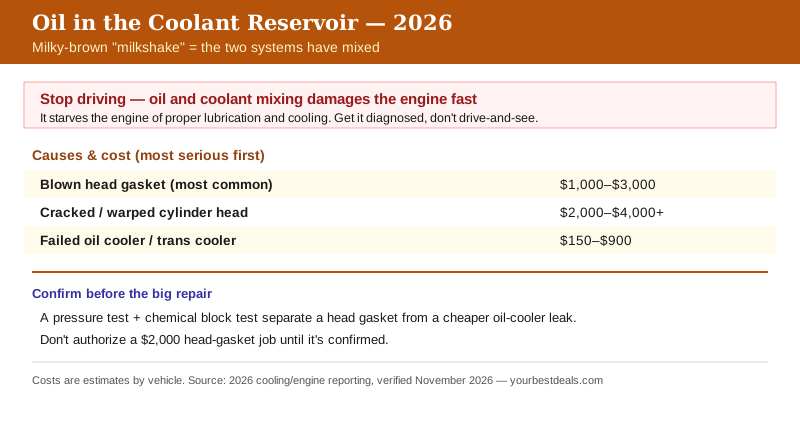
Oil in the coolant reservoir – usually showing up as a milky-brown, chocolate-milkshake-looking film or sludge – means the barrier that keeps your oil and coolant in separate systems has failed, and they’re mixing. This is a serious symptom. The most common and expensive cause is a blown head gasket ($1,000 to $3,000), followed by a cracked or warped cylinder head (higher still), and on some vehicles a cheaper failed oil cooler or transmission cooler ($150 to $900). Critically, this is not a drive-it-and-see problem: oil and coolant mixing starves the engine of proper lubrication and cooling and can cause major internal damage quickly. Stop driving, get it diagnosed, and confirm the cause before authorizing an expensive repair. Here’s what it means and what to do.
This is one of the few symptoms I’d tell a customer to stop driving over immediately. That milky sludge means the engine is running with contaminated oil and coolant, and every mile risks turning a repairable problem into a destroyed engine. Let me explain the causes, why confirming matters before you spend, and what each fix costs.
Why oil and coolant mixing is serious
Your engine keeps oil and coolant in completely separate passages – oil lubricates moving parts, coolant carries away heat, and they never touch. When you see oil in the coolant (or the reverse, coolant in the oil, which makes the oil look milky on the dipstick), a physical barrier between those passages has broken. The mixed fluids can’t do their jobs: the oil loses lubricating ability and the coolant loses cooling ability, so the engine is simultaneously under-lubricated and under-cooled – a fast track to serious internal damage if you keep driving.
That’s why this is a stop-driving symptom, unlike many warning signs where you have time to plan. Continuing to drive with mixed fluids can wipe out bearings, warp or crack the head further, and turn a head-gasket repair into an engine replacement. So the moment you spot that milkshake film in the reservoir or on the oil cap, park the car and arrange a diagnosis. See our cooling system guide and engine guide for the related systems.
The causes and costs
Here’s what’s behind oil in the coolant, most serious first. These are estimated ranges that vary by vehicle.
| Cause | Typical cost | Notes |
|---|---|---|
| Blown head gasket | $1,000–$3,000 | Most common cause |
| Cracked or warped cylinder head | $2,000–$4,000+ | Often from overheating |
| Cracked engine block | $$$ (often not worth it) | Rare, severe |
| Failed oil cooler | $150–$900 | The cheaper, hoped-for cause |
| Leaking transmission cooler (in radiator) | $150–$900 | Pinkish, not milky |
The head gasket is the usual and most likely culprit, especially if the car has overheated. But the reason to diagnose before repairing is that a failed oil cooler or a transmission cooler leaking inside the radiator can produce fluid mixing for far less money than a head gasket – so you don’t want to authorize a $2,000 head-gasket job if a $400 oil cooler is the real cause. Our overheating guide covers the overheating that often precedes a blown gasket.
Shop Talk
Before anyone quotes you a head gasket, insist on two confirming tests: a cooling-system pressure test and a chemical block test (also called a combustion-leak or block tester), which detects exhaust gases in the coolant – a positive result strongly indicates a head gasket or cracked head. These cost little compared to the repair and can save you thousands by revealing that the real cause was a much cheaper oil cooler or a transmission-cooler leak in the radiator. One quick clue you can check yourself: truly milky brown, oil-and-coolant sludge points at the engine (head gasket / head), while a pinkish, thinner contamination in the coolant often means automatic transmission fluid leaking from a cooler inside the radiator, which is a cheaper fix. Don’t authorize a four-figure engine repair until the cause is actually confirmed.
What Gets Misdiagnosed
The costly misdiagnosis is assuming oil-in-coolant automatically means a head gasket and authorizing a $2,000-plus repair without confirming. While the head gasket is the most common cause, a failed oil cooler or a transmission cooler leaking inside the radiator can mimic the symptom for a fraction of the price. A pressure test and a chemical block test distinguish them – a positive combustion-gas test points at the head gasket or head, while a negative one sends you looking at the cheaper coolers. Never let a shop replace a head gasket on the sight of milky coolant alone; demand the confirming tests first.
The opposite mistake is ignoring the symptom or “just topping off” and continuing to drive, hoping it’s minor. It isn’t – mixed oil and coolant damages the engine with every mile, and a head gasket caught early (before the head warps or the bearings are wiped) is a far smaller repair than one driven until the engine is destroyed. So the two errors to avoid are spending big without confirming, and driving on it at all. The right path is stop driving, get the pressure and block tests, and repair the confirmed cause. That sequence protects both your engine and your wallet.
The Real Number
Milky oil in the coolant means oil and coolant have mixed – stop driving, because it damages the engine fast. The most common cause is a blown head gasket ($1,000 to $3,000), or a cracked/warped head (higher), but a failed oil cooler or transmission-cooler leak can cause it for $150 to $900. Before authorizing a big repair, insist on a cooling-system pressure test and a chemical block test to confirm a head gasket versus a cheaper cooler leak – a positive combustion-gas test points at the gasket. Don’t drive on it (mixed fluids destroy engines) and don’t pay for a head gasket unconfirmed.
Frequently Asked Questions
What does oil in the coolant mean?
It means the barrier that normally keeps your engine’s oil and coolant in separate passages has failed, and the two fluids are mixing – often showing as a milky-brown, milkshake-like film or sludge in the coolant reservoir or on the oil cap. Because the mixed fluids can no longer properly lubricate or cool the engine, it’s a serious symptom that can cause major internal damage if you keep driving. The most common cause is a blown head gasket, though a cracked cylinder head or a cheaper failed oil cooler can also do it. The key takeaway is to stop driving and get it diagnosed rather than topping off and continuing.
Is oil in the coolant always a head gasket?
No, though a blown head gasket is the most common and most likely cause, especially if the car has overheated. Other possibilities include a cracked or warped cylinder head, a rare cracked block, and – importantly for cost – a failed engine oil cooler or a transmission cooler leaking inside the radiator, which are much cheaper to fix at $150 to $900. Because the price gap between a head gasket and a cooler leak is huge, you should confirm the cause with a cooling-system pressure test and a chemical block test before authorizing a repair. A pinkish rather than milky-brown contamination often points at transmission fluid from a cooler, a cheaper fix.
Can I drive with oil in my coolant?
No, you should not drive with oil in the coolant. Unlike many warning signs that give you time to plan, mixed oil and coolant means the engine is running under-lubricated and under-cooled at the same time, and every mile risks wiping out bearings, warping the head further, or destroying the engine – turning a repairable head gasket into an engine replacement. This is a stop-driving symptom. The moment you spot the milky sludge in the reservoir or on the oil cap, park the car and arrange a diagnosis, ideally a tow rather than driving it to the shop. Continuing to drive is the single fastest way to escalate the repair cost dramatically.
How much does it cost to fix oil in the coolant?
It depends entirely on the cause. A blown head gasket runs $1,000 to $3,000, a cracked or warped cylinder head $2,000 to $4,000 or more, and a cracked block can be so costly it’s often not worth repairing. On the cheaper end, a failed oil cooler or a transmission cooler leaking in the radiator runs $150 to $900. These are estimated ranges that vary by vehicle. Because the spread is enormous, confirming the cause with a pressure test and chemical block test before repairing is essential – you don’t want to pay head-gasket money for what turns out to be a cooler. And catching a head gasket early, before further damage, keeps it at the lower end.
What’s the difference between oil in coolant and coolant in oil?
They’re two sides of the same failure – a breach between the oil and coolant passages – but show up in different places. Oil in the coolant appears as a milky film or sludge in the coolant reservoir or radiator. Coolant in the oil shows as a milky, tan, or “chocolate milkshake” appearance on the oil dipstick or under the oil filler cap, and can raise the oil level. Both indicate mixing and both are serious, most often from a head gasket. Sometimes you’ll see one more than the other depending on the failure. Either way, the response is the same: stop driving and get it diagnosed with pressure and block tests before authorizing repair.
Could it be the oil cooler instead of the head gasket?
Yes, and that’s the cheaper outcome worth hoping for and testing for. Many engines have an oil cooler where oil and coolant flow close together to exchange heat, and if its internal seal or core fails, oil and coolant can mix – producing the same milky symptom as a head gasket but costing only $150 to $900 to fix. Similarly, a transmission cooler inside the radiator can leak transmission fluid into the coolant. This is exactly why the confirming tests matter: a chemical block test that comes back negative for combustion gases suggests the problem is a cooler rather than the head gasket. So don’t assume the worst until a shop has ruled out the cheaper cooler causes.
What tests confirm a blown head gasket?
Two tests are key. A cooling-system pressure test pressurizes the system to reveal leaks and loss of pressure. A chemical block test (combustion-leak test) draws air from the coolant through a special blue fluid that changes color if combustion gases are present – a positive result strongly indicates a head gasket or cracked head, because it means exhaust is leaking into the coolant. Shops may also check for coolant loss, white exhaust smoke, and cylinder compression or leak-down. These tests are inexpensive relative to the repair and are what separate a genuine head gasket from a cheaper oil-cooler or transmission-cooler leak. Insist on this confirmation before authorizing any four-figure head-gasket repair.
Sources
Oil-in-coolant causes and cost ranges verified against 2026 cooling and engine reporting on November 9, 2026. Costs are estimated ranges that vary by vehicle; pressure and block tests confirm the cause.
- RepairPal – head gasket replacement cost estimate, 2026
- Synchrony – blown head gasket repair cost, 2026
- CRC Industries – blown head gasket repair cost and diagnosis, 2026
Related Guides
- Cooling system guide: coolant, radiator, and cost
- 9 reasons your engine is overheating
- Engine and fuel system: parts and cost
- Radiator replacement cost

Eddie Brennan spent 11 years as an ASE Master Certified technician at an independent shop in Columbus, OH, where “milky coolant” was one of the few symptoms he’d tell someone to stop driving over immediately – and always block-tested before quoting a head gasket. His A1 Engine Repair certification covers this diagnosis. He takes no referral fees and drives a 250,000-mile 2015 Subaru Outback and a 2020 Ford F-150.