
Last updated: November 7, 2026 – By Eddie Brennan
November 2026 update: refreshed the five failure signs and reconfirmed the water pump replacement cost and timing-belt bundling.
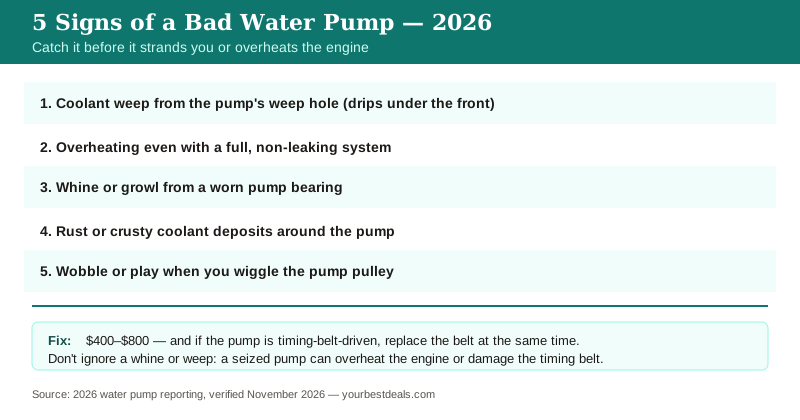
A failing water pump gives you five telltale signs: a coolant weep from its weep hole, overheating even with a full system, a whine or growl from a worn bearing, rust or crusty coolant deposits around the pump, and wobble when you wiggle the pump pulley. Catching any of these early matters, because the water pump circulates the coolant that keeps your engine alive – when it quits, the engine overheats, and a seized pump can even take out the timing belt on some engines.
I replaced a lot of water pumps, and the ones that went smoothly were caught on the first weep or whine. The ones that got expensive were driven until the pump failed completely and cooked the engine. This guide walks through the five signs so you can spot a failing pump early, plus what replacement costs and why the timing belt often rides along.
The 5 signs, in order of what you’ll notice
1. Coolant weep from the weep hole
Water pumps have a small weep hole designed to leak externally when the internal seal starts to fail, rather than letting coolant into the bearing. So a coolant drip or a wet, stained trail from the front-center of the engine, often with a small puddle under the front of the car, is a classic early sign. Catching this weep is the best-case scenario – the pump is telling you it’s on the way out before it strands you. Trace a front-of-engine coolant leak to the pump before it worsens.
2. Overheating with a full system
If the coolant is full and there’s no external leak but the engine overheats, a water pump that’s not circulating coolant is a prime suspect, alongside a stuck thermostat. A pump with a broken or eroded impeller, or a failing bearing that’s slowing it down, can’t move coolant even though the system is full. Overheating is a serious symptom on its own – see our overheating guide for the full list of causes – but with a full, non-leaking system, the pump and thermostat top the list.
3. A whine or growl from the bearing
The water pump spins on a bearing, and when that bearing wears it makes a whine, growl, or grinding noise from the front of the engine that often changes with engine speed. This is the same kind of bearing-failure sound you’d hear from a failing pulley or alternator, so a shop pinpoints it by listening with the belt off. A bearing noise means the pump is failing mechanically and will eventually seize, so don’t wait it out – a whine is your window to replace it on your schedule instead of on the roadside.
4. Rust or coolant deposits around the pump
A slow, long-term weep leaves rust, crusty greenish or orange coolant deposits, and staining around the water pump housing and the surrounding area. This is the visible history of a leak that’s been happening for a while, even if it’s not actively dripping at the moment. If a shop shows you crusty deposits caked around the pump, that’s evidence of a seeping pump seal, and it’s a legitimate reason to replace the pump before the seep becomes a flow.
5. Wobble or play in the pulley
With the engine off and the belt removed, a tech can grab the water pump pulley and try to wiggle it. A healthy pump’s pulley spins smoothly with no play; a failing one has noticeable wobble or roughness because the bearing is worn. This physical check confirms bearing failure that a noise only suggests, and it’s part of a proper diagnosis. Play in the pulley means the bearing is going and the pump is due, often before it’s leaked or overheated at all.
Straight From the Invoice: water pump calls
These are jobs I either did myself or watched come through the bay – a weep caught early, a bundled belt, and a pump ignored too long.
Invoice #1 – 2016 Ford Escape, weep caught early, independent, Ohio
Small coolant drip and a stain from the weep hole, caught before it overheated. Accessory-belt-driven pump, replaced for $520. In and out, no drama. Lesson: a weep-hole drip is the pump warning you early – catch it there and it’s a clean, planned repair, not a roadside overheat.
Invoice #2 – 2014 Honda Accord, pump + timing belt bundled, Charlotte NC
Whining pump on a timing-belt-driven engine near its belt interval. Doing the pump and belt together came to about $1,180 – the pump added little labor since the belt was already off. Lesson: on a timing-belt-driven pump, bundle the belt; doing the pump alone later means paying that teardown twice.
Invoice #3 – 2012 sedan, pump ignored into an overheat, Texas
A whine the owner drove on for months until the pump seized on the highway and the engine overheated. What should’ve been a $500 pump became a much bigger cooling-and-engine repair. Lesson: a water pump whine is a warning with a deadline; ignore it and a seized pump can cook the engine.
What it costs and why the belt matters
Replacement cost
A water pump replacement runs $400 to $800 on most cars, with the pump part itself only $100 to $350 and the rest labor. Access is the swing – an accessory-belt-driven pump that’s easy to reach is a simpler job, while a pump buried behind the timing belt costs more because of the teardown to get to it. See our water pump replacement cost guide for the full breakdown.
Bundle the timing belt
On engines where the timing belt drives the water pump, replace both together. The pump sits behind the belt, so the big labor cost – removing the belt and tearing down the front of the engine – happens for either job. Adding the pump to a timing belt service costs little extra, while doing the pump alone later means paying that teardown a second time, at $400 to $900. If your pump is timing-belt-driven and the belt is anywhere near its interval, bundling is the clear money-saver.
Shop Talk
Don’t drive on a water pump whine or a weep-hole drip hoping it holds. A weep and a bearing whine are the pump giving you notice, and the whole value of that notice is replacing it on your schedule instead of on the shoulder of the highway with a cooked engine. Ask the shop two things: is the pump driven by the timing belt or the accessory belt, and is the belt near its interval? If it’s timing-belt-driven and the belt is due, do both at once – the pump is nearly free labor-wise while the belt’s off, and skipping it just means paying to tear the engine down again later.
What gets misdiagnosed
The water pump overlaps with two other things worth separating. A bearing whine from the pump sounds like a whine from a failing idler pulley, tensioner, or alternator, so a shop should pinpoint the source by listening with the belt off rather than assuming it’s the pump. And overheating with a full system can be the pump or a stuck thermostat, which a pressure test and a thermostat check distinguish – no sense replacing a $500 pump when a $180 thermostat was the culprit.
On the other side, a front-of-engine coolant leak gets blamed on hoses or the radiator when it’s actually the water pump weeping, or vice versa. Tracing the leak to its exact source, sometimes with dye, confirms which part is leaking. The water pump has clear, checkable signs – the weep hole, the bearing play, the deposits – so a proper look confirms it rather than guessing, which keeps you from replacing the pump for a leak that was really a hose.
The Real Number
Watch for the five signs – a weep-hole coolant drip, overheating with a full system, a bearing whine, crusty deposits around the pump, and pulley wobble – and catch a failing pump early, when it’s a clean $400-to-$800 job. If the pump is timing-belt-driven and the belt is near its interval, replace both together and save the second teardown. Above all, don’t drive on a whine or a weep: a seized pump overheats the engine and, on some engines, damages the timing belt, turning a planned $500 repair into a roadside disaster.
Frequently Asked Questions
What are the signs of a bad water pump?
Five main signs: a coolant weep or drip from the pump’s weep hole at the front-center of the engine, overheating even with a full and non-leaking system, a whine or growl from a worn pump bearing that changes with engine speed, rust or crusty coolant deposits around the pump housing from a long-term seep, and wobble or play when you wiggle the pump pulley with the belt off. Catching any of these early lets you replace the pump on your schedule for $400 to $800, before it seizes and overheats the engine.
Can you drive with a bad water pump?
Not for long, and it’s risky. A weeping pump might give you a little time, but a failing water pump leads to overheating, which can destroy an engine, and a failing bearing can seize the pump entirely. On engines where the pump is driven by the timing belt, a seized pump can even damage the belt and valvetrain. Once you have a coolant weep or a bearing whine, treat it as a repair to do soon, not something to drive on indefinitely. The pump is warning you before it fails completely.
How much does it cost to replace a water pump?
Most cars run $400 to $800, with the pump part only $100 to $350 and the rest labor. The swing is access: an accessory-belt-driven pump that’s easy to reach is cheaper, while a pump behind the timing belt costs more because of the teardown. If your pump is timing-belt-driven, replace both together, since the pump adds little labor while the belt is off and doing it alone later means paying that teardown again. See our water pump cost guide for the full breakdown.
What does a bad water pump sound like?
A failing water pump bearing makes a whine, growl, or grinding noise from the front of the engine that often rises and falls with engine speed. It’s the same character as other bearing-related noises from the accessory drive, like a failing idler pulley or alternator, so a shop pinpoints the exact source by listening with the belt removed. A whine from the pump means the bearing is worn and the pump will eventually seize, so it’s a warning to replace it soon rather than a noise to live with.
Is a coolant leak always the water pump?
No. A coolant leak can come from the water pump, but also from a hose, the radiator, the thermostat housing, the heater core, or a bad radiator cap. The water pump specifically leaks from its weep hole at the front-center of the engine, so a leak traced there points to the pump. A leak elsewhere points to a different part. That’s why a shop should trace the leak to its exact source, sometimes with dye, rather than assuming any front-end coolant leak is the pump. Confirming the source avoids replacing the wrong part.
Should I replace the timing belt with the water pump?
If your pump is driven by the timing belt, yes. The pump sits behind the belt, so the expensive labor of removing the belt and tearing down the front of the engine happens for either job. Adding the pump to a timing belt service costs little extra, while doing the pump alone later means paying that teardown a second time. So if the pump is timing-belt-driven and the belt is anywhere near its replacement interval, bundle them. On accessory-belt-driven pumps, there’s no timing belt to bundle and the pump is a simpler standalone job.
How long does a water pump last?
Most water pumps last 60,000 to 100,000 miles, which often lines up with the timing belt interval on belt-driven engines, one reason to replace them together. Pumps fail from worn bearings and seals over time and heat. If your engine is due for a timing belt and the pump is behind it, replacing the pump proactively during that service is smart insurance, since it’s cheap to add then and expensive to do alone later. Watch for the weep, whine, and deposits as your car approaches those mileages.
Sources
Water pump failure signs and cost figures verified against 2026 reporting on November 7, 2026. Costs vary by engine and whether the pump is timing-belt-driven; confirm locally. Overheating requires prompt attention.
- ConsumerAffairs – water pump replacement cost, 2026
- CARFAX – car overheating causes including water pump
- UseCalcPro – timing belt and water pump estimator, 2026
Related Guides
- Water pump replacement cost
- Car cooling system guide
- 9 reasons your engine is overheating
- Radiator replacement cost

Eddie Brennan is an ASE Master Certified technician who spent 11 years at an independent shop in Columbus, OH, catching water pumps on the first weep and bundling them with timing belts. He writes the repair and diagnostic guides on Your Best Deals and takes no referral fees. He drives a 250,000-mile 2015 Subaru Outback and a 2020 Ford F-150.