
Last updated: November 5, 2026 – By Diane Holcomb
November 2026 update: rechecked Pit Stop’s quick-lube-and-service model and typical pricing; amounts vary by location.
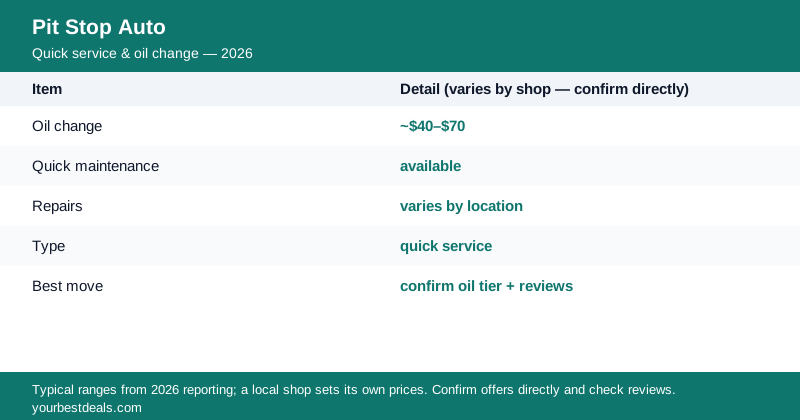
Pit Stop is a local quick-lube and service shop doing fast oil changes plus some broader maintenance. Typical prices: a conventional change around $45 to $65 and synthetic around $75 to $110. Get the current coupon from the shop’s official site rather than third-party pages. These are typical ranges; prices are set per location and change often, so confirm with your store. As a regional quick-lube, the service is a standard fast change (with some locations offering more) – pair the coupon with declining add-ons that aren’t due.
Pit Stop is a longtime Chicago name, and whether it’s a quick change or a bit more, the drill is the same as any quick-lube. Here it is.
What you’ll actually pay
Here’s the picture. Prices vary by location and change often, so confirm locally.
| Service | Typical price | Notes |
|---|---|---|
| Conventional oil change | ~$45–$65 | Fast change |
| Synthetic oil change | ~$75–$110 | Varies by vehicle |
| Other service | varies by location | Some do more than oil |
| Coupons | location site | Rotate |
Compare alternatives: our oil change cost guide, Valvoline coupons guide, and Jiffy Lube coupons guide.
Shop Talk
Pit Stop is a regional local operation, so it has a local reputation to attend to – often a plus for service. The approach is the same as any quick-lube: pull the current coupon from the shop’s site, confirm your oil tier (the low number is conventional; most newer cars need synthetic), and decline the add-on pitch unless your maintenance schedule says it’s due. Because it’s regional, prices and coupons vary by location, and some Pit Stop spots offer more than a bare oil change (tires, brakes, or other service depending on the location), so if you need more than a change, ask what that specific store handles and price any bigger work normally – itemized estimate for repairs, out-the-door price for tires. For the quick change, it’s a convenient Chicago option with a coupon. If you’re outside your local area, it won’t be near you – any national quick-lube (Valvoline, Take 5, Jiffy Lube) or Walmart for the cheapest basic change covers the same need. Bring the coupon, know your oil tier, skip the add-ons that aren’t due, and treat any larger service as a separate, verified decision.
Where Drivers Overpay
Same as any quick-lube: the add-on menu on the oil change, and – where a location offers more – approving bigger work without verifying it. The change is fairly priced; extras and unverified repairs are where it climbs.
The pattern: pull the current coupon, confirm your oil tier, decline oil-change add-ons that aren’t due, and treat any tire or repair work as a separate decision with its own itemized/out-the-door price.
The Real Number
Pit Stop is a local quick-lube (conventional ~$45–$65, synthetic ~$75–$110), with some locations offering more service. Pull the current coupon from the shop’s site, confirm your oil tier, and decline add-ons that aren’t due. If a location offers tires or repair, price that work separately – itemized estimate or out-the-door number. Outside Chicago, a national quick-lube or Walmart covers the same need.
Frequently Asked Questions
How much is an oil change at Pit Stop?
A conventional oil change at Pit Stop typically runs around $45 to $65, and a synthetic change roughly $75 to $110, with diesel and large engines higher. These are typical ranges; prices are set per location and change often, so check the shop’s site or call for an exact figure, and expect a small disposal fee. The low number is conventional oil – most newer cars require synthetic, so expect the synthetic tier. The change is a fast quick-lube service with a courtesy check, and some locations offer more. Grab the current coupon before visiting. For how it compares with national quick-lubes, see our oil change cost guide, and confirm the price for your vehicle locally. If lowest price matters most, Walmart may undercut it; for a convenient local change with a coupon, Pit Stop is a reasonable local option. If you’re outside your local area, use a national quick-lube instead.
Where is Pit Stop located?
Pit Stop is a local operation, so it’s a regional option concentrated in and around Chicago rather than a national chain – whether it’s near you depends on your location. If you’re in your local area, it’s a convenient, locally known quick-lube and service option. If you’re elsewhere, you won’t find it and should use national alternatives: Valvoline Instant Oil Change or Take 5 for a fast stay-in-car change, Walmart for the cheapest basic change, Jiffy Lube, or a full-service shop. The easiest way to confirm whether Pit Stop is near you, and what services a specific location offers, is its website’s location finder or a call to the store. For the oil change itself, the approach is the same wherever you go: pull the current coupon, confirm your oil tier, and decline add-ons that aren’t due. So if Pit Stop is in your local neighborhood, it’s a solid local choice with a coupon; if not, the national quick-lubes in our other guides cover the same need. Match the shop to what’s available where you live, and apply the same quick-lube discipline regardless.
Does Pit Stop do more than oil changes?
Some locations do – Pit Stop is primarily a quick-lube, but depending on the specific location it may offer additional services beyond the oil change, such as tires, brakes, or other maintenance, so what’s available varies by store. If you need more than an oil change, ask your specific Pit Stop location what it handles. For any work beyond the basic change, apply normal scrutiny: get an itemized written estimate for repairs, an out-the-door installed price for tires, question add-ons that aren’t due, and on a bigger job consider a second quote. The oil change is the core quick service; any broader repair capability is a location-by-location bonus. So treat Pit Stop as a quick-lube first, with some locations doubling as a fuller service shop – use it for the fast change with a coupon, and if it can also handle a repair or tires you need, price that separately like you would at any shop. For major mechanical work, a full-service shop or your usual mechanic may be preferable. Check your local Pit Stop’s actual service menu if you need something beyond an oil change, and don’t assume every location offers the same range.
Where do I find current Pit Stop coupons?
Pit Stop’s official website (and local advertising) is the reliable source for current coupons, better than third-party code pages that often list expired offers. Because it’s a regional operation with prices set per location, confirm a coupon at your specific store, and check for any location loyalty or email offer if you go regularly. Pull the coupon right before your visit since deals rotate, and confirm it applies to your oil tier. The main point: use the shop’s official source for the current coupon, confirm your location honors it, and don’t rely on stale third-party codes. Pairing the coupon with declining unneeded add-ons keeps the visit affordable. For the oil change, the coupon plus the right oil tier is what determines your real cost; for any bigger service a location offers, make sure any coupon applies to a verified, itemized price. Since it’s a local operation, the simplest approach is to look up your specific nearby Pit Stop, check its current offer and price for your vehicle, and go in with the coupon ready.
Should I decline the extra services offered?
Decline anything that isn’t due per your maintenance schedule or addressing a real symptom – the same rule as at any quick-lube. During the oil change, the shop will inspect the car and may recommend add-ons: air filter, cabin air filter, wiper blades, fluid flushes, and so on. Some are legitimate when truly due, but they’re offered routinely and the suggested intervals can be shorter than your manufacturer’s. Know your maintenance schedule (in the owner’s manual) and approve only what’s actually at its interval or fixing a real problem; a cabin air filter, for instance, is often a cheap part you can replace yourself. It’s fine to say “not today” and check later. This keeps the visit from ballooning past the coupon-discounted oil-change price, since the coupon covers the oil change, not the extras. For genuine repair needs at a location that offers them, get an itemized estimate and decide deliberately. So accept what’s due, politely decline the rest, and treat any larger repair as a separate, verified decision – that discipline keeps a Pit Stop visit economical.
Is Pit Stop a good quick-lube?
Pit Stop is a long-standing, generally well-regarded local quick-lube, comparable to national chains like Jiffy Lube for a routine oil change, with the usual quick-lube pros and cons. The pros: convenient, relatively quick, a local reputation to maintain, and some locations offer more service. The cons are the standard ones: prices sit in the mid-range (not rock-bottom), and the courtesy inspection doubles as an add-on sales opportunity. None of that makes it a poor choice – it means you should use a current coupon, confirm your oil tier, and decline add-ons that aren’t due, as at any quick-lube. For a simple oil change in your local area where you bring a coupon, Pit Stop is a solid, convenient option. If your priority is the absolute lowest basic-change price, Walmart may undercut it; if you want a specific national brand’s consistency, Valvoline, Take 5, or Jiffy Lube are alternatives. Check your local Pit Stop’s reviews and current coupon, and it’s a reasonable routine-maintenance option in its market. As always, the coupon, the right oil tier, and skipping unneeded add-ons are what keep the visit cheap.
What should I check before using the coupon?
A few quick checks make the visit economical. First, get the coupon from Pit Stop’s official source so it’s current and valid, and have it ready before you go. Second, read what it applies to – the oil tier, any restrictions, and expiration. Third, confirm the oil your vehicle requires (most newer cars need synthetic) so the discount applies to the right tier. Fourth, budget for the small disposal fee on top. Fifth, plan to decline add-ons (air filter, wiper blades, flushes) unless your maintenance schedule says they’re due – the coupon covers the oil change, not the extras. Sixth, confirm your location honors the offer, and if you need more than an oil change, check what that specific store handles and price it separately. Do those, and you get a convenient local change at the lowest realistic price: the right oil, the coupon applied, the fee accounted for, and no unnecessary add-ons. The approach is the same quick-lube discipline that works anywhere – coupon, oil tier, skip the extras – applied to a regional shop with a local reputation.
Sources
Typical pricing and the quick-lube model verified against Pit Stop’s regional information and third-party quick-lube pricing reporting in November 2026. Prices are set per location and coupons rotate; amounts here are typical ranges, not quoted codes – confirm current offers and pricing locally.
- SoFi – average cost of an oil change (2026)
- ThePricer – quick-lube oil change pricing
- ASE – National Institute for Automotive Service Excellence
Related Guides
- Oil Change Cost Guide
- Valvoline Coupons & Prices
- Jiffy Lube Coupons & Prices
- Walmart Auto Care Coupons & Prices
- Auto Service Coupons Hub

Diane Holcomb spent seven years as a service advisor at multi-brand dealerships in Charlotte, NC, and treats a regional name like Pit Stop the same as any quick-lube: a local reputation is a nice plus, but the coupon, the right oil tier, and skipping the add-ons are what keep the visit cheap. She drives a 2019 Honda CR-V and a hand-me-down 2007 Toyota Camry, and takes no referral fees or advertising money from any shop or chain.