
Last updated: November 2, 2026 – By Eddie Brennan
November 2026 update: reconfirmed the symptom list, replacement cost range, and the root-cause guidance.
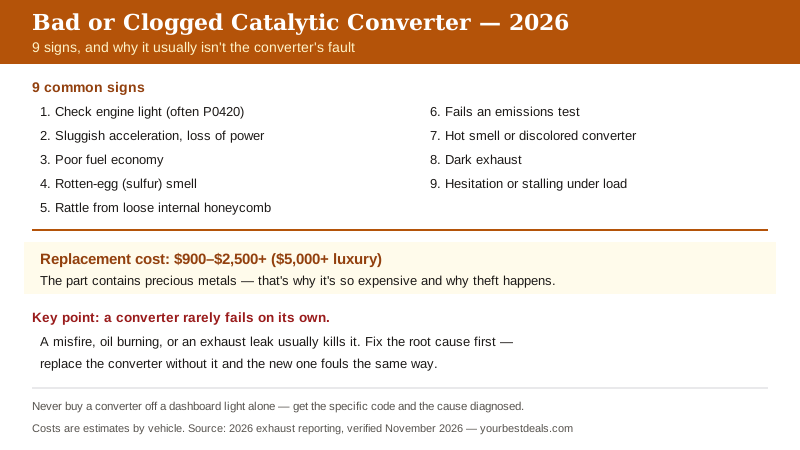
A bad or clogged catalytic converter usually shows up as a check engine light, weak acceleration, poor fuel economy, or a rotten-egg smell – and replacing it runs $900 to $2,500 or more. But here’s the thing most guides skip: the converter almost never fails on its own. It gets killed by something else – a misfire, an engine burning oil, or an exhaust leak – so if you swap the converter without fixing that root cause, the new one fouls the same way. That’s why the most important sign isn’t on the car; it’s the diagnostic code that tells you why the converter went bad. Below are the nine common signs, plus what to do about each so you don’t spend four figures twice.
I replaced a fair number of these in Columbus, and the ones that came back were always the jobs where somebody bolted in a converter without asking what killed the old one. Let me give you the signs, the cost, and – more usefully – how to tell whether the converter is really the problem or just the victim.
The nine signs
These are the symptoms of a failing or clogged catalytic converter, from most common to more subtle. Several overlap with other problems, which is exactly why the code reading matters.
1. Check engine light, often code P0420. The computer monitors converter efficiency, and a P0420 “catalyst efficiency below threshold” code is the classic signal – though it can also be triggered by a bad sensor or leak, not just the converter.
2. Sluggish acceleration and loss of power. A clogged converter restricts exhaust flow, so the engine struggles to breathe, especially when you try to accelerate or climb a hill.
3. Poor fuel economy. A restricted or inefficient converter throws off engine performance and can noticeably drop your miles per gallon.
4. Rotten-egg, sulfur smell. A failing converter can’t process the small amount of sulfur in fuel, so it comes through as that distinctive smell.
5. A rattle from loose internal honeycomb. The ceramic honeycomb inside can break apart from overheating or age, rattling like a can of gravel, especially at idle or startup.
6. Failing an emissions test. A worn converter can’t clean the exhaust enough to pass, which is often how people first learn it’s bad.
7. A hot smell or discolored converter. A clogged converter overheats, sometimes glowing or discoloring and giving off a hot, acrid smell from under the car.
8. Dark exhaust. A failing converter combined with a rich-running engine can produce darker exhaust than normal.
9. Hesitation or stalling under load. A badly clogged converter can choke the engine enough to make it hesitate, stumble, or even stall when you ask for power.
What replacement costs – and why it’s so much
Replacing a catalytic converter runs $900 to $2,500 for most vehicles, and can climb past $5,000 on some luxury and performance cars. The reason it’s so pricey is the part itself: a converter contains precious metals like platinum, palladium, and rhodium that do the chemical cleaning, and those metals are expensive. That same value is why converter theft became a widespread problem – thieves cut them off for the metal. So this is one repair where the part, not the labor, drives the bill.
Because of that cost, there’s real money in getting the diagnosis right and in your options. On many vehicles an aftermarket CARB-compliant converter costs far less than the dealer part, though some states and some cars require an exact match, so confirm what’s legal where you live before buying. And critically, confirm the converter is actually the failed part and not a healthy converter being fouled by something upstream. Our exhaust system guide covers where the converter sits in the bigger picture.
Shop Talk
A P0420 code does not mean “buy a converter.” It means the converter isn’t cleaning the exhaust well enough – which is often because a bad upstream oxygen sensor is lying to the computer, or a small misfire or leak is degrading the reading. I’ve seen plenty of P0420s fixed with a $250 sensor instead of a $1,500 converter. Before you spend big, have a shop check the upstream oxygen sensor, scan for misfire codes, and look for exhaust leaks. If the converter really is clogged, there’s a cheap test: a tech can measure exhaust backpressure, and high backpressure confirms a genuine clog. Insist on that confirmation before paying converter money.
What Gets Misdiagnosed
This is the repair most often done wrong, and the mistake is expensive. A P0420 code gets read as “converter” and a converter gets installed – but if the real cause was a lazy oxygen sensor, a misfire, or a leak, the code comes right back and you’ve spent $1,500 for nothing. The converter is frequently the victim, not the culprit. A good diagnosis checks the upstream sensor, scans for misfires, and confirms an actual clog with a backpressure test before condemning the converter.
The second misdiagnosis runs the other way: ignoring the root cause and letting it destroy a good converter. A persistent misfire dumps raw fuel into the converter and overheats it; an engine burning oil or coolant coats and clogs it. If you have a misfire or an oil-burning problem and keep driving, you can turn a cheap repair into a converter replacement. So the rule cuts both ways – don’t replace a converter that’s just a victim, and don’t ignore the engine problem that’s actively killing a healthy one. Fix the cause, and the converter usually takes care of itself.
The Real Number
The signs of a bad catalytic converter are a check engine light (often P0420), sluggish acceleration, poor fuel economy, a rotten-egg smell, and a rattle – with replacement at $900 to $2,500 and up because the part contains precious metals. The single most valuable thing to know: the converter rarely fails on its own, so a P0420 might really be a $250 oxygen sensor, a misfire, or a leak. Before spending converter money, have a shop confirm an actual clog with a backpressure test and rule out the cheaper upstream causes. Fix the root cause, or a new converter will foul the same way.
Frequently Asked Questions
What are the symptoms of a bad catalytic converter?
The common signs are a check engine light (often code P0420), sluggish acceleration and loss of power, poor fuel economy, a rotten-egg sulfur smell, and a rattle from broken internal honeycomb. You may also fail an emissions test, notice a hot smell or discolored converter, see darker exhaust, or feel the engine hesitate or stall under load. Because a clogged converter restricts exhaust flow, the performance symptoms tend to show up when you ask for power. Several of these overlap with other exhaust and engine problems, so a diagnostic code reading is what confirms the converter versus a cheaper cause like an oxygen sensor.
How much does it cost to replace a catalytic converter?
Most vehicles run $900 to $2,500 for a catalytic converter replacement, and some luxury and performance cars exceed $5,000. The high cost comes from the part itself, which contains precious metals like platinum, palladium, and rhodium – the same value that makes converters a target for theft. On many cars an aftermarket CARB-compliant converter costs considerably less than the dealer part, but some states and vehicles require an exact match, so check what’s legal where you live. These are estimated ranges that vary by vehicle. Given the cost, it’s worth confirming the converter is truly the failed part before replacing it.
Can I drive with a bad catalytic converter?
You can sometimes drive with a mildly failing converter, but it’s not advisable for long. A clogged converter restricts exhaust flow and chokes the engine, causing power loss, poor economy, and potential overheating, and a severely clogged one can leave you stalling or stranded. It will also fail emissions testing. If the converter is overheating, that’s a fire risk worth taking seriously. And whatever caused the converter to fail – a misfire or oil burning – may be doing further engine damage while you wait. So while a bad converter isn’t always an immediate breakdown, it’s a repair to address promptly rather than ignore.
What causes a catalytic converter to go bad?
A converter rarely wears out on its own; something else usually kills it. The big causes are a misfire, which dumps unburned fuel into the converter and overheats it; an engine burning oil or coolant, which coats and clogs the honeycomb; and a rich fuel mixture or unfixed exhaust leak that degrades it over time. Physical damage from road debris or theft is another. Because the failure is usually a symptom of an upstream problem, fixing the converter without addressing that cause just fouls the new one. That’s why proper diagnosis looks for the root cause – a misfire, sensor, or leak – before condemning the converter.
Does a P0420 code always mean I need a new converter?
No, and this is the most important thing to understand. P0420 means “catalyst efficiency below threshold” – the converter isn’t cleaning the exhaust well enough – but that reading can be thrown off by a lazy upstream oxygen sensor, a misfire, or an exhaust leak, not just a bad converter. Many P0420s are fixed with a much cheaper oxygen sensor. Before spending on a converter, a shop should check the upstream sensor, scan for misfires and leaks, and confirm an actual clog with a backpressure test. Replacing a converter on a P0420 alone is how people end up paying four figures and seeing the same code return.
How do I know if my catalytic converter is clogged?
The telltale symptoms are power loss, especially under acceleration or on hills, poor fuel economy, hesitation or stalling under load, and sometimes an overheating, hot smell from the converter. The definitive test is measuring exhaust backpressure: a technician connects a gauge, and abnormally high backpressure confirms a genuine clog restricting flow. This test is what separates a truly clogged converter from a P0420 caused by a sensor or leak. If a shop wants to replace your converter, ask whether they’ve confirmed a clog with a backpressure test, because that’s the evidence that justifies the expensive repair rather than a guess off a code.
Is it illegal to remove or gut a catalytic converter?
Yes. Removing, gutting, or bypassing a catalytic converter on a street-driven vehicle is illegal under US federal law and state emissions rules, and the car will fail emissions testing. Beyond the legal issue, it releases pollutants the converter is designed to clean. If your converter is bad, the legal path is to replace it with a proper OEM or CARB-compliant aftermarket unit that meets your state’s requirements. “Test pipes” and converter deletes are for off-road or racing use only. Given the cost of converters, the temptation is real, but a failed emissions test and potential fines make deletion a poor choice for a street car.
Sources
Catalytic converter symptoms and replacement cost verified against 2026 exhaust and emissions reporting on November 2, 2026. Costs are estimated ranges that vary widely by vehicle; a backpressure test confirms an actual clog.
- ConsumerAffairs – cost to replace a catalytic converter, 2026
- Empire Auto Protect – catalytic converter replacement cost, 2026
- Otter Auto Parts – catalytic converter price guide, 2026
Related Guides
- Exhaust and emissions system: parts and cost
- 8 signs of a failing oxygen sensor
- What does a check engine light mean?
- Exhaust leak repair cost

Eddie Brennan spent 11 years as an ASE Master Certified technician at an independent shop in Columbus, OH, where the converters that came back were always the ones installed without finding what killed the old one. His A6 electrical certification covers the sensor diagnostics behind a P0420. He takes no referral fees and drives a 250,000-mile 2015 Subaru Outback and a 2020 Ford F-150.