
Last updated: November 5, 2026 – By Diane Holcomb
November 2026 update: reconfirmed solenoid pricing and the solenoid-vs-converter point.
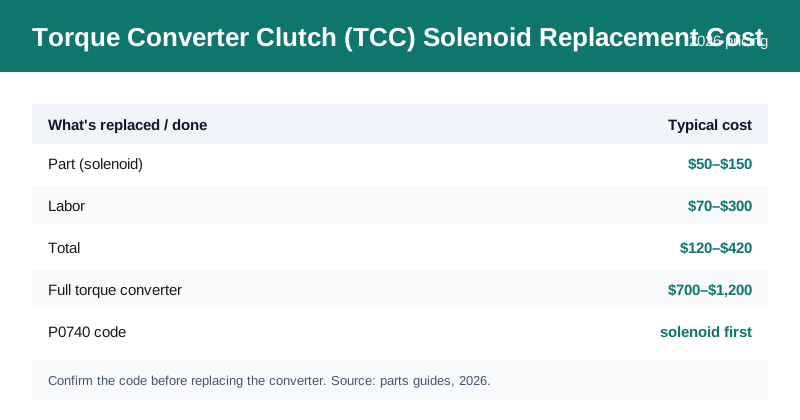
A torque converter clutch (TCC) solenoid replacement runs about $120 to $420, with the part at roughly $50 to $150 and labor $70 to $300 – the labor is mostly to drop the transmission pan to reach it. The crucial point: this is far cheaper than a full torque converter, which runs $700 to $1,200, and a P0740 code (TCC circuit) points to the solenoid first, not the converter itself. The TCC solenoid is a small electronic valve that controls the torque converter’s lockup clutch – at cruising speed, that clutch locks the converter to create a direct connection (like a manual’s engaged clutch) for better fuel economy. When the solenoid fails or sticks, you get a shudder or vibration (especially at steady highway speed), a check engine light with a P0740 or P0744 code, poor fuel economy, or the engine stalling as you come to a stop (the converter stays locked). Because the words sound like the whole torque converter, confirming it’s the solenoid first saves a lot.
A P0740 scares people into torque-converter quotes, but it’s usually the cheap solenoid. Let me break it down.
What you’ll actually pay
Here’s the picture. These are estimates that vary by vehicle and shop.
| Item | Cost | Notes |
|---|---|---|
| Part (solenoid) | $50–$150 | Cheap part |
| Labor | $70–$300 | Drop the pan |
| Total | $120–$420 | Most cars |
| Full torque converter | $700–$1,200 | Much more |
This is a transmission solenoid, like the shift solenoids; our shift solenoid guide, transmission fluid guide, and TCM guide cover related parts.
Shop Talk
Don’t let the name scare you into the wrong repair. A P0740 (torque converter clutch circuit) code names the “torque converter,” so people panic and get quoted a torque converter replacement – a $700 to $1,200 job that means pulling the transmission. But the code points first at the TCC solenoid and its circuit, which is a cheap solenoid (often inside the transmission pan or valve body) that runs $120 to $420 to replace. So before anyone replaces a converter for a P0740 or a shudder, the solenoid, the wiring, and the fluid should be checked. Speaking of fluid: low or burnt transmission fluid is a sneaky cause of TCC shudder – the lockup clutch relies on good fluid, and a fluid-and-filter service sometimes cures a TCC shudder for even less than a solenoid. The classic symptom to recognize is a shudder or vibration at a steady cruising speed (often 40 to 55 mph) as the converter tries to lock up, or the engine stalling when you come to a stop (the converter stays locked and drags the engine down, like stalling a manual by not pressing the clutch). Both of those point to the TCC system – solenoid or fluid – not necessarily a dead converter. The honest order of operations: scan the code, check the fluid, replace the solenoid if that’s the fault, and only consider the converter itself if those don’t fix it.
Where Drivers Overpay
The big overpay is being sold a torque converter (a $700–$1,200 transmission-out job) for a P0740 code or a shudder when the cheap TCC solenoid – or even just a fluid service – was the fix. The code names the converter, but it points at the solenoid and circuit first.
The cheapest possibility of all is the fluid: low or burnt transmission fluid causes TCC shudder, and a fluid-and-filter service sometimes cures it for less than a solenoid. The pattern: scan the code, check the fluid first, replace the solenoid if confirmed, and only look at the converter if those don’t resolve it.
The Real Number
A TCC solenoid is $120 to $420 (part $50 to $150, labor $70 to $300 to drop the pan) – a fraction of a full torque converter ($700 to $1,200). A P0740 code and a cruising-speed shudder point to the solenoid and circuit first, not the converter. And low or burnt fluid causes TCC shudder too, so check the fluid first. Don’t authorize a converter until the solenoid and fluid are ruled out.
Frequently Asked Questions
How much does it cost to replace a TCC solenoid?
About $120 to $420, with the solenoid part at roughly $50 to $150 and labor $70 to $300 – the labor is mostly dropping the transmission pan and transmission fluid to reach the solenoid (often in the valve body). These are estimates that vary by vehicle and shop. Crucially, this is far cheaper than replacing the whole torque converter, which runs $700 to $1,200 and requires removing the transmission. A P0740 (TCC circuit) code points to the solenoid and its circuit first, so confirming the solenoid is the issue – rather than jumping to a converter – keeps the cost low. The job usually includes a fluid refill since the pan is dropped. Because low or burnt fluid can cause the same symptoms, a fluid check is worth doing as part of the diagnosis too.
What does the TCC solenoid do?
The torque converter clutch (TCC) solenoid controls the lockup clutch inside the torque converter. A torque converter is the fluid coupling that connects the engine to an automatic transmission; at low speed it allows slip (so the engine can idle while you’re stopped in gear). But at cruising speed, that slip wastes energy and fuel, so modern converters have a lockup clutch that mechanically locks the converter for a direct, efficient connection – like engaging a manual’s clutch. The TCC solenoid is the electronically controlled valve that engages and releases that lockup clutch at the right times, under the transmission computer’s command. So the solenoid manages fuel-saving lockup. When it fails or sticks, lockup happens at the wrong time or not smoothly, causing shudder, stalling, or efficiency loss – and setting a TCC circuit code.
What are the symptoms of a bad TCC solenoid?
Common symptoms include a shudder or vibration at a steady cruising speed (often around 40 to 55 mph) as the lockup clutch engages roughly; a check engine light with a P0740 (TCC circuit) or P0744 (intermittent) code; the engine stalling or nearly stalling as you come to a stop (if the converter stays locked, it drags the engine down like stalling a manual without pressing the clutch); poor fuel economy; and erratic or harsh shifting. The cruising-speed shudder and the stall-at-stop are the two most telling signs. Because low or burnt transmission fluid can cause the same TCC shudder, and because the code names the “torque converter,” a proper diagnosis checks the fluid and the solenoid/circuit before condemning the converter itself. Recognizing these symptoms as TCC-system issues – not necessarily a dead converter – is what points toward the cheaper fix.
Is a TCC solenoid problem the same as a bad torque converter?
No, and this distinction saves a lot of money. The TCC solenoid is a small, inexpensive electronic valve that controls the converter’s lockup clutch, replaceable for $120 to $420. The torque converter itself is the large fluid-coupling component between the engine and transmission, and replacing it means removing the transmission – a $700 to $1,200 (or more) job. A P0740 code says “torque converter clutch circuit,” which sounds alarming but points to the solenoid, wiring, or control circuit first – not automatically a failed converter. Many P0740s and TCC shudders are resolved by the cheap solenoid (or even just a fluid service), not a converter replacement. So if you’re quoted a torque converter for a P0740 or a shudder, it’s worth confirming the solenoid and fluid have been ruled out first. Don’t let the code’s name push you into the expensive repair before the cheap causes are checked.
Can low transmission fluid cause TCC shudder?
Yes, and it’s one of the cheapest things to rule out. The torque converter’s lockup clutch relies on transmission fluid at the right level and condition to engage smoothly. When the fluid is low, old, oxidized, or burnt, the lockup clutch can shudder or engage roughly – producing the same cruising-speed shudder a bad TCC solenoid causes. In some cases, a transmission fluid and filter service (with the correct fluid) cures a TCC shudder for even less than replacing the solenoid. That’s why checking the fluid level and condition is a smart first step when you have a TCC shudder or a P0740-type complaint. If fresh fluid doesn’t resolve it, then the solenoid (or wiring) is the next suspect. So before buying any parts for a shudder, have the fluid checked – it’s the cheapest possible fix and a common cause. Keeping transmission fluid serviced on schedule helps prevent TCC shudder in the first place.
Is it safe to drive with a bad TCC solenoid?
It’s usually drivable in the short term, but it depends on the symptom and shouldn’t be ignored. A mild cruising-speed shudder isn’t an immediate danger, but it’s uncomfortable and signals a problem to address. The more concerning symptom is stalling when coming to a stop – if the converter stays locked and the engine stalls at stops, that can be inconvenient and unsafe (losing power assist momentarily), and repeated stalling is a reason to get it fixed promptly. Driving long-term with a TCC problem can also hurt fuel economy and, if fluid-related, contribute to further wear. So while a TCC solenoid issue won’t usually strand you, it’s worth diagnosing and fixing soon rather than living with the shudder or stalling. Because the fix is often cheap (solenoid or fluid), there’s little reason to put it off once it’s diagnosed. If it’s stalling at stops, treat that as more urgent.
Where is the TCC solenoid and why is there labor?
On most automatic transmissions, the TCC solenoid is located inside the transmission, typically in or on the valve body, which sits inside or above the transmission pan. To reach it, the technician usually has to drop the transmission pan (draining the fluid), sometimes remove the valve body or filter, replace the solenoid, and then reassemble and refill with fresh fluid. That’s where the $70 to $300 labor comes from – it’s not a hard part to replace once you’re in, but getting in requires opening up the transmission pan. This is also why the job naturally includes a fluid change (the fluid’s already out) and why a filter is often done at the same time. On a few vehicles the solenoid is more accessible, lowering the labor. Because the pan-drop is the bulk of the work, it’s efficient to also check the other solenoids and the fluid condition while you’re in there.
Sources
Price ranges verified against 2026 TCC solenoid pricing in November 2026. Dollar amounts are estimates that vary by vehicle and shop.
- RepairPal – repair cost estimator
- thePricer – torque converter replacement cost
- ASE – National Institute for Automotive Service Excellence
Related Guides
- Shift Solenoid Replacement Cost
- Transmission Fluid Change Cost
- Transmission Control Module Replacement Cost
- Transmission Replacement Cost
- Car Repair Cost Estimator

Diane Holcomb spent seven years as a service advisor at multi-brand dealerships in Charlotte, NC, where a P0740 code and a highway shudder usually meant the cheap TCC solenoid or a fluid service – not the torque converter the name made customers fear. She drives a 2019 Honda CR-V and a hand-me-down 2007 Toyota Camry, and takes no referral fees or advertising money from any shop or chain.