
Last updated: November 3, 2026 – By Diane Holcomb
November 2026 update: reconfirmed drain-and-fill vs flush pricing and the lifetime-fluid point.
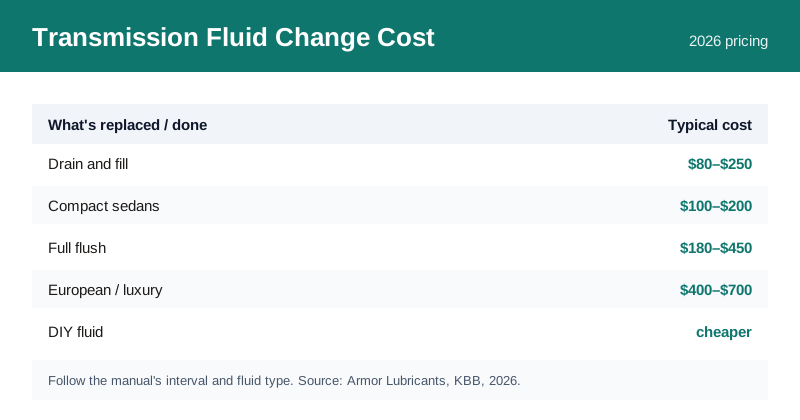
A transmission fluid change runs about $80 to $250 for a drain and fill (roughly $100 to $200 on compact sedans), $180 to $450 for a full flush, and $400 to $700 on European and luxury vehicles. DIY fluid is cheaper if you’re set up for it. Transmission fluid lubricates and cools the transmission and provides the hydraulic pressure that actually makes it shift – so when it gets old and burnt, you get harsh or slipping shifts and the transmission wears faster. A drain and fill replaces part of the fluid (what drains from the pan); a flush replaces most of it using a machine. The big catch: you must use the exact fluid your transmission calls for, because the wrong type can cause real damage. And despite “lifetime fluid” claims on some cars, many transmissions still benefit from a fluid change – “lifetime” often means the life the maker warrants, not the life you want from the car.
This is cheap maintenance that protects a very expensive part, so let me cover the cost and the fluid-type trap.
What you’ll actually pay
Here’s the picture. These are estimates that vary by vehicle and shop.
| Service | Cost | Notes |
|---|---|---|
| Drain and fill | $80–$250 | Partial change |
| Compact sedans | $100–$200 | Common |
| Full flush | $180–$450 | Most of the fluid |
| European / luxury | $400–$700 | Pricey fluid |
Fresh fluid protects the transmission itself; our transmission replacement guide, shift solenoid guide, and transmission filter guide cover the related parts.
Shop Talk
Two things matter more than the price here. First, the fluid type – this is not a place to let someone grab a generic bottle. Modern transmissions are specific about their fluid (there are many types, and some are brand-specific), and the wrong fluid can cause shifting problems or damage. A good shop uses the exact specified fluid; if you’re unsure, insist on it. Second, “lifetime fluid.” A lot of newer cars are marketed as having sealed, lifetime transmission fluid with no service interval. In practice, many techs will tell you that changing that fluid at a sensible interval (your manual or a trusted shop can advise) is cheap insurance, because transmission fluid does break down with heat and miles, and a worn-out transmission is a multi-thousand-dollar part. Now the one real caution: on a high-mileage transmission that’s never had its fluid changed and is already slipping, a full flush is sometimes blamed for finishing it off. The fluid change didn’t cause the failure – the neglect did – but if a transmission is already failing, a drain-and-fill with the correct fluid is gentler than an aggressive flush, and honestly, fresh fluid won’t rescue a transmission that’s already slipping. The move is to change the fluid on schedule before there’s a problem, not as a last-ditch fix. Drain-and-fill versus flush: a flush replaces more fluid but costs more; for routine maintenance on a healthy transmission, either is fine, and some cars have a specific recommended method.
Where Drivers Overpay
The real cost here isn’t the service – it’s never doing it. Fresh fluid on schedule is cheap; a transmission worn out early by burnt, neglected fluid is a multi-thousand-dollar replacement. Changing it on a sensible interval (even on a “lifetime fluid” car) is the save.
The costly mistake in the other direction is the wrong fluid: a generic or incorrect type can damage the transmission, undoing any savings. The pattern: change the fluid on schedule with the exact specified type, don’t treat “lifetime” as “never,” and don’t expect a flush to rescue an already-slipping transmission – this is preventive maintenance, not a repair.
The Real Number
A transmission fluid change is $80 to $250 for a drain and fill, $180 to $450 for a flush, and $400 to $700 on European or luxury cars. Use the exact specified fluid – the wrong type can damage the transmission. Treat “lifetime fluid” as a maker’s warranty term, not a reason to never change it, since fresh fluid on schedule is cheap insurance against a multi-thousand-dollar transmission. Don’t expect a flush to save one that’s already slipping.
Frequently Asked Questions
How much does a transmission fluid change cost?
About $80 to $250 for a drain and fill (roughly $100 to $200 on compact sedans), and $180 to $450 for a full flush that replaces most of the fluid using a machine. European and luxury vehicles run higher, around $400 to $700, largely because of pricier specified fluid and more involved service. DIY fluid is cheaper if you’re equipped to do it. These are estimates that vary by vehicle and shop. The cost depends on the method (drain-and-fill versus flush), how much fluid the transmission holds, whether the filter and pan gasket are done, and the specific fluid your transmission requires. Using the exact manufacturer-specified fluid is essential, and it’s a factor in the price on vehicles that need expensive specialty fluid.
What does transmission fluid do?
Transmission fluid does several critical jobs. It lubricates the gears, clutches, and bearings inside the transmission; it cools the transmission by carrying heat away; and in an automatic, it provides the hydraulic pressure that actually engages the clutches and makes the transmission shift. It also keeps seals conditioned. Because it does so much, its condition directly affects how the transmission shifts and how long it lasts. Over time and heat, the fluid breaks down, oxidizes, and gets contaminated with clutch material, losing its protective and hydraulic properties. That’s when you get harsh, slipping, or delayed shifts and accelerated wear. Fresh fluid restores those properties. Manual transmissions use a gear oil or specific fluid that lubricates but doesn’t provide hydraulic shifting; automatics are more fluid-dependent.
How often should transmission fluid be changed?
It varies widely by vehicle and transmission type, so your owner’s manual is the guide – intervals commonly fall anywhere from about 30,000 to 100,000 miles for automatics, with severe-use schedules (towing, heat, stop-and-go) calling for more frequent changes. Manual transmissions often have their own interval. The complication is “lifetime fluid”: some modern cars are marketed as never needing a change, but many technicians recommend changing it at a sensible interval anyway, since fluid still degrades with heat and miles and a transmission is expensive to replace. So rather than trusting “lifetime,” check your manual and consider a trusted shop’s advice for your specific vehicle and driving conditions. Changing it on a reasonable schedule, before problems appear, is the protective approach.
What’s the difference between a drain-and-fill and a flush?
A drain-and-fill drains the fluid that comes out of the transmission pan and refills with fresh fluid. It’s cheaper, but it only replaces part of the total fluid (often around 40–60%), since a lot stays in the torque converter and passages. A flush uses a machine to circulate and push out most of the old fluid, replacing nearly all of it – more thorough, but more expensive, and it uses more fluid. For routine maintenance on a healthy transmission, either works; some people do repeated drain-and-fills to gradually refresh the fluid. Some vehicles have a manufacturer-recommended method. One nuance: on a high-mileage, neglected transmission, a gentler drain-and-fill is often preferred over an aggressive flush. Your shop can recommend the right method for your transmission’s condition and the maker’s guidance.
Why does the fluid type matter so much?
Because modern transmissions are engineered for a specific fluid, and the wrong one can cause real problems. There are many transmission fluid types – various ATF specifications, some brand- or model-specific, plus CVT fluid for continuously variable transmissions and specific fluids for dual-clutch units – and they differ in friction characteristics, viscosity, and additives. Using an incorrect or generic fluid can cause harsh or erratic shifting, slipping, or even damage, because the clutches and valve body are calibrated to that fluid’s properties. This is especially true for CVTs and dual-clutch transmissions, which are very particular. So “transmission fluid” isn’t one-size-fits-all. A reputable shop uses the exact specified fluid for your transmission; if you’re doing it yourself or unsure, confirm the correct type from the manual. Getting this right is as important as doing the change at all.
Can changing transmission fluid cause problems on a high-mileage car?
This is a common worry, and the truth is nuanced. You may have heard that changing the fluid on an old, high-mileage transmission “caused it to fail.” What actually happens: if a transmission is already worn and on its way out from neglected fluid, fresh fluid won’t rescue it, and the failure that was coming anyway may show up around the time of the service – so the fluid change gets blamed. The fluid change didn’t cause the wear; the years of old fluid did. That said, on an already-marginal transmission, a gentle drain-and-fill with the correct fluid is safer than an aggressive flush. The real lesson is to change the fluid on schedule throughout the car’s life, before it’s neglected and slipping – then fresh fluid is purely protective. Don’t avoid fluid changes out of this fear on a well-maintained car.
Should the filter and pan gasket be done too?
On many transmissions, yes, it’s good practice when doing a fluid service that involves dropping the pan. Many automatics have a transmission filter (or screen) inside that catches debris, and a pan gasket that seals it. When the pan is removed for a fluid change, replacing the filter and gasket at the same time makes sense – the filter can clog over time, and you’re already in there. Some modern transmissions have a sealed design or a lifetime filter that isn’t routinely serviced, and some fluid changes are done through a fill port without dropping the pan (so the filter isn’t accessed). So whether the filter is done depends on your transmission’s design and the service method. A shop will tell you if your vehicle has a serviceable filter worth replacing with the fluid. See our transmission filter guide.
Sources
Price ranges verified against 2026 transmission fluid service pricing in November 2026. Dollar amounts are estimates that vary by vehicle and shop.
- Armor Lubricants – transmission fluid change cost
- Kelley Blue Book – transmission fluid guidance
- ASE – National Institute for Automotive Service Excellence
Related Guides
- Transmission Replacement Cost
- Shift Solenoid Replacement Cost
- Transmission Filter Change Cost
- Radiator Flush Cost
- Car Repair Cost Estimator

Diane Holcomb spent seven years as a service advisor at multi-brand dealerships in Charlotte, NC, where she pushed on-schedule fluid changes with the exact specified fluid – cheap insurance against a transmission that costs thousands. She drives a 2019 Honda CR-V and a hand-me-down 2007 Toyota Camry, and takes no referral fees or advertising money from any shop or chain.