
Last updated: November 8, 2026 – By Diane Holcomb
November 2026 update: reconfirmed bulb, lens, and assembly pricing and the LED point.
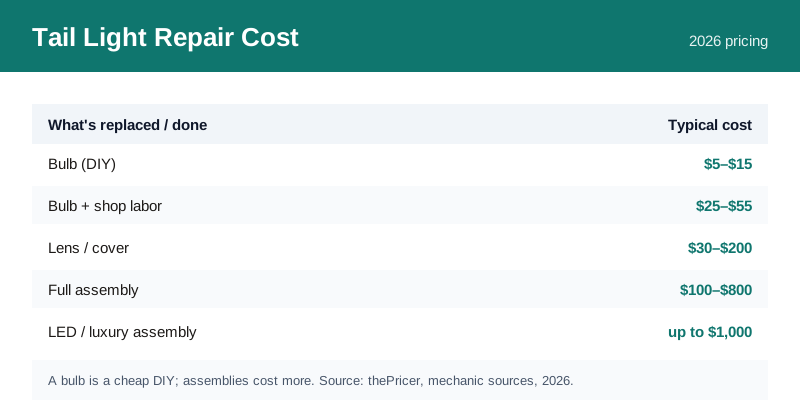
A tail light fix ranges enormously depending on what actually failed. A bulb is about $5 to $15 as a DIY, or $25 to $55 with a shop doing it (a little labor on top). A cracked lens or cover runs $30 to $200. A full assembly (the whole housing) runs $100 to $800 for parts, and LED or luxury assemblies can hit $1,000. The tail light assembly at each rear corner houses several functions – brake lights, running/tail lights, turn signals, and often reverse lights – so “my tail light is out” could mean a 5-dollar bulb or a several-hundred-dollar housing. Make and model matter a lot, and whether your car uses replaceable bulbs or sealed LED units is the big cost divider. The good news: a burned-out bulb, the most common cause, is usually a quick, cheap DIY.
Most of the time this is a cheap bulb, not the scary assembly price – so let me break down which is which.
What you’ll actually pay
Here’s the picture. These are estimates that vary by vehicle and shop.
| What failed | Cost | Notes |
|---|---|---|
| Bulb (DIY) | $5–$15 | Most common |
| Bulb + shop labor | $25–$55 | Quick job |
| Lens / cover | $30–$200 | Cracked |
| Full assembly | $100–$800+ | LED up to $1,000 |
A tail light is part of your car’s lighting and safety; our side mirror guide, windshield guide, and car door guide cover related exterior repairs.
Shop Talk
First figure out what’s actually out, because the cost swing is huge. If one function is dead – say the brake light but the running light works – it’s almost always a burned-out bulb, and on most cars that’s a $5 to $15 bulb you can change yourself by accessing it from inside the trunk or hatch (there’s usually a panel or wingnuts holding the assembly). That’s the cheapest, most common fix. If the lens is cracked but the lights work, you may just need a lens/cover, or the whole assembly if the lens isn’t sold separately. If the whole corner is dead or the housing is smashed, you’re looking at a full assembly. Two cost drivers to know. One, LED tail lights: many newer cars use sealed LED assemblies where the LEDs aren’t individually replaceable, so if an LED section fails you replace the whole (pricey) assembly, not a bulb – that’s why some tail lights cost $500+. Two, aftermarket versus OEM: for an out-of-warranty car, a quality aftermarket assembly can be much cheaper than the dealer part. And a practical tip: a cracked or out tail light is a common reason to get pulled over and can fail inspection, so it’s worth fixing promptly – but for a cheap bulb or even a lens, it’s usually not worth an insurance claim, since the deductible likely exceeds the cost.
Where Drivers Overpay
The overpay is paying assembly or shop prices for what a bulb would fix. One dead function (just the brake light, just the turn signal) is almost always a cheap, DIY-able bulb – so checking what’s actually out before assuming the worst is the save.
On the bigger repairs, the saves are choosing a quality aftermarket assembly over the dealer OEM part on an older car, and not filing an insurance claim for a cheap fix where the deductible exceeds the cost. The pattern: identify whether it’s a bulb, lens, or whole assembly, DIY the bulb, consider aftermarket for an assembly, and skip the insurance claim on anything cheap.
The Real Number
A tail light is a $5 to $15 bulb (the most common fix, and an easy DIY), a $30 to $200 lens, or a $100 to $800+ full assembly – LED units can top $1,000 because the LEDs aren’t individually replaceable. Check what’s actually out before assuming the worst: one dead function is almost always a cheap bulb. Fix it promptly (it’s a pull-over and inspection issue), but skip an insurance claim on anything this cheap.
Frequently Asked Questions
How much does it cost to fix a tail light?
It depends entirely on what failed. A burned-out bulb – the most common issue – is about $5 to $15 as a DIY, or $25 to $55 if a shop does it with a little labor. A cracked lens or cover runs $30 to $200. A full tail light assembly (the whole housing) runs $100 to $800 for parts, and LED or luxury assemblies can reach $1,000. These are estimates that vary by vehicle and shop. The biggest cost divider is whether your car uses replaceable bulbs (cheap) or sealed LED assemblies (where a failure means replacing the whole pricey unit). Make and model matter a lot, and a quality aftermarket assembly is often much cheaper than the dealer part on an out-of-warranty car. Most tail light problems turn out to be the cheap bulb.
What’s in a tail light assembly?
The tail light assembly at each rear corner of the car combines several lighting functions in one housing: the tail/running lights (on with your headlights), the brake lights (brighter, when you press the brake), the turn signals, and often the reverse (backup) lights, plus sometimes a rear fog light. On traditional setups, each function uses a replaceable bulb behind a colored lens. On many newer cars, these are LED units, sometimes with the LEDs sealed into the assembly. Because one housing contains multiple functions, when “a tail light is out” it’s important to identify which specific function failed – that tells you whether it’s one bulb or a bigger problem. The assembly also includes the lens/cover and the wiring connector. Its job is rear visibility and signaling, which is why it’s both a safety and a legal item.
Can I replace a tail light bulb myself?
For most cars with replaceable bulbs, yes – it’s one of the easiest DIY jobs. Typically you open the trunk or hatch, find the access panel or cover behind the tail light (or remove a couple of wingnuts or screws holding the assembly), twist out the bulb socket, swap the old bulb for the correct new one, and reinstall. The bulb is $5 to $15, and the whole job often takes a few minutes with little or no tools. The keys are getting the correct bulb type for your car (the owner’s manual or a parts store lookup tells you) and not touching certain bulbs’ glass with bare fingers. On cars with sealed LED tail lights, there’s no bulb to replace, so that’s not a DIY – a failed LED means a new assembly. But for a standard replaceable bulb, DIY saves the shop labor easily.
Why are LED tail lights so expensive to fix?
Because on many vehicles the LEDs are built into a sealed assembly and aren’t individually replaceable. With traditional tail lights, a burned-out bulb is a cheap, separate part you swap out. But when a car uses integrated LED tail lights and one or more LEDs or the LED circuit fails, you often can’t just replace a bulb – the entire assembly has to be replaced, and LED assemblies are more expensive parts to begin with (sometimes $300 to $800 or more, occasionally over $1,000 on luxury vehicles). So the same “tail light out” problem that’s a $10 bulb on an older car can be a several-hundred-dollar assembly on a newer LED-equipped one. This is worth knowing before assuming a tail light issue is cheap. On some vehicles, a portion of the assembly or a module is serviceable, but many are full-assembly replacements.
Is it illegal to drive with a tail light out?
In practice, yes – driving with a non-functioning tail light, brake light, or turn signal is a common reason to get pulled over and can result in a ticket (a “fix-it” citation in many places), and it will fail a safety or state inspection. More importantly, it’s a genuine safety issue: your tail lights and brake lights are how drivers behind you see you, especially at night and in bad weather, and a dead brake light means they can’t tell when you’re slowing. So beyond the legal angle, a working tail light is about not getting rear-ended. Because the most common fix (a bulb) is cheap and quick, there’s little reason to delay. If a light is out, replace it promptly – it’s inexpensive, it keeps you legal, and it keeps you visible to traffic behind you.
Should I use OEM or aftermarket for a tail light assembly?
For an out-of-warranty car, a quality aftermarket assembly is often a good money-saver. OEM (original equipment, from the dealer) tail light assemblies fit perfectly and match exactly, but they’re the most expensive option. Aftermarket assemblies – made by other manufacturers to fit your car – can cost significantly less and, if you choose a reputable brand, fit and function well. The things to watch with aftermarket are fit quality, whether it’s DOT-compliant/legal, and color/appearance match, especially on visible rear lighting. For a daily driver out of warranty, aftermarket is a common, sensible choice. For a newer car under warranty, a lease, or where exact match matters, OEM may be preferable. If you want to save, ask the shop whether they can use a quality aftermarket assembly, or source one yourself – it’s often a big part of the price difference on an assembly replacement.
My tail light works but the lens is cracked – do I need the whole assembly?
It depends on whether the lens is sold separately, which varies by vehicle. On some cars, the tail light lens or cover is available as its own part, so you can replace just the cracked lens ($30 to $200) and keep the rest of the assembly. On many modern vehicles, though, the lens is bonded or integrated into the assembly and isn’t sold on its own – in which case a cracked lens means replacing the whole assembly. A small crack that doesn’t let water in and still shows the correct colors may be okay to leave or patch temporarily, but a cracked lens that lets moisture into the housing can cause bulb or electrical problems and may fail inspection (especially if it changes the light color, like a cracked red lens showing white). So check whether your car offers a separate lens; if so, that’s the cheaper fix, and if not, it’s an assembly replacement.
Sources
Price ranges verified against 2026 tail light repair pricing in November 2026. Dollar amounts are estimates that vary by vehicle and shop.
- thePricer – tail light replacement cost
- TestingAutos – tail light assembly replacement
- ASE – National Institute for Automotive Service Excellence
Related Guides
- Side Mirror Replacement Cost
- Windshield Replacement Cost
- Car Door Replacement Cost
- Window Regulator Replacement Cost
- Car Repair Cost Estimator

Diane Holcomb spent seven years as a service advisor at multi-brand dealerships in Charlotte, NC, where “my tail light’s out” was usually a $10 bulb – and where she’d warn LED-equipped owners that theirs could be a whole pricey assembly. She drives a 2019 Honda CR-V and a hand-me-down 2007 Toyota Camry, and takes no referral fees or advertising money from any shop or chain.