
Last updated: November 8, 2026 – By Eddie Brennan
November 2026 update: refreshed rack and pinion parts, labor, and alignment ranges against 2026 reporting and reconfirmed the hydraulic-versus-electric price gap.
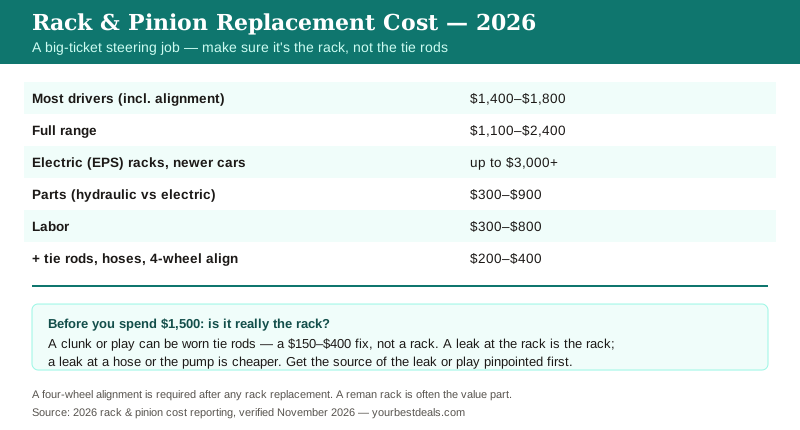
Rack and pinion replacement in 2026 costs $1,400 to $1,800 for most cars including the alignment, with a full range of $1,100 to $2,400 and electric power-steering racks on newer cars pushing past $3,000. This is a genuine big-ticket steering repair, which is exactly why the most important question isn’t the price – it’s whether you actually need a rack at all. A clunk or a bit of play in the steering is often worn tie rods, a $150-to-$400 fix, not a rack.
The steering rack is a serious job, and I always slowed people down before they authorized one, because it’s the kind of repair where a wrong diagnosis costs you well over a thousand dollars. Steering is one of my ASE certs, A4, and the truth is that a lot of “the rack is bad” quotes are really tie rods, a leaking hose, or the power-steering pump – all far cheaper. This guide gives you the real rack cost and, more importantly, how to make sure it’s the rack before you spend $1,500 on one.
Rack and pinion cost breakdown
These are the parts, labor, and total ranges. The biggest single variable is whether your car has a hydraulic or an electric power-steering rack.
| Item | Cost | Notes |
|---|---|---|
| Most drivers (total, incl. alignment) | $1,400–$1,800 | Typical hydraulic rack |
| Full range | $1,100–$2,400 | By vehicle and rack type |
| Electric (EPS) racks | up to $3,000+ | Newer cars, pricier part |
| Parts (rack) | $300–$900 | Reman cheaper than OEM |
| Labor | $300–$800 | Heavy, involved job |
| Tie rods, hoses, 4-wheel alignment | +$200–$400 | Usually part of the job |
A four-wheel alignment is required after any rack replacement, because removing the rack changes the steering geometry – that’s not an upsell, it’s mandatory to drive straight and not chew up your tires. A remanufactured rack is often the value part at $300 to $900 versus OEM new. Electric power-steering racks on newer cars are the expensive outlier, sometimes doubling the job.
What gets misdiagnosed
This is the section that can save you a thousand dollars. Three cheaper problems get mistaken for a bad rack. First, tie rods: worn inner or outer tie-rod ends cause a clunk over bumps and play in the steering that feels exactly like a loose rack, but tie rods are a $150-to-$400 repair, not a $1,500 one. Second, leaks: power-steering fluid on the ground gets blamed on the rack, but it’s often a leaking hose or the pump, both far cheaper than the rack itself. Third, the pump: whining and hard steering point to the power-steering pump, not the rack.
The rack is really bad when it’s leaking from the rack body itself, when there’s play that a tech traces specifically to the rack and not the tie rods, or when the internal valve fails and gives you uneven or wandering steering assist. A good tech can pinpoint the source of a leak with dye and check tie-rod play by hand before condemning the rack. Insist on that. On a repair this expensive, “it’s probably the rack” is not good enough – you want the specific finding that it’s the rack and not one of the cheaper causes.
Straight From the Invoice: steering jobs
These are jobs I either did myself or watched come through the bay – one real rack, one that was tie rods, one that was a leaking hose.
Invoice #1 – 2014 Honda Accord, rack + alignment, independent, Ohio
Fluid leaking from the rack body itself, confirmed with dye, plus wandering assist. Reman rack, tie rods, and a four-wheel alignment came to $1,550. Steep but truly the rack. Lesson: a leak traced to the rack body plus bad assist is a real rack job, and $1,400 to $1,800 with alignment is the fair number.
Invoice #2 – 2013 Toyota Camry, “bad rack” that was tie rods, Columbus
Quoted a $1,600 rack elsewhere for a clunk and steering play. The play was worn outer tie-rod ends – a $320 fix with an alignment. Lesson: a clunk and play feel like a loose rack but are usually tie rods. Have someone check tie-rod play by hand before authorizing a rack; it’s a $1,300 difference.
Invoice #3 – 2016 Ford Escape, leak that was a hose, Texas
Power-steering fluid on the driveway, owner braced for a rack. Dye showed the leak was a pressure hose, not the rack – a $220 repair. Lesson: a puddle of steering fluid isn’t automatically a rack. Trace the leak to its source; a hose or the pump is far cheaper than replacing the rack.
Reman vs new, and the mandatory alignment
Reman is usually the value
A quality remanufactured rack – rebuilt with new seals and internals – is the value pick for most cars at $300 to $900 versus OEM new, and it carries a warranty. For a mainstream out-of-warranty car, reman is a sound choice. Go OEM new mainly on a car that’s fussy about steering feel or that has an electric rack where reman options are limited. Avoid the cheapest no-name reman, since a rack that leaks again means paying the heavy labor twice.
The alignment isn’t optional
Any time the rack comes out, the car needs a four-wheel alignment afterward – removing the rack changes the steering angles, and without an alignment the car pulls, the steering wheel sits crooked, and your tires wear unevenly and fast. So the alignment showing up on a rack quote is correct and expected, not padding. What you should confirm is that it’s a proper four-wheel alignment included in the price, since that’s part of doing the job right.
Shop Talk
On a rack quote this expensive, get a second opinion and one specific answer: what exactly points to the rack rather than tie rods, a hose, or the pump? If the leak is traced with dye to the rack body, or a tech shows you play that’s in the rack and not the tie-rod ends, it’s real. But if the diagnosis is a vague “steering’s loose, probably the rack,” that’s your cue to have the tie rods checked by hand first – worn tie rods cause the same clunk and play for a fraction of the cost. A thousand-dollar difference is worth the extra checkup.
What actually drives the price
Two things: the rack type and being sure it’s the rack. A hydraulic rack keeps the job in the $1,400-to-$1,800 range, while an electric power-steering rack on a newer car can push past $3,000, so your car’s steering type sets the ceiling before anything else. A reman rack over OEM new keeps the parts side down. The mandatory alignment and any tie rods or hoses add a legitimate $200 to $400.
The truly avoidable cost is replacing a rack that was never bad. Tie rods, a leaking hose, or the pump can all masquerade as a bad rack, and each is a fraction of the price – so the diagnosis is where the real money is saved or lost on this repair. Get the leak traced or the play pinpointed to the rack specifically, and only then is the big number justified. Everything else on the quote, the reman rack and the required alignment, is predictable once the diagnosis is solid.
The Real Number
Budget $1,400 to $1,800 including alignment for most cars, more for an electric power-steering rack. But before you spend it, make sure it’s actually the rack – a clunk or play is often tie rods at $150 to $400, and a fluid leak is often a hose or the pump, all far cheaper. Get the leak traced with dye or the play pinpointed to the rack, not the tie rods. A reman rack is the value part, the four-wheel alignment is mandatory and not an upsell, and on a repair this size a second opinion is always worth it.
Frequently Asked Questions
How much does rack and pinion replacement cost in 2026?
Most drivers pay $1,400 to $1,800 including the alignment, with a full range of $1,100 to $2,400. Electric power-steering racks on newer cars can push past $3,000. The rack part is $300 to $900 depending on whether it’s hydraulic or electric and reman or OEM, labor is $300 to $800, and tie rods, hoses, and the required four-wheel alignment add $200 to $400. It’s a big-ticket steering repair, which is why confirming the rack is actually the problem, and not cheaper tie rods, matters so much.
How do I know if it’s the rack or the tie rods?
A clunk over bumps and play in the steering feel the same whether it’s a worn rack or worn tie rods, but tie rods are a $150-to-$400 repair versus $1,500 for a rack. The difference is found by hand: a tech grabs the tie-rod ends and checks for play, and if the looseness is in the tie rods, that’s your much cheaper fix. The rack is the culprit when a leak is traced to the rack body itself or when play is specifically in the rack and not the tie rods. Always have the tie rods checked before authorizing a rack.
Why is a rack and pinion replacement so expensive?
Because it’s a heavy, involved job on a costly part. The rack sits deep in the front of the car, so labor runs $300 to $800, the rack itself is $300 to $900 (much more for an electric one), and a four-wheel alignment is required afterward. Electric power-steering racks on newer cars are the priciest, sometimes over $3,000. That’s why it’s worth being certain the rack is the actual problem – the expense is real, but so is the risk of paying it when tie rods or a hose were the true cause.
Do I need an alignment after a rack and pinion replacement?
Yes, always, and it’s not optional or an upsell. Removing and replacing the rack changes the steering geometry, so without a four-wheel alignment afterward the car will pull, the steering wheel will sit crooked, and the tires will wear unevenly and quickly. A legitimate rack quote includes the alignment for exactly this reason. What you should confirm is that it’s a proper four-wheel alignment and that it’s included in the price you were quoted, since skipping it would ruin an otherwise correct repair.
Can I drive with a bad rack and pinion?
It depends on the failure, but don’t push it. A small leak with steering still working may give you some time, though the fluid loss can worsen and lead to hard steering. Play or a failing internal valve that makes steering wander or feel inconsistent is a safety issue, since predictable steering is not something to gamble with. If your steering feels loose, wanders, or the assist cuts in and out, get it diagnosed promptly and don’t take long trips until it’s sorted. Steering problems are one area where waiting isn’t worth the risk.
Is a remanufactured rack as good as a new one?
For most cars, a quality remanufactured rack is a sound choice – it’s rebuilt with new seals and internals, carries a warranty, and costs well under OEM new. Given how expensive the labor is, the main thing is avoiding the cheapest no-name reman, since a rack that leaks again means paying the heavy labor a second time. Go OEM new on a car that’s particular about steering feel or has an electric rack with limited reman options. Otherwise, a reputable brand’s reman rack is the value pick and what many good shops install.
What are the symptoms of a failing rack and pinion?
A power-steering fluid leak traced to the rack body, play or looseness in the steering that’s in the rack rather than the tie rods, uneven or wandering steering assist, a clunk that’s specifically from the rack, and sometimes a grinding feel when turning. The catch is that several of these overlap with cheaper problems – tie rods for the play and clunk, a hose or pump for the leak. That’s why the symptoms alone aren’t enough, and a proper diagnosis that pinpoints the rack is essential before committing to this repair.
Sources
Rack and pinion cost ranges verified against 2026 parts-and-labor reporting on November 8, 2026. Ranges vary by vehicle, rack type, and region; confirm your exact price locally.
- AutoNation Mobile Service – rack and pinion replacement cost, 2026
- RepairPal – rack and pinion replacement cost estimate
- AutoZone DIY – rack and pinion replacement cost
Related Guides
- CV joint replacement cost
- Car repair cost estimator hub
- Serpentine belt replacement cost
- About Eddie Brennan – ASE Master technician

Eddie Brennan is an ASE Master Certified technician (including A4, Suspension & Steering) who spent 11 years at an independent shop in Columbus, OH, and talked more than one customer out of a rack they didn’t need. He writes the repair and diagnostic guides on Your Best Deals and takes no referral fees. He drives a 250,000-mile 2015 Subaru Outback and a 2020 Ford F-150.