
Last updated: November 7, 2026 – By Diane Holcomb
November 2026 update: reconfirmed pricing, reversal cost, and the legality/inspection caveats.
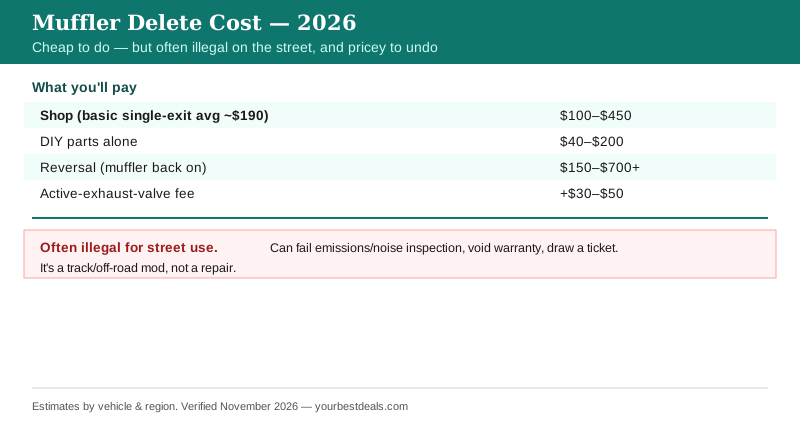
A muffler delete – removing the muffler and replacing it with a straight pipe for a louder exhaust – runs about $100 to $450 at a shop, with a basic single-exit job averaging around $190; DIY parts alone are roughly $40 to $200. That sounds cheap, and the install is, but two costs most guides skip change the picture. First, reversing it later – putting a proper muffler back on – runs about $150 to $700 or more. Second, and more important: a muffler delete is often illegal for street use. It can fail emissions or noise inspection, void powertrain or exhaust warranty coverage, and in many areas draw a ticket or a fix-it order. Removing the resonators too adds roughly one to one and a half hours of labor, and cars with active exhaust valves may carry an extra $30 to $50 to avoid triggering error codes. Really, a muffler delete is a track or off-road modification, not a repair.
This one isn’t a repair – it’s a modification, and the sticker price is the least important number. Let me cover what it actually costs, the legal and warranty catches, and the reversal expense.
What you’ll actually pay
Here’s the price picture. These are estimated ranges that vary by vehicle and shop.
| Item | Cost | Notes |
|---|---|---|
| Shop install | $100–$450 | Basic single-exit avg ~$190 |
| DIY parts alone | $40–$200 | Pipe + clamps/welding |
| Reversal (muffler back on) | $150–$700+ | A real future cost |
| Active-exhaust-valve fee | +$30–$50 | To avoid error codes |
Removing the resonators along with the muffler adds about 1 to 1.5 hours of labor. Note that a muffler delete does not add meaningful power on a normal street car – it’s about sound. Our muffler repair cost guide covers a proper muffler replacement if the goal is actually fixing a loud, failing exhaust.
Shop Talk
Before you spend the $150, know what you’re really signing up for. A muffler delete is loud – often drone-on-the-highway loud in a way that gets old fast on a daily driver – and it’s frequently illegal for street use. Many states and localities have noise limits and require a functioning exhaust, so a delete can earn you a ticket or a fix-it order, and it will typically fail a state emissions or safety inspection where those exist. It can also jeopardize your warranty: if a dealer decides the modified exhaust contributed to a problem, they can deny related powertrain or emissions coverage. Here’s the part people forget until it’s time to sell or trade the car: you’ll likely need to put a real muffler back on to pass inspection or satisfy a buyer, and that reversal runs $150 to $700 or more – on top of what you spent to delete it. One more myth to retire: on a normal naturally aspirated street car, a muffler delete doesn’t add usable power. It changes the sound, nothing more. If you want sound legally, a quality aftermarket muffler or cat-back system keeps you street-legal and inspection-friendly while still changing the note.
Where Drivers Overpay
The hidden cost here isn’t the install – it’s everything after. A delete that’s illegal for street use can mean tickets, a failed inspection, or a denied warranty claim, and then the reversal to put a legal muffler back on runs $150 to $700 or more. So the true cost of a delete is often the install plus the eventual undo, plus whatever fines or inspection headaches come in between.
The other way people overpay is in expectation: paying for a delete believing it adds power on a normal street car, when it only changes the sound. If sound is the goal, a quality aftermarket muffler or cat-back system delivers a changed note while staying street-legal and inspection-friendly. The pattern: treat a delete as a track-only mod, budget for the reversal, and choose a legal exhaust if the car sees public roads.
The Real Number
A muffler delete is $100 to $450 at a shop, but that’s the smallest number involved. It’s often illegal for street use (tickets, failed inspection, possible warranty denial), it doesn’t add usable power on a normal street car, and undoing it to pass inspection or sell the car runs $150 to $700+. Treat it as a track-only modification. If you want a changed exhaust note on a street car, a quality aftermarket muffler or cat-back keeps you legal.
Frequently Asked Questions
How much does a muffler delete cost?
At a shop, about $100 to $450, with a basic single-exit job averaging around $190; DIY parts alone run roughly $40 to $200. Removing the resonators along with the muffler adds about 1 to 1.5 hours of labor, and cars with active exhaust valves may carry an extra $30 to $50 to avoid triggering error codes. These are estimates that vary by vehicle and shop. The install is cheap, but the full cost picture should include the likely future expense of reversing it ($150 to $700 or more) and any fines or failed-inspection consequences if the car is driven on public roads where deletes are restricted.
Is a muffler delete legal?
Often not for street use. Many states and localities set noise limits and require a functioning exhaust system, so a muffler delete can violate noise ordinances and earn a ticket or a fix-it order. Where state emissions or safety inspections exist, a delete will typically fail. Federal and state tampering rules can also apply to emissions-related components. The specifics vary widely by location, so a delete that’s tolerated in one area may be clearly illegal in another. Because of this, a muffler delete is realistically a track or off-road modification; for a street-driven car, a legal aftermarket exhaust is the safer route.
Does a muffler delete add horsepower?
On a normal naturally aspirated street car, not in any meaningful way. The muffler on a modern car creates very little flow restriction at street power levels, so removing it changes the sound dramatically but doesn’t free up usable horsepower. Any dyno difference is typically negligible. The power-gain idea is largely a myth for everyday vehicles. On certain high-performance or heavily modified setups there can be small gains, but for the typical driver, a muffler delete is a sound modification, not a performance upgrade. If power is the goal, the money is better spent elsewhere, and if sound is the goal, a quality exhaust achieves it legally.
How much does it cost to reverse a muffler delete?
Putting a proper muffler back on runs about $150 to $700 or more, depending on the vehicle, the exhaust configuration, and the parts chosen. This reversal cost is one of the most overlooked parts of a muffler delete, because many owners eventually need it – to pass a state inspection, to stop a drone they’ve grown tired of, or to satisfy a buyer when selling or trading the car. So the realistic total cost of a delete is often the install plus this later reversal. Factoring the undo cost in up front helps you decide whether the temporary louder sound is worth it, especially on a car you plan to keep street-legal.
Will a muffler delete void my warranty?
It can jeopardize related coverage. A manufacturer generally can’t void your entire warranty for a modification, but if a dealer determines the muffler delete contributed to a problem – for example, an exhaust, emissions, or related powertrain issue – they can deny that specific claim. Modifying the exhaust can also affect emissions-system coverage. So while a delete won’t automatically cancel everything, it opens the door to denied claims on anything the dealer links to the modification, and it may complicate your relationship with the dealer on warranty work. On a vehicle still under factory warranty, that’s a real risk worth weighing against the cost of the modification.
What’s the difference between a muffler delete and an aftermarket exhaust?
A muffler delete simply removes the muffler and runs a straight pipe in its place – cheapest, loudest, usually not street-legal, and it changes sound without adding real power. An aftermarket exhaust, like a cat-back system or a performance muffler, is a designed replacement that changes the exhaust note (often deeper and more aggressive) while keeping a functioning muffler, so it can stay within noise limits and pass inspection in many areas. An aftermarket system costs more than a bare delete but avoids the legal, inspection, and reversal problems. For a street-driven car where sound is the goal, a quality aftermarket exhaust is generally the smarter choice than a delete.
Can I do a muffler delete myself?
Mechanically, yes, if you can cut out the muffler and fit a straight pipe with clamps or by welding – the parts are inexpensive. But the DIY question misses the bigger issues: whether it’s legal where you drive, whether it’ll fail your inspection, whether it affects your warranty, and the cost to reverse it later. There’s also the practical reality that it’s often louder than people expect, with highway drone that wears thin on a daily driver. So while the job itself is approachable for a DIYer, the decision deserves more thought than the install does. If the car is street-driven, a legal aftermarket exhaust avoids most of these headaches.
Sources
Price ranges verified against 2026 muffler delete pricing in November 2026. Dollar amounts are estimates that vary by vehicle and shop. Legality varies by state and locality; confirm local rules.
- ThePricer – muffler delete cost
- U.S. EPA – vehicle tampering and aftermarket rules
- ASE – National Institute for Automotive Service Excellence
Related Guides
- Muffler Repair Cost
- Catalytic Converter Replacement Cost
- Exhaust Leak Repair Cost
- Car Inspection Cost
- Car Repair Cost Estimator

Diane Holcomb spent seven years as a service advisor at multi-brand dealerships in Charlotte, NC, where she saw plenty of trade-ins come in needing a muffler put back on before they could be sold – the reversal nobody budgeted for. She drives a 2019 Honda CR-V and a hand-me-down 2007 Toyota Camry, and takes no referral fees or advertising money from any shop or chain.