
Last updated: November 8, 2026 – By Diane Holcomb
November 2026 update: reconfirmed manual transmission pricing and the do-the-clutch-too point.
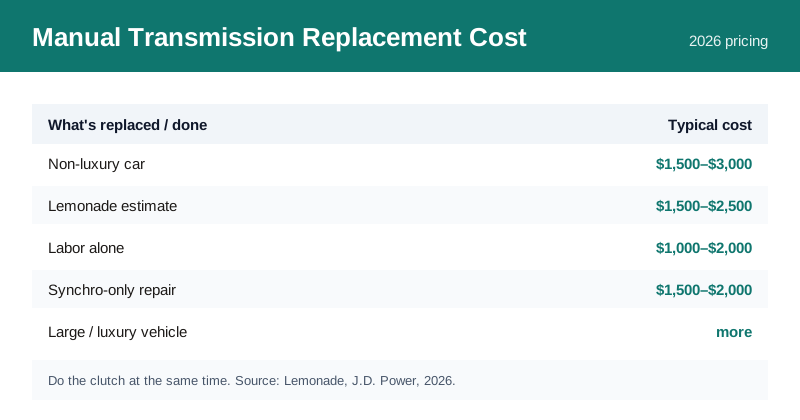
A manual transmission replacement runs about $1,500 to $3,000 for a non-luxury car (Lemonade estimates $1,500 to $2,500), with labor alone $1,000 to $2,000. A synchronizer-only repair (rebuilding worn synchros rather than replacing the whole unit) is about $1,500 to $2,000, and larger or luxury vehicles cost more. A manual transmission uses a clutch and a set of gears you shift by hand to transfer engine power to the wheels. Manuals are generally durable, but they fail from worn synchronizers (you get grinding when shifting into a gear), bad bearings (whining or growling noises), being popped out of gear, or hard shifting. Here’s a key money point: because the transmission has to come out either way, the clutch is often replaced at the same time to save the shared labor – and when the transmission is worn out, a quality rebuilt or used (good-condition) unit can beat a new one on cost.
Manuals are tough, so this is a less common repair than it sounds – but when it’s needed, the clutch and the new-vs-rebuilt question matter. Let me break it down.
What you’ll actually pay
Here’s the picture. These are estimates that vary a lot by vehicle and shop.
| Item | Cost | Notes |
|---|---|---|
| Non-luxury car | $1,500–$3,000 | Lemonade $1,500–$2,500 |
| Labor alone | $1,000–$2,000 | Transmission out |
| Synchro-only repair | $1,500–$2,000 | If limited to synchros |
| Larger / luxury | more | Higher end |
The clutch comes out with the transmission; our clutch replacement guide, clutch disc guide, and automatic transmission guide cover the related parts.
Shop Talk
A few things worth knowing before you spend on a manual transmission. First, manuals are generally durable and a full replacement is less common than people fear – a lot of “transmission” complaints on a manual turn out to be the clutch (slipping, won’t disengage) rather than the gearbox itself, and the clutch is a different (though also labor-heavy) repair. So get a real diagnosis of whether it’s the transmission or the clutch. Second, if the transmission truly has internal damage, consider the options: a shop can sometimes rebuild it (replacing worn synchros, bearings, and seals) rather than replace it, and a good used transmission from a low-mileage donor or a quality remanufactured unit is often cheaper than new – ask about all three (rebuild, used, reman, new) and the warranty on each. Third, and this is the big labor tip: since the transmission has to come out, and the clutch is right there, if your clutch has any real miles on it, replace the clutch at the same time – paying that big labor twice (once now for the transmission, again later for the clutch) is the thing to avoid. The classic symptoms that point to the gearbox rather than the clutch: grinding when you shift into a specific gear (worn synchro), a whine or growl that changes with gear or speed (bearings), popping out of gear, or leaking gear oil. Match the repair to what’s actually worn.
Where Drivers Overpay
The first overpay is replacing the transmission when the real problem was the clutch – slipping or failure to disengage are clutch issues, not gearbox ones, so a diagnosis separating the two comes first.
When the gearbox is truly bad, buying new when a rebuild, a good used unit, or a quality reman would cost less is the second overpay – ask about all the options and their warranties. And since the transmission is out anyway, replacing a worn clutch now avoids paying that big shared labor twice. The pattern: diagnose transmission vs clutch, weigh rebuild/used/reman/new, and do the clutch at the same time if it has miles on it.
The Real Number
A manual transmission is $1,500 to $3,000 (labor alone $1,000 to $2,000), with a synchro-only rebuild around $1,500 to $2,000. First confirm it’s the transmission and not the clutch – slipping and not disengaging are clutch problems. When the gearbox is truly bad, a rebuild, good used unit, or quality reman often beats new. And since it’s out anyway, replace a worn clutch at the same time to avoid paying that labor twice.
Frequently Asked Questions
How much does it cost to replace a manual transmission?
About $1,500 to $3,000 for a non-luxury car (Lemonade estimates $1,500 to $2,500), with labor alone running $1,000 to $2,000 since the transmission has to be removed. A synchronizer-only repair – rebuilding worn synchros rather than replacing the whole unit – is about $1,500 to $2,000, and larger vehicles, luxury models, or performance cars cost more. These are estimates that vary widely by vehicle and shop. The cost depends on whether you rebuild the existing transmission, install a good used or remanufactured unit, or buy new, and on your vehicle. Because the transmission must come out, the clutch is often replaced at the same time (sharing the labor), which adds to the parts but is cost-effective. Confirming the problem is the transmission and not the clutch is an important first step before this expense.
How does a manual transmission work?
A manual transmission transfers engine power to the wheels through gears that you select by hand with the gear shifter, using the clutch pedal to connect and disconnect the engine from the transmission. When you press the clutch, the engine is disconnected so you can change gears; when you release it, power flows through the selected gear. Inside are gear sets, synchronizers (which match gear speeds so you can shift smoothly without grinding), shafts, and bearings, all lubricated by gear oil. The driver chooses the gear ratio for the situation. Manual transmissions are generally simple and durable compared to automatics, with fewer complex hydraulic and electronic parts. Their main wear items are the synchronizers and bearings, and of course the clutch (which is technically separate but works with the transmission). When those wear, you get the characteristic grinding, whining, or hard-shifting symptoms.
What are the signs a manual transmission is failing?
Signs pointing to the transmission itself (not the clutch) include grinding when you shift into a particular gear (worn synchronizers for that gear), a whining, growling, or humming noise that changes with gear or speed (worn bearings), the transmission popping out of gear on its own, difficulty getting into or out of gears, and gear oil leaks. By contrast, a slipping clutch (engine revs climb without acceleration) or a clutch that won’t disengage (can’t get into gear with the pedal down) are clutch problems, not transmission problems. Distinguishing the two matters a lot, since they’re different repairs. Because the symptoms can overlap and both are expensive, a proper diagnosis is important before deciding on a transmission replacement. A technician can determine whether the noise or shifting trouble is internal transmission wear or the clutch.
Should I rebuild, replace with used, or buy new?
All are options, and the best one depends on your vehicle, budget, and how long you’ll keep the car. Rebuilding the existing transmission (replacing worn synchros, bearings, and seals) can be cost-effective if the case and gears are sound and you have a good rebuilder. A quality used transmission from a low-mileage donor vehicle is often the cheapest route, though its condition and remaining life are less certain – a good warranty helps. A remanufactured unit is rebuilt to spec with a warranty, a middle-ground choice. A new (or new OEM) transmission is the most expensive and usually reserved for newer vehicles or where other options aren’t available. For most out-of-warranty cars, a rebuild, quality used, or reman unit beats new on value. Ask your shop about all the options, their costs, and the warranty on each, and weigh them against the car’s overall worth.
Should the clutch be replaced at the same time?
Usually yes, if the clutch has meaningful miles on it – this is the key labor-saving tip. Because replacing or removing the transmission requires pulling it out, and the clutch sits right there between the engine and transmission, the big labor to access everything is already being spent. If your clutch is worn or even just aged, replacing it during the transmission job means you avoid paying that same large labor charge again later when the clutch eventually needs doing. Installing a new clutch kit (disc, pressure plate, release bearing) while the transmission is out is far cheaper than a separate clutch job down the road. If the clutch is relatively new, you might leave it, but on a higher-mileage car it’s smart, cost-effective timing. So when you do a manual transmission, ask whether doing the clutch at the same time makes sense – it very often does.
Is a grinding or hard shift always the transmission?
Not always – the cause depends on the symptom, and some are cheaper than a transmission. Grinding when shifting into a specific gear usually points to a worn synchronizer in the transmission. But hard shifting or trouble getting into gear can also come from the clutch not fully disengaging (a clutch hydraulic problem – a bad master or slave cylinder, or low fluid – or a worn clutch), the shifter linkage or cables, or low/incorrect gear oil. A clutch that won’t release makes every shift difficult and is a clutch-system issue, not internal transmission wear. So before assuming the transmission needs replacing, a diagnosis should check the clutch hydraulics, linkage, and fluid – some of those are far cheaper fixes. Grinding into one gear is more transmission-specific (synchro), while general hard shifting into all gears often points to the clutch not disengaging. Pinpointing the cause avoids an unnecessary transmission job.
How long does a manual transmission last?
A manual transmission itself is generally long-lived and can last the life of the vehicle – well over 150,000 miles and often much more – because it’s mechanically simpler and more durable than an automatic, with fewer parts to fail. The clutch, by contrast, is a wear item that typically needs replacing one or more times during the car’s life (its lifespan depends heavily on driving style). So on a manual, you’ll usually replace clutches, not transmissions. What shortens a manual transmission’s life is abuse (money-shifting, riding the clutch, grinding gears, racing), running it low on or with the wrong gear oil, or a clutch problem that lets the engine’s power jolt the gearbox. With reasonable driving and the correct gear oil maintained, the transmission can outlast most other major components. That durability is why a full manual transmission replacement is a relatively uncommon repair compared to clutch jobs.
Sources
Price ranges verified against 2026 manual transmission pricing in November 2026. Dollar amounts are estimates that vary by vehicle and shop.
- Lemonade – transmission replacement cost
- J.D. Power – transmission replacement cost
- ASE – National Institute for Automotive Service Excellence
Related Guides
- Clutch Replacement Cost
- Clutch Disc Replacement Cost
- Transmission Replacement Cost
- Clutch Slave Cylinder Replacement Cost
- Car Repair Cost Estimator

Diane Holcomb spent seven years as a service advisor at multi-brand dealerships in Charlotte, NC, where a manual “transmission” complaint often turned out to be the clutch – and where, if the gearbox did come out, she’d have the clutch done at the same time to save the shared labor. She drives a 2019 Honda CR-V and a hand-me-down 2007 Toyota Camry, and takes no referral fees or advertising money from any shop or chain.