
Last updated: November 7, 2026 – By Diane Holcomb
November 2026 update: reconfirmed clutch kit and labor pricing and the replace-the-whole-kit point.
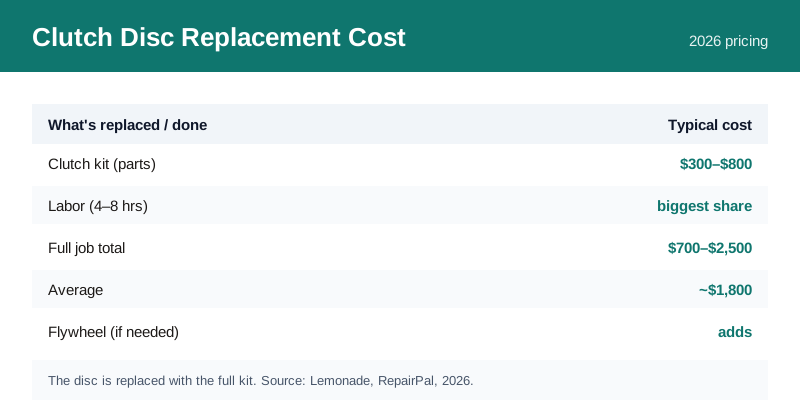
Replacing a clutch disc means doing a clutch job, which runs about $700 to $2,500 total, averaging near $1,800. Here’s the key: the clutch disc is the main wear part, but you don’t replace it alone – the whole clutch kit (disc, pressure plate, and release bearing) is $300 to $800 for parts, and labor is the biggest share, because the transmission has to come out to reach the clutch (4 to 8 hours of work). A worn or damaged flywheel adds cost if it needs resurfacing or replacing. The clutch disc is the friction plate that transfers engine power to a manual transmission – it’s designed to wear, like a brake pad, and when it’s worn out you get slipping (engine revs climb but the car doesn’t accelerate), a high or grabby pedal, and sometimes a burning smell. Because the labor to remove the transmission dwarfs the price difference between one part and the whole kit, replacing the complete kit at once is standard.
The disc is the part that wears, but the job is a full clutch replacement – so let me explain why you do the whole kit.
What you’ll actually pay
Here’s the picture. These are estimates that vary by vehicle and shop.
| Item | Cost | Notes |
|---|---|---|
| Clutch kit (parts) | $300–$800 | Disc + plate + bearing |
| Full job total | $700–$2,500 | Labor-heavy |
| Average | ~$1,800 | Typical |
| Flywheel (if needed) | adds | Resurface or replace |
The disc is one piece of the clutch system; our clutch replacement guide, pressure plate guide, and release bearing guide cover the related parts.
Shop Talk
Here’s the thing about a “clutch disc” job: the disc is the wear part, but you never pay someone to replace just the disc. To reach it, the transmission has to come out – that’s most of the cost, 4 to 8 hours of labor – and once it’s out, the pressure plate and release (throwout) bearing are right there, aging at the same rate. The parts difference between a disc alone and a full kit (disc, pressure plate, bearing) is small compared to the labor, so replacing the whole kit is standard. Doing just the disc and reusing an old pressure plate and bearing is false economy – if either fails soon, you pay that big labor bill again. While the transmission’s out, the shop should also inspect the flywheel: if it’s scored or worn, it needs resurfacing or replacement (that’s an added cost, but again, cheap labor-wise since you’re already in there). A couple of things to know. One, a clutch disc wears from use and driving style – riding the clutch and lots of stop-and-go wear it faster – so there’s no set mileage; it lasts until it’s worn. Two, the classic sign it’s going is slipping: you accelerate, the engine revs climb, but the car doesn’t pull like it should, often worst in higher gears or uphill. A burning smell after hard clutch use is another tell. Get it done before it fully fails and leaves you unable to drive.
Where Drivers Overpay
The overpay is replacing only the disc and reusing an old pressure plate and release bearing. The parts cost difference is small, but if either reused part fails soon, you pay the big transmission-out labor a second time. Doing the full kit once is the save.
The same logic covers the flywheel: since the transmission’s already out, resurfacing or replacing a worn flywheel now avoids a repeat teardown. The pattern: treat a clutch disc job as a full clutch kit, do the flywheel if it’s worn while you’re in there, and replace it all at once rather than piecemeal.
The Real Number
A clutch disc job is a full clutch replacement: $700 to $2,500 total (average ~$1,800), with the kit $300 to $800 and labor the bulk. Don’t replace just the disc – the transmission is already out, so do the whole kit (disc, pressure plate, bearing) and the flywheel if it’s worn, to avoid paying that labor twice. Slipping, a grabby pedal, or a burning smell are the signs it’s due.
Frequently Asked Questions
How much does it cost to replace a clutch disc?
Replacing a clutch disc means doing a clutch job, which runs about $700 to $2,500 total, averaging near $1,800. The clutch kit (disc, pressure plate, and release bearing) is $300 to $800 for parts, while labor is the biggest share because the transmission must be removed to reach the clutch – a 4 to 8 hour job. A worn flywheel that needs resurfacing or replacing adds cost. These are estimates that vary widely by vehicle and shop. You don’t replace just the disc on its own; because the labor to pull the transmission far exceeds the parts-price difference, the complete kit is replaced together. So the “clutch disc cost” is really the cost of a full clutch replacement.
What does the clutch disc do?
The clutch disc is the friction plate that transfers engine power to a manual transmission. It sits between the engine’s flywheel and the pressure plate; when you release the clutch pedal, the pressure plate clamps the disc against the spinning flywheel, locking the engine to the transmission so power flows to the wheels. When you press the pedal, the clamp releases and the disc disengages, letting you shift or stop. The disc has friction material (like a brake pad) that grips the flywheel, and that material wears down over time with use. So the clutch disc is the main wear item in a manual clutch – it’s designed to be a consumable that eventually needs replacing, unlike the flywheel or the transmission itself.
What are the signs of a worn clutch disc?
The classic sign is slipping: you press the gas and the engine RPMs climb, but the car doesn’t accelerate proportionally – the worn disc isn’t gripping the flywheel firmly. Slipping is often worst in higher gears, under load, or going uphill. Other signs include a burning smell (like burnt friction material) after hard clutch use or slipping, a clutch pedal that engages very high or feels grabby, difficulty shifting, and reduced power getting to the wheels. A chattering or shuddering on takeoff can also indicate clutch problems. Because these point to a worn clutch, it’s worth having it checked when they appear. Catching it at the slipping stage lets you plan the repair rather than being stranded when the clutch fails completely and the car can no longer move under power.
Why do I have to replace the whole clutch kit, not just the disc?
Because the expensive part of the job is the labor to remove the transmission, not the parts. To reach the clutch disc, the transmission has to come out – 4 to 8 hours of work – and once it’s out, the pressure plate and release bearing are right there and aging at the same rate as the disc. The price difference between replacing just the disc and replacing the whole kit (disc, pressure plate, bearing) is small compared to that labor. So if you replace only the disc and reuse an old pressure plate or bearing, and one of those fails soon after, you pay the entire big labor bill again. Replacing the complete kit at once is standard practice and the smart value. It’s the same logic as doing the water pump with a timing belt – bundle the parts that share the expensive labor.
Should the flywheel be replaced or resurfaced too?
It should at least be inspected while the transmission is out, and done if needed. The flywheel is the surface the clutch disc grips against, and over time (especially with slipping or a worn clutch) it can become scored, warped, glazed, or heat-damaged. If it’s in good shape, it can be left alone. If it’s worn, it needs either resurfacing (machining it smooth, on flywheels that allow it) or replacement – and some modern cars use a dual-mass flywheel that’s expensive and often replaced rather than machined. Doing the flywheel while the transmission is already out is cost-effective, since the labor is shared; discovering a bad flywheel after reassembling with a new clutch means tearing it apart again. So a good shop inspects the flywheel during a clutch job and recommends resurfacing or replacement if it’s not fit to grip the new disc properly.
How long does a clutch disc last?
There’s no fixed mileage – it depends heavily on driving style and conditions. A clutch disc can last anywhere from around 50,000 miles to well over 100,000 miles. What wears it faster: riding the clutch (resting your foot on the pedal), slipping it excessively when starting off, lots of stop-and-go city driving, towing or hauling heavy loads, and aggressive driving. Gentle, smart clutch use in easier conditions makes it last much longer. Because it’s a friction wear part like a brake pad, it simply wears until it’s done rather than failing at a set interval. So “how long does it last” is really about how it’s driven. A driver who fully releases the clutch smoothly and doesn’t ride the pedal can get very high mileage; hard use can wear one out much sooner.
Can I drive with a slipping clutch?
Briefly and gently, but it’s on its way out and shouldn’t be ignored. A slipping clutch still moves the car, but slipping generates heat that accelerates the wear, so driving on it hard (especially under load or uphill) makes it worse faster and can damage the flywheel. Eventually a badly worn clutch slips so much the car can barely move under power, or fails entirely, leaving you unable to drive. So once you notice clear slipping, it’s best to plan the replacement soon rather than push it. Driving many miles on a slipping clutch risks both a roadside failure and extra flywheel damage that adds to the repair. If it’s slipping mildly, you have some time to arrange the job; if it’s slipping badly, treat it as urgent before it leaves you stranded.
Sources
Price ranges verified against 2026 clutch pricing in November 2026. Dollar amounts are estimates that vary by vehicle and shop.
- Lemonade – clutch replacement cost
- RepairPal – repair cost estimator
- ASE – National Institute for Automotive Service Excellence
Related Guides
- Clutch Replacement Cost
- Clutch Pressure Plate Replacement Cost
- Clutch Release Bearing Replacement Cost
- Manual Transmission Replacement Cost
- Car Repair Cost Estimator

Diane Holcomb spent seven years as a service advisor at multi-brand dealerships in Charlotte, NC, where she’d explain why a “clutch disc” quote was really a full clutch kit – the transmission’s out, so you do it all once. She drives a 2019 Honda CR-V and a hand-me-down 2007 Toyota Camry, and takes no referral fees or advertising money from any shop or chain.